A regulated product has two lives. There is the thing people use, made of code, components and decisions. Then there is the proof that the thing was built deliberately: requirements connected to risks, risks connected to controls, controls connected to tests, tests connected to exact releases. The first life attracts engineers. The second has traditionally attracted spreadsheets.
Erez Kaminski has spent his career noticing the distance between those lives. At Ketryx, the Cambridge software company he co-founded in 2021, he is trying to collapse it. The platform sits across tools such as Jira, GitHub and automated test systems, keeping a live account of what changed, why it changed and what evidence must follow. Compliance becomes less like an archaeological dig at the end of a release and more like a property of the work as it happens.
This is not a story about escaping rules. Kaminski's point is that the rules exist because the product has consequences. His complaint is with the machinery used to satisfy them: manual transfers, disconnected records, static documents and long intervals between an engineering decision and the quality evidence that explains it. The target is lag.
A physicist learns to see the joins
Kaminski was born and raised in Israel. At 18 he entered military service, joined an infantry unit and eventually became a staff sergeant. Around age 20, he was responsible for 36 soldiers. Years later, he would describe the experience as an early look behind the management curtain: responsibility arrived before the usual corporate rehearsal for it.
He then made an improbable geographic and cultural jump. American football, first encountered through a league in Israel, helped take him to Birmingham-Southern College in Alabama. There he played and studied physics and mathematics. The pairing seems odd only until you hear him talk about either subject. Football offered systems, formations and statistics. Physics offered models, variables and the satisfaction of taking something unruly and finding its governing relationships.
Research followed. He worked on electric space propulsion at the Technion and electron plasma waves at Princeton Plasma Physics Laboratory. In 2017, he co-authored a paper in Physical Review E on kinetic simulations of ladder climbing by electron plasma waves. Yet an important self-diagnosis had already appeared: he loved studying physics, perhaps more than doing physics research. The appetite was for difficult ideas that could travel.
“The reason you're hammering it wrong is because you have the wrong kind of hammer, or you actually need a drill.”Erez Kaminski on seeing problems through tools
His first major industry stop was Wolfram Research, the company behind Mathematica and Wolfram|Alpha. Kaminski worked in technical and operating roles, led startup initiatives and spent time as a special assistant to founder Stephen Wolfram. It was a close education in computational ambition: a company where sophisticated mathematics was packaged into tools other people could actually use.
A talk Kaminski gave on data science changed the next chapter. Someone in the audience invited him to lunch. That conversation led eventually to Amgen, where his work moved into strategy, operations, software, AI and applied mathematics for medical devices. His later advice on career networking was wonderfully practical: if someone interesting invites you to lunch, go.
When faster code meets slower evidence
At Amgen, the abstract systems problem became concrete. Modern software teams could revise code continuously, but regulated development also required a durable chain of evidence. A changed requirement might alter a hazard analysis. That change might require a new test, a review, a signature and an update to a large technical file. Each connection mattered. Too often, each connection lived somewhere else.
Kaminski did not conclude that quality teams were moving too slowly. He concluded that the surrounding tools had separated quality from engineering. One group worked in tickets, repositories and pipelines. Another assembled controlled documents and traceability records. Both were trying to describe the same product, but their systems behaved like distant pen pals.
Code
Tests
evidence layer
Approvals
Release record
MIT supplied a place to fuse the two languages. Through the Leaders for Global Operations program, Kaminski pursued an MBA and a master's in electrical engineering and computer science at the same time. Engineering explained how systems behave. Management explained how organizations behave around them. He completed both degrees in 2021, the year Ketryx began.
He co-founded the company with Jan Pöschko, another Wolfram veteran who brought deep infrastructure experience. Their early product connected common development systems into a central orchestration layer. A requirement could remain linked to the code change that implemented it, the test that checked it and the risk control that justified it. The result was not merely a tidier document. It was a model of the product that could be interrogated as the product changed.
The glamour of a dependable audit trail
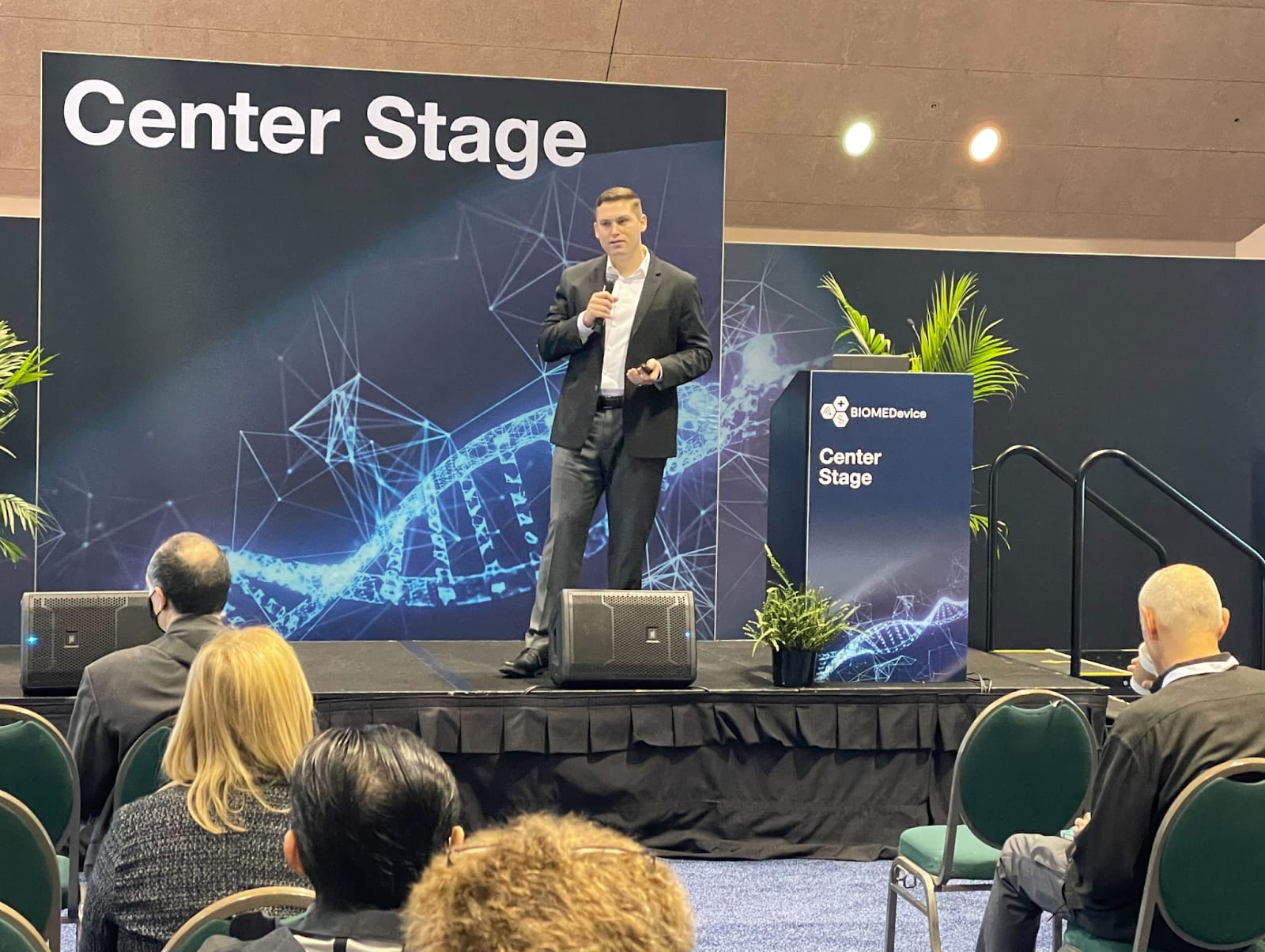
Kaminski has joked that he wanted to build an exceptionally boring software company. The line works because Ketryx sits beside fashionable technologies while selling the discipline required to use them. AI can draft a change assessment or propose a trace link. It still needs context, controls and a human approval path. A clever answer is not the same object as an auditable decision.
This gives his position on AI an unfashionably architectural flavor. The model is only one component. The larger system needs permissions, source records, version history, electronic signatures and rules that prevent an unreviewed output from quietly becoming controlled truth. Ketryx's bet is that AI becomes more useful in regulated work when its freedom is paired with a clear boundary.
The company found an audience. It raised a $14 million Series A in 2023, then a $39 million Series B led by Transformation Capital in September 2025. The later round brought total announced funding above $55 million. In early 2026, Ketryx said four of the five largest Fortune 500 medical-technology companies used its platform and that products supported by it reached more than 100 million patients worldwide.
What customers appeared to buy was not a replacement for every tool they already had. Ketryx operated as connective tissue around those tools. That matters in large organizations, where asking engineers, quality teams and regulatory specialists to abandon their working systems can turn a software rollout into a constitutional crisis. An overlay makes a subtler promise: keep the familiar interfaces, but stop losing the relationships between them.
The operating results described by the company made that promise tangible. One customer completed 170 medical-device releases in a year. Flo Health built an audit-ready, FDA-grade operation in under 90 days. Meta Reality Labs used the platform to establish a regulated-product compliance foundation. Different organizations, same bottleneck: engineering work can happen quickly while review cycles wait for someone to assemble the story of what happened. Ketryx is designed to make that story available continuously.
Graduates in physics and mathematics, then joins Wolfram Research.
Moves to Amgen and works across strategy, applied mathematics and medical-device AI.
Completes two MIT graduate degrees and co-founds Ketryx.
Ketryx announces a $39 million Series B and expands its Cambridge footprint.
The company reports more than 100 million patients reached by products supported on its platform.
The numbers show scale. The more revealing detail is where Kaminski directs his attention. He participates in standards work through AAMI, with a focus on AI and machine-learning risk management and cloud-enabled medical devices. Standards committees are where abstractions meet sentences that engineers and reviewers must live with. It is consistent with a founder who treats the rulebook as part of the product landscape, not weather to complain about.
“Persist, and structure your career around your goals.”Erez Kaminski on finding a path into technical work
Carry the lens, not the job title
Kaminski's résumé looks like a sequence of turns: soldier, football player, physicist, researcher, developer-tool specialist, biotech operator, MIT student, founder. The thread is easier to see from the side. Each role involved a complex system whose behavior depended on relationships among many parts. Each rewarded the ability to move between fine detail and the whole.
That is the portable lesson in his story. Careers do not only compound through increasingly senior versions of the same job. They can compound through a repeated way of looking. Kaminski kept asking how evidence, tools and people fit together. Plasma became software. Software became operations. Operations became a company. The nouns changed. The method survived.
He is direct about pace. His advice to his earlier self is that you can never move fast enough. But his company complicates that sentence in a useful way. In safety-critical work, moving fast cannot mean losing the map. It means building a map that redraws itself faithfully with every step.
That is why the supposedly boring layer matters. When requirements, tests, risks and approvals remain connected, a team can spend less time reconstructing yesterday and more time making a careful decision today. The paperwork does not vanish. It becomes alive, which is a rather dramatic ambition for a boring software company.