At the University of San Francisco, Fe’ Campbell had a problem that would be familiar to anyone who has ever searched an inbox for the attachment that was definitely there yesterday. She helped manage visas and green cards for international employees. Departments wrote to HR. HR wrote to the lawyer. HR wrote to the candidate. Somewhere in this relay, the record of what had happened became harder to follow than the work itself.
- The job: coordinate corporate immigration, from work permits to permanent residence.
- The mechanism: put employers, employees and immigration professionals on one case platform.
- The bill: flat service fees per matter; government fees separate; standard platform included.
- The boundary: better preparation and visibility cannot determine a government’s decision.
In a published Envoy case study, Campbell described long email chains, documents arriving by mail and attachments disappearing into separate conversations. Her team had built extra folders and checks to stay organized. She had attended an immigration conference and done her own research, but knowing more about immigration had not made the correspondence easier to manage.
Campbell urged the university to work with Envoy. The appeal was concrete: paperwork in one place, a clearer communication record and access to people who could answer the difficult questions. It is a modest story by the standards of technology marketing. There is no victorious robot. Someone can find the document.
That small victory explains a great deal about Envoy Global. Immigration is full of legal complexity. It also contains a surprising amount of ordinary office confusion. The company has built its business around handling both.
01 / The inbox becomes a workplace
Envoy provides corporate immigration services backed by its own technology. Employers use it when they need to hire someone who requires work authorization, move an employee between countries, support a family’s accompanying applications or keep an existing workforce compliant. Its work extends to permanent residence, consular processes, business travel and immigration program strategy.
The platform gives the employer a view of cases and gives the employee somewhere to upload documents and follow progress. Immigration professionals work within the same system. Instead of making HR the switchboard for every question, employees can communicate directly with their legal team. A case becomes a shared record with milestones, rather than a collection of private inboxes.
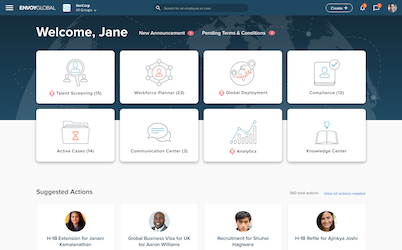
There are two audiences here, and their needs overlap without being identical. An employer wants to know whether a hire can start, which authorizations need attention and what the program is spending. An employee wants to understand what is happening to a life decision. The same case can be a budget line for one person and a family’s next home for another.
Envoy’s client-success page reports more than 2,000 companies and displays names including Toyota, Zscaler, Quora and ShipBob. Its customer base therefore stretches beyond the usual picture of immigration as a problem reserved for software companies. A university’s professor and a growing company’s specialist can both arrive at the same administrative bottleneck.
“Employees want to know that their information is secure.”Fe’ Campbell, University of San Francisco
Published Envoy client case study
02 / The software is included. The work has a price.
Envoy’s pricing reveals what kind of company it is. Its current offer uses flat fees for individual matters, scoped to the employer’s volume, countries and complexity. Case preparation, filing and case-specific consultation sit within that scope. Government filing fees appear separately. Standard platform access carries no additional charge, and the technology FAQ says implementation is also free.
Quoted for the case and agreed scope.
Filing fees are itemized.
Standard access has no extra fee.
Custom integrations, dedicated instances and data residency options are quoted individually. For a buyer, the useful exercise is to agree precisely what a matter includes, then add the government fees and any custom technology work. The bill depends on the program being purchased. A five-case employer and a multinational moving staff between several jurisdictions need different proposals.
This puts Envoy in the market for technology-enabled professional services. The software makes the service easier to coordinate; the company explicitly says its pricing is not a subscription. A dashboard can report that an application needs attention. The valuable work includes deciding what that attention should be.
The distinction matters in the United States, where legal services are provided by affiliated Corporate Immigration Partners, P.C. Envoy Global itself is not a U.S. law firm. That arrangement gives the user a connected experience while preserving a specific answer to the question of who provides legal representation.
03 / A border still requires someone who knows it
The business began as VISANOW, founded by Robert Meltzer in 1998. Richard Burke became chief executive in 2015, while Meltzer moved into a chief immigration strategist role. A $21 million Series C followed in 2017. Palladium Equity Partners invested in 2021; the transaction terms were undisclosed.
The subsequent expansion has involved buying regional expertise. Envoy acquired Dubai-based Sesam Immigration in August 2023. It announced its combination with Smith Stone Walters in November 2024, strengthening its UK presence and adding operations in Hong Kong, Frankfurt and Mumbai. IBN Immigration Solutions joined in February 2025, bringing offices in Cape Town, Johannesburg, Nairobi and Windhoek.
- 2023Sesam ImmigrationUnited Arab Emirates
- 2024Smith Stone WaltersUK and additional regional operations
- 2025IBN Immigration SolutionsSouth Africa, Kenya and Namibia
Selected additions, not a complete office map.
In July 2025, affiliated Corporate Immigration Partners acquired German firm Offer & Mastmann. That is an acquisition by the law firm, a distinction worth keeping straight. Later that month, Jason Brennan took over as Envoy’s CEO. Burke remained a shareholder and board advisor.
There is an obvious commercial logic to these deals: a global employer would rather coordinate one program than repeatedly assemble a new provider network. There is also a practical logic. Immigration expertise has an address. Knowing how a process works in one jurisdiction does not supply the missing knowledge in another. Shared technology benefits from people who understand the local steps.

The company’s stated culture fits that labor-intensive reality. It emphasizes accountability, transparency and treating people with attention. Its careers material describes remote, hybrid and office roles, along with regular meetings across a distributed team. Those are employer statements, but they tell a buyer something about the service Envoy intends to deliver: approachable expertise, with someone responsible for the next step.
04 / The robot checks the form
Envoy now describes several live AI and automation capabilities. AskEnvoy lets program stakeholders query immigration data in ordinary language. AI Quality Sensors screen forms for possible errors. Government data capture logs expiration dates, while employee support handles routine questions and routes matters requiring expertise to qualified professionals.
The useful division of labor is quite specific. Repetitive data handling can be automated. Potential discrepancies can be surfaced. Legal judgment still requires professional review. Envoy also says its team assesses policy changes and identifies affected employees before sending targeted guidance. An alert is more useful when it answers whether your case is involved.
These features operate in a competitive market. Fragomen has its own immigration technology practice, and BAL offers the Cobalt case-management system. Software combined with immigration expertise is an established category. Envoy’s pitch rests on its employer-facing workflows, employee communication, included platform and coordinated service coverage. A serious comparison should test those details in a demonstration, alongside the legal team’s relevant experience.
05 / A better record cannot shorten every queue
Envoy’s 2026 U.S. Corporate Immigration Trends report supplies a useful dose of realism. Its online survey, conducted with Cint, included 519 U.S.-based HR professionals involved in immigration or mobility. Among the findings, 83% reported processing delays disrupting operations. This is a survey of employers, rather than a measurement of Envoy customer outcomes.
reported processing delays
disrupting operations
Envoy Global’s annual U.S. survey; 519 HR respondents overall. A market finding, not a provider performance score.
No shared record controls government adjudication, visa availability or a change in policy. Nor does it help much if employees fail to supply documents or the organization keeps critical decisions outside the system. The coordination model depends on participation and on clear responsibility. An employer with an occasional, straightforward case may place greater value on a particular specialist relationship than on program-wide reporting.
What another organization can copy is simple enough. Keep a shared case record. Assign an owner to each deadline. Give employees a way to see progress and reach the right professional. Measure the employee’s understanding alongside the case’s movement. These habits are useful even before a company selects its next provider.
Campbell’s story began with the gap between a capable HR team and the correspondence it had to navigate. Envoy’s opportunity lives in that gap. A government may still keep an application waiting. At least the employee, the employer and the lawyer should know which application it is.