A hyphen has one modest job: hold two things together. It is punctuation as stage crew, rarely applauded, always carrying weight. ENHYPEN took that small horizontal line as a name and an assignment. The members arrived from different places and different lives. Their task was to connect, discover one another and grow in public. Pop branding often asks a word to perform acrobatics. Here, the word turned out to be unusually honest.
The public part began in 2020 on I-Land, the survival series that turned trainee evaluation into weekly television. Viewers watched individual scores, eliminations and alliances before a live finale produced seven members: Jungwon, Jay, Jake, Ni-Ki, Heeseung, Sunghoon and Sunoo. Six places came through global voting, one through the producers. It was a peculiar way to meet future colleagues, somewhere between an audition and an election.
Then the screen went dark and the real test began. ENHYPEN debuted on November 30, 2020, during a period when crowds existed mostly as camera lenses and comment streams. Their first EP, Border: Day One, introduced “Given-Taken,” a title that neatly captured the uncertainty. Had the opportunity been given? Had they taken it? More than 300,000 pre-orders offered an early answer, but numbers could not teach seven young performers how to become one group.
The name is the operating system
Seven individuals, one count
Synchronization is the most visible answer. ENHYPEN’s performances favor clean angles, quick formations and the satisfying snap of several bodies reaching the same beat. Yet precision alone becomes chilly. The group’s better trick is to let personality leak through the geometry. Ni-Ki brings a dancer’s appetite for detail. Sunghoon arrived with the balance and competitive calm of a former figure skater. Jake has an easy conversational warmth. Jay supplies dry wit and guitar-minded musical curiosity. Sunoo can brighten a room with a glance. Jungwon, the leader, pairs composure with a fondness for what he cheerfully calls “nerdy stuff.”
That last quality becomes useful on tour. Jungwon recommends a mobile game, the others fall into it, and the hours between soundcheck and show acquire a tiny shared obsession. Fame has grand scenery and extremely long waits. Friendship often enters through the side door carrying a phone charger.
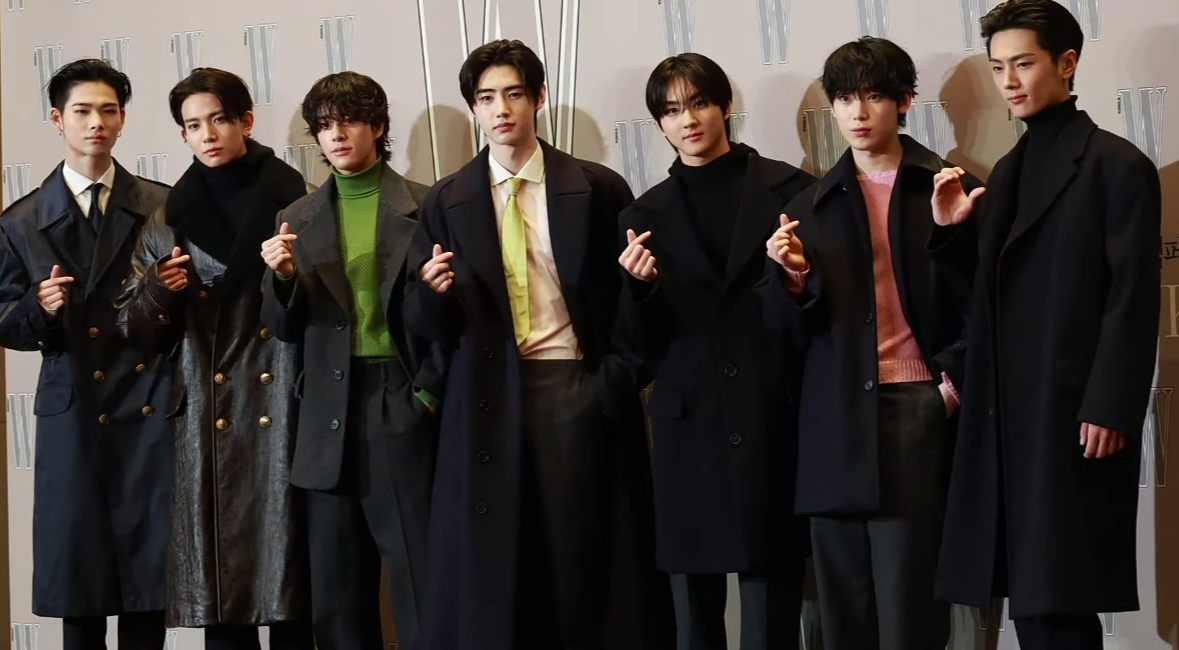
Their musical world is darker than the backstage jokes. From the beginning, borders, blood, desire and fate have returned across records and videos. Vampires provide the wardrobe and the mythology, but the durable subject is adolescence: wanting something, fearing its price, choosing a person or path anyway. Each release behaves like a new episode. A listener can enjoy one song; an ENGENE, as the fandom is called, can map clues across years.
This continuity gives the group a rare advantage in a feed built for forgetting. The last comeback is never wholly last. It leaves a thread for the next one. The fandom remembers, compares and argues. A fan becomes a reader, and reading invites return visits.
ENGENE is another name asked to do two jobs. An engine supplies motion; shared genes suggest a bond between artist and audience. The language risks sounding grand until you watch the smaller exchanges that maintain it: live broadcasts from hotel rooms, fan chants rebuilt for a new song, handwritten messages held above heads at a concert. The relationship is organized through platforms and memberships, but its texture comes from repetition. People return. The group notices.
The members are also clear that the fantasy requires a small city of workers. When asked how much they shape the elaborate concepts, Jungwon gave an answer with little vanity. The company develops much of that architecture; the members concentrate on music and performance, then work out how to embody it. He pointed toward staff who sleep even less during award shows and year-end concerts. Pop loves the myth of effortless charisma. ENHYPEN’s version is more interesting: ideas pass through choreographers, stylists, camera crews, musicians and six performers until the machinery disappears and three minutes feel inevitable.
The rooms kept getting bigger
In 2021, “Drunk-Dazed” brought ENHYPEN its first music-show win. Later that year, Dimension: Dilemma became the group’s first million-selling album. The first offline concert arrived in Seoul in September 2022, followed by a world tour and a rapid expansion into arenas and domes. By 2023, ENHYPEN had performed at Tokyo Dome less than three years after its Korean debut.
Speed creates its own pressure. Jake has described those “firsts” as gifts from fans and also as a force that pushes the group forward. Ni-Ki experiences that pressure differently in Japan. As the member fluent in Japanese, he feels responsible for helping the group speak naturally to the audience, respond in the moment and loosen the air in the room. Global reach sounds abstract until one person has to find the right joke at the right second.
The American chart climb shows the same accumulation. Border: Carnival reached No. 18 on the Billboard 200 in 2021. Dimension: Dilemma rose to No. 11. Manifesto: Day 1 made the top ten. In 2024, Romance: Untold stopped at No. 2. A trainee-room ritual made the proximity especially sharp: Jake recalled that trainees at the company printed the Billboard Hot 100 every week and pinned it up to watch trends move. The charts were once office wallpaper. Eventually the group appeared on them.
A six-year ascent, from Border: Carnival to The Sin: Bliss.
A piece of their history in the desert
Coachella in April 2025 condensed years of rehearsal into one desert set. ENHYPEN performed with a live band and approached the production as participants rather than passengers. The members discussed the setup, the shape of each section and the mechanics of the show. Jungwon called it a culmination and said the performance held “a piece of ENHYPEN’s history.” The phrasing is revealing. A festival slot can look like a trophy from outside. Inside the group, it was an edit: which parts of the story deserved those minutes?
They chose force and pace. “Future Perfect (Pass the Mic),” “Drunk-Dazed” and “Bite Me” translated cleanly to the larger, less forgiving festival field. The band gave the polished tracks extra grain. Choreography remained central, but the set breathed. The achievement lay partly in sounding like ENHYPEN in a room that had not been built for them.
Later that year, fans gave the group the Visa Fans’ Choice of the Year grand prize at the MAMA Awards. The result suited a band formed partly by global votes. Five years after the public helped select the lineup, the public was still helping write the record.
The line bends
In March 2026, BELIFT LAB announced that Heeseung would leave the group to pursue his own musical direction and prepare a solo album. ENHYPEN would continue with Jungwon, Jay, Jake, Sunghoon, Sunoo and Ni-Ki. A group whose name promises connection now had to show that connection could survive a change in shape.
The six-member chapter opened at touring scale. Blood Saga began with three May concerts at Seoul’s KSPO Dome and continued through Busan and Japan. The title kept the familiar fictional vocabulary while the performances carried a practical question: how does choreography, vocal distribution and stage chemistry settle after one place becomes empty? The answer came through work, visible each night.
The Sin: Bliss, released on August 21, supplied the recorded answer. The eighth mini album continues the story of lovers who broke a vampire taboo and fled together. Its central idea is that togetherness can remain a blessing even with an uncertain end. The theme landed with unusual precision for a group negotiating continuity in real time.
On the Billboard 200 dated September 5, The Sin: Bliss debuted at No. 1 with 98,000 equivalent album units. The peak arrived after the near miss of Romance: Untold and in the first year of the new lineup. Charts flatten messy careers into orderly integers. This one still carried the residue of six years: pandemic cameras, voting screens, rehearsal mirrors, jet lag, domes, a desert and a changed formation.
The next mark on the page
ENHYPEN has never been shy about the next target. When asked what “higher” meant, Jungwon answered, “No. 1 on the Billboard Hot 100,” and the room laughed. The laugh gave the ambition scale, not dismissal. Everyone understood how far away it was. Everyone also knew the group had spent years making faraway rooms familiar.
There is a pleasing stubbornness in that goal. An album at No. 1 proves depth, organization and a committed audience. A No. 1 single asks for one song to escape the existing circle and enter ordinary life at enormous scale. ENHYPEN’s history suggests they will approach it through their usual tools: refine the performance, extend the story, read the room, keep the fans close.
The hyphen remains small. That is its charm. It never takes credit for the words on either side. It simply makes a relationship possible. ENHYPEN has spent six years discovering how much can be built on that line.