A profile in eight parts, moving as one
Before the arenas, the chart peaks and the desert wind at Coachella, there was a package. Kim Hongjoong, then a teenager with more intention than leverage, mailed KQ Entertainment a letter and a demo mixtape. Someone at the Seoul company noticed. He became its first official trainee, alone for roughly six months before Yunho joined and the room slowly filled. It is a suitably handmade opening for ATEEZ: no inherited mythology, just an envelope pushed into the world and the hope that somebody might press play.
Six more young performers arrived: Seonghwa, Yeosang, San, Mingi, Wooyoung and Jongho. Some had trained elsewhere. Together they became KQ Fellaz, travelled to Los Angeles for dance training and appeared in brisk pre-debut videos that already treated choreography as a declaration. By October 24, 2018, the provisional name was gone. ATEEZ debuted with Treasure EP.1: All to Zero, an opening chapter full of maps, horizons and pirate nerve.
The nautical imagery proved useful, but the group's durable instrument was less romantic: conversation. Eight performers create a crowd before anyone buys a ticket. They also create eight tastes, eight thresholds for risk and eight versions of what a song ought to do. ATEEZ learned to make that abundance legible.
“We talk a lot about our staging, our songs, and our next concept.”Hongjoong, on balancing individual character with the group
The slogan became a working method
“8 makes 1 team” is the introduction ATEEZ deliver together. In lesser hands, a line like that expires on contact with merchandise. Here it has survived because it names the daily problem. The members are not interchangeable. Hongjoong captains, writes and composes. Mingi's low-slung rap changes the floor of a track. Jongho supplies a tensile vocal center. Seonghwa, Yunho, Yeosang, San and Wooyoung each move through the camera and the stage with different temperatures.
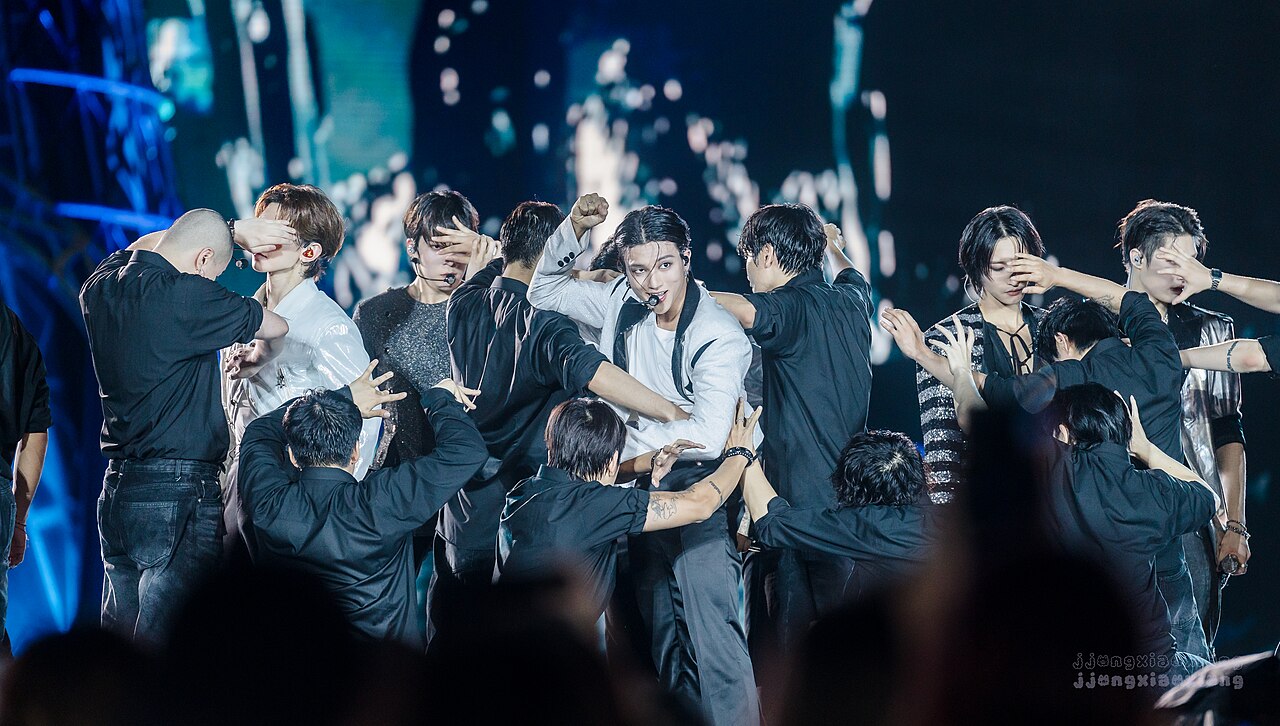
Their unity works because those differences remain visible. Watch a formation open and close: one member catches the eye, another interrupts the mood, a third resolves it. Synchronization supplies grammar, not personality. In 2026, when the group built the choreography for “Adrenaline,” San contributed ideas from inside the formation. The draft went through revisions; Hongjoong asked for certain moments to be emphasized; Wooyoung pushed for more dancers. The result was negotiated, not bestowed.
Hongjoong has described the strain of coordinating eight opinions and the effort not to let one person's view swallow the rest. That may be the least glamorous sentence ever attached to pop spectacle. It is also the revealing one. ATEEZ's heat is produced by meetings.
There is play inside the structure, too. Ask the members to assign songs to one another and the answers become affectionate sketches. Seonghwa once chose the ferocious “HALA HALA” for San, then explained that the intimidating performer is sweet away from the stage. San gave “The Leaders” to Hongjoong because its attitude fits the captain. These small observations show the members acting as one another's audience. Years spent sharing rehearsal mirrors have made them fluent in the distance between a public silhouette and the person who steps out of it.
A tour before the furniture settled
ATEEZ went abroad early. Their 2019 Expedition Tour began only months after debut, when the catalogue was compact and every performance carried the nerves of a first introduction. The speed mattered. Touring forced the songs out of their carefully framed videos and into rooms where timing could wobble, crowds could surprise them and charisma had to survive distance.
Years later, Hongjoong compared the group's first Australian visit with its 2026 return. In 2019, they did not have many songs and conversation with fans felt less natural. On the later stage, he said, the members could feel one another and express themselves to ATINY more freely. This is an unflashy definition of mastery: not simply hitting the planned mark, but knowing one another well enough to breathe around it.
The climb, in selected releases
Treasure
Fever Pt.3
Movement
Will
Part.5
Selected Billboard 200 milestones. By July 2026, ATEEZ had reached No. 1 with The World EP.Fin: Will, Golden Hour: Part.2 and Golden Hour: Part.5.
The records grew alongside the stage vocabulary. The early Treasure releases chased horizons. The Fever sequence turned toward youth and its unstable weather. The World sharpened rebellion into a more severe theatrical universe. Then Golden Hour examined success while the group was living inside it. These eras reward close reading, but their storytelling is not a locked cabinet. Each concert converts lore back into bodies, light and sound.
That conversion depends on expression, Hongjoong's preferred word for the group's priority. The choreography is exact, yet the face must tell a story large enough to cross a stadium. A shoulder angle can make menace comic; a glance can turn confidence into conspiracy. ATEEZ perform as if the camera were a scene partner, then widen the gesture for the person at the rear of the venue. Precision provides the confidence to exaggerate without losing the beat.
When the room became the world
The visible milestones arrived in a rush. The World EP.1: Movement reached No. 3 on the Billboard 200 in 2022. The World EP.Fin: Will reached No. 1 in 2023. In 2024, ATEEZ became the first K-pop boy group to perform at Coachella and the first K-pop act to headline Morocco's Mawazine festival. The UK charts provided another kind of evidence: three new Top 10 albums within one year, a first for a Korean act.
The scoreboard, as of September 2026
Coachella could have become a coronation scene. ATEEZ treated it more like an exam with a very expensive set. Hongjoong later said the group invested more in building the performance than it received for appearing. The revealing detail is the choice: faced with a room full of people who may not know the mythology, spend on the stage. Make the introduction undeniable before asking for affection.
That approach travelled to London. Two days after releasing Golden Hour: Part.5 in June 2026, ATEEZ headlined BST Hyde Park. The record then became their third Billboard 200 No. 1. Charts turn messy human effort into neat integers; a park full of voices reverses the process. The number becomes noise again.
Physical records remain part of that relationship. Albums arrive as objects to open, study and trade, while videos extend the visual argument online. The sales and streams measure different habits, but ATEEZ connect them through serial storytelling. A new release is less a sealed product than another room in a house ATINY already knows. The door changes color; the shared memory comes inside.
“Those memories made us family. When I'm with the members now, I feel like I'm home.”San, reflecting on seven years together
The ninth presence in an eight-person team
ATINY, the fandom name made from ATEEZ and destiny, occupies an unusual grammatical position in the group's story. The fans are outside the eight, yet repeatedly described as part of the mechanism. At a show, the relationship becomes audible. ATEEZ throw out a phrase; thousands return it. During “Guerrilla,” the command to “break the wall” comes back as architecture made of breath.
The exchange prevents the theatricality from becoming remote. ATEEZ traffic in dystopian worlds, alter egos, masks and revolutions, but the live contract is wonderfully plain: we prepared this for you; tell us if it lands. Fan response then travels back into the next arrangement, the next album discussion, the next way a member holds a pause. Their scale is intimacy repeated.
This also explains why gratitude appears so often in their interviews without sounding like a ceremonial fee. The group remembers touring early, before the domestic and international numbers aligned. They learned to recognize support as a practical force. Audiences created opportunities; opportunities produced better performers; better performers drew larger audiences. Destiny, in this account, looks suspiciously like a feedback loop.
No finish line, only a larger rehearsal room
By 2026, the ambitions could be said aloud without apology. In their rookie years, Hongjoong hesitated even to write “enter the Billboard chart” as a dream. After three No. 1 albums, he named the Grammy Awards and the Super Bowl halftime show. Mingi imagined a Korean-language performance resonating on that scale. Jongho offered the useful corrective: music remains endless, with another height visible whenever one is reached.
This is the tension that keeps ATEEZ interesting. They have enough evidence to trust their method and enough appetite to keep revising it. All eight renewed their contracts with KQ Entertainment in 2025. Renewal is an administrative word, almost aggressively dull. For a group whose central promise depends on the number eight, it also carries emotional weight. The formation holds.
So the package Hongjoong mailed years ago did find its listener. Yet the cleaner ending belongs to the stage. Eight people stand at separate points, each recognizable. Music gives the signal. They move toward the same beat without becoming the same person. The audience answers, and for a few minutes the room grows larger than its walls.