The useful thing about a curtain is that it makes a beginning look clean. It opens; somebody appears; the mess of preparation stays politely out of sight. JENNIE chose that image for Ruby, her first solo album, because pop understands curtains better than most industries. Yet the real change in her career had happened offstage. In 2023, after years of being one quarter of BLACKPINK, she founded Odd Atelier. The performer who had learned to hit every mark was now responsible for deciding where the marks should go.
That shift sounds glamorous until one remembers that ownership includes meetings. It means choosing songs, finding collaborators, hiring people, defending a visual idea and saying no when a perfectly competent suggestion belongs on somebody else’s record. JENNIE told Billboard that she approached Ruby as if she were introducing herself again. This was not amnesia. It was authorship, with all the freedom and administrative weather that authorship brings.
Her public image had long been built on control: clipped rap lines, stillness that holds a camera, clothes worn as punctuation. Odd Atelier turned control from a performance quality into an operating model. The company’s name is almost comically apt. An atelier is a workshop, not a throne room. Things are cut, pinned, rejected and remade there.
“I don’t see Jennie, Ruby and Jane as different personas. These three are simply one identity that I have.”JENNIE, on the name behind Ruby
The girl who said yes to Auckland
Before there was a workshop, there was an eight-year-old on a family trip. JENNIE was born in Seongnam, South Korea, in 1996. While visiting Australia and New Zealand, her mother asked whether she liked New Zealand and wanted to stay. She said yes. A year later she was living with a homestay family in Auckland, attending Waikowhai Intermediate School and learning how to function at a distance from everything familiar.
It is tempting to retrofit destiny onto childhood, but the plainer lesson is better: she practiced adaptation early. English arrived through daily necessity, not a branding exercise. When plans later pointed toward study in the United States, she returned to South Korea instead and auditioned for YG Entertainment in 2010. She was 14. Six years of training followed before BLACKPINK debuted in August 2016.
The trainee system prizes repetition, stamina and evaluation. JENNIE emerged fluent in its grammar. BLACKPINK’s grammar was exact, too: four distinct personalities, huge songs, fashion as narrative and choreography designed to survive both an arena and a phone screen. The group’s rise gave her a scale few artists ever encounter. It also meant that “JENNIE” reached millions of people before Jennie had made a full album of her own.
Returns to South Korea and enters YG Entertainment’s trainee system.
Debuts with BLACKPINK.
Releases “Solo,” a chart-topping first single under her own name.
Founds Odd Atelier for individual work while remaining in BLACKPINK.
Releases Ruby and stages The Ruby Experience.
Headlines festivals and follows the album with Fallen Angel.
A solo, then a company
Her first independent release arrived well before her independent structure. “Solo,” issued in 2018, topped South Korea’s Circle Digital Chart and Billboard’s World Digital Song Sales chart. The title was direct enough to become prophecy by accident, though she did not leave her group. In fact, the interesting part of her later move is how little it resembles the old pop script in which a group must fracture for an individual to emerge.
BLACKPINK renewed with YG for group activities. JENNIE built Odd Atelier for her individual ones, then partnered the company with Columbia Records. It was not escape so much as architecture: one room for the group, another for solo work, a door between them. The arrangement let her retain the chemistry and scale of BLACKPINK while accepting final responsibility for a record carrying only her name.
She did not use that freedom to become a hermit. Ruby is crowded with company: Doechii, Dua Lipa, Dominic Fike, FKJ, Childish Gambino and Kali Uchis all appear. Collaboration was not a retreat from ownership; it was proof of it. The guest list traced her listening habits across rap, R&B, electronic music and pop. The executive act was selection. Taste became visible because it had consequences.
The record sold one million copies worldwide in its first week, according to her label, and entered the top ten in 19 countries. Those numbers establish reach, but the seven videos say more about intent. Nearly half the album received a dedicated visual treatment. JENNIE did not merely want the songs heard. She wanted the world around them built.
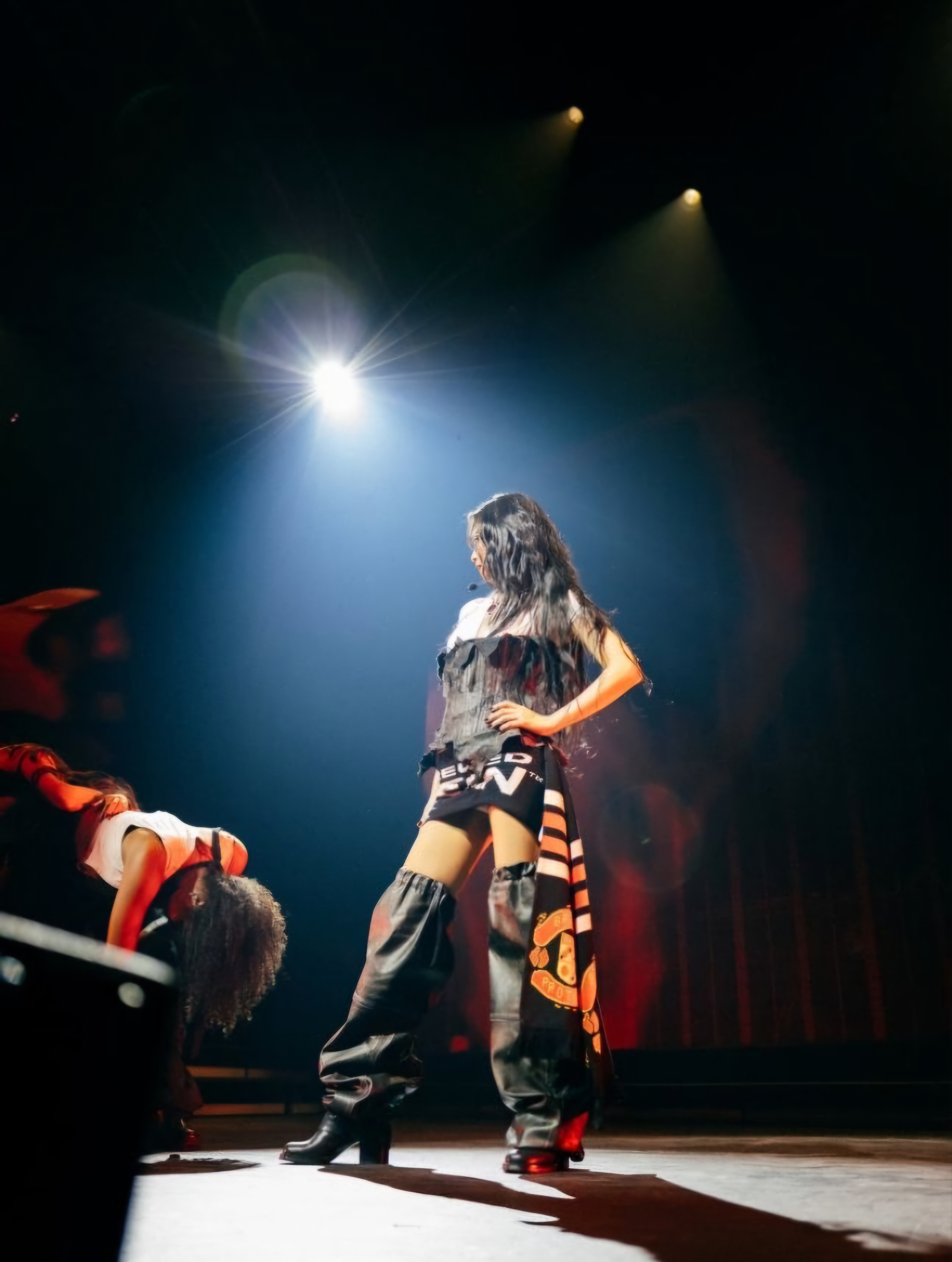
Confidence, with the seams showing
The most appealing glimpses of this period are the ones where mastery and uncertainty occupy the same frame. Before her first solo show at Radio City Music Hall, Vogue found her listening to the opening track of Ruby and keeping the backstage circle close. It included Allison Chang, her longtime collaborator and the head of global business at Odd Atelier. Performing without her BLACKPINK bandmates was new. Stadium experience did not cancel the nerves of a smaller room.
The same account catches another tiny contradiction. Despite years of fashion shoots, JENNIE asked the camera team for tips on posing. A few shots later, she was moving without direction and then directing a camcorder sequence herself. There is no need to varnish this into a fable about fearlessness. The more useful quality is responsiveness. She can admit that she does not yet have the angle, find it and take charge of the lens.
Gracie Abrams described a related quality in her 2026 TIME100 tribute: the presence visible before 100,000 people is still there in a party corner or backstage hallway, but so are kindness, warmth and softness. This is a sharper observation than the customary language of star power. It suggests that JENNIE’s quietness is not the opposite of her command. It is part of the mechanism.
A person can command the frame and still ask where to stand. The trick is knowing when the answer becomes hers.
One identity, several volumes
Ruby treated identity as theater, complete with curtains and a title drawn from Jennie Ruby Jane. She resisted the tidy idea that each name was a separate alter ego. They belonged to one person. That answer quietly refuses a common demand placed on pop stars: invent a new self whenever the old image becomes inconvenient. JENNIE’s proposal was integration. The rapper, singer, group member, fashion figure, actor and founder could share the billing.
Two releases, two kinds of space
Her 2026 work turned that idea inward. After festival headlining sets in New York and Europe, she released “Less Than a Lover” in July and the three-song digital EP Fallen Angel in August. Where Ruby sprawled across 15 tracks and a bright network of guests, Fallen Angel lasts eight minutes. Its smaller scale leaves less room to hide behind eventfulness. A six-track physical edition, including three additional songs, was announced for selected markets in October.
The compact release also clarifies what has changed since “Solo.” In 2018, independence was a theme delivered by a performer. By 2026, independence was infrastructure: a label, a team, a partnership, a visual language and a sequence of decisions. That does not make every decision correct. It makes them legible as hers.
The signature after the spectacle
Pop tends to measure control by visibility. Who stands in the center? Whose name is largest? JENNIE’s recent career offers a less photogenic measure: who chose the room, approved the track, assembled the people and accepted the outcome? Odd Atelier matters because it moves her signature from the poster to the process.
She remains connected to the institutions and people that formed her. BLACKPINK is not an erased draft. Dua Lipa is both collaborator and longtime friend. Chang, who has worked with her since the group’s early years, helps run the new operation. The independent chapter is full of continuity. Only the direction of responsibility has changed.
That may be why the curtain remains the right symbol. It does not create the performer. It changes what the audience is allowed to see. With Ruby, the curtain opened on a more complete name. With Fallen Angel, the lighting softened. Behind both sits the real plot: a meticulous performer learning that her taste can organize not only a stage, but the company, collaborators and choices around it.
A signature is not the same as certainty. It is simply a decision for which one accepts credit and blame. JENNIE has spent years making impossible polish look routine. Her current work is more interesting because the seams are visible: the questions, the small team, the new-room nerves, the quick pivot from asking for direction to giving it. The curtain rises. This time, she knows who signed off on the view.
Keep following the thread
- Official JENNIE website
- Official YouTube channel
- TikTok
- X
- The Ruby interview with Zane Lowe
- A day on tour at Radio City
- The 2026 TIME100 tribute
Performance photograph licensed via Wikimedia Commons. Reporting current through September 19, 2026.