Before Stray Kids had stadiums, they had a room. Inside it, Bang Chan, Changbin and Han made tracks as 3RACHA, a pre-debut unit with the useful impatience of people who would rather test an idea than wait for permission. The setup was modest. The implication was not. If the people who had to sing, rap and dance the music could also help build it, perhaps the group's identity would survive every handoff between studio, rehearsal room and stage.
That instinct became the organizing principle of an eight-member act. Bang Chan, Lee Know, Changbin, Hyunjin, Han, Felix, Seungmin and I.N do not occupy identical jobs, nor do they need to. 3RACHA supplies much of the writing and production framework. The whole group tests how a track sits in the mouth and moves through the body. Dancers turn percussion into angles. Vocalists make a crowded arrangement breathe. Eight temperaments take turns at the front, then fold back into the formation.
The result can sound like several radio stations colliding at an intersection: clipped rap, sweet melody, metallic electronics, a guitar flare, a cartoon sound effect, then a hook with the confidence of a fire alarm. Early listeners called the music noisy. Stray Kids heard a usable adjective. They titled a 2021 album NOEASY, a pun that treated the complaint as both joke and mission statement. The word stopped belonging to the critics.
The team came before the category
The group's origin contains an unusual wrinkle. Bang Chan, after years as a JYP Entertainment trainee, took part in choosing the trainees around him. A 2017 reality program put the proposed team through the familiar pressure cooker of evaluations, eliminations and reversals, but the underlying unit had already begun forming through work. Stray Kids officially debuted on March 25, 2018, with I Am Not. The name carried a declaration: step outside inherited standards and find a direction of your own.
There is an obvious danger in turning autonomy into mythology. Pop music remains collaborative, expensive and full of specialists. Stray Kids work with outside writers, producers, choreographers, directors and label staff. What makes their arrangement interesting is simpler: the group's members remain present at the point where musical identity is decided. Authorship is neither a ceremonial credit nor a purity test. It is a way to keep the feedback loop short.
3RACHA builds a track, lyric or structural idea.
Eight voices reveal where the song catches or drags.
Movement, styling and staging make the sound visible.
The audience response enters the next round of work.
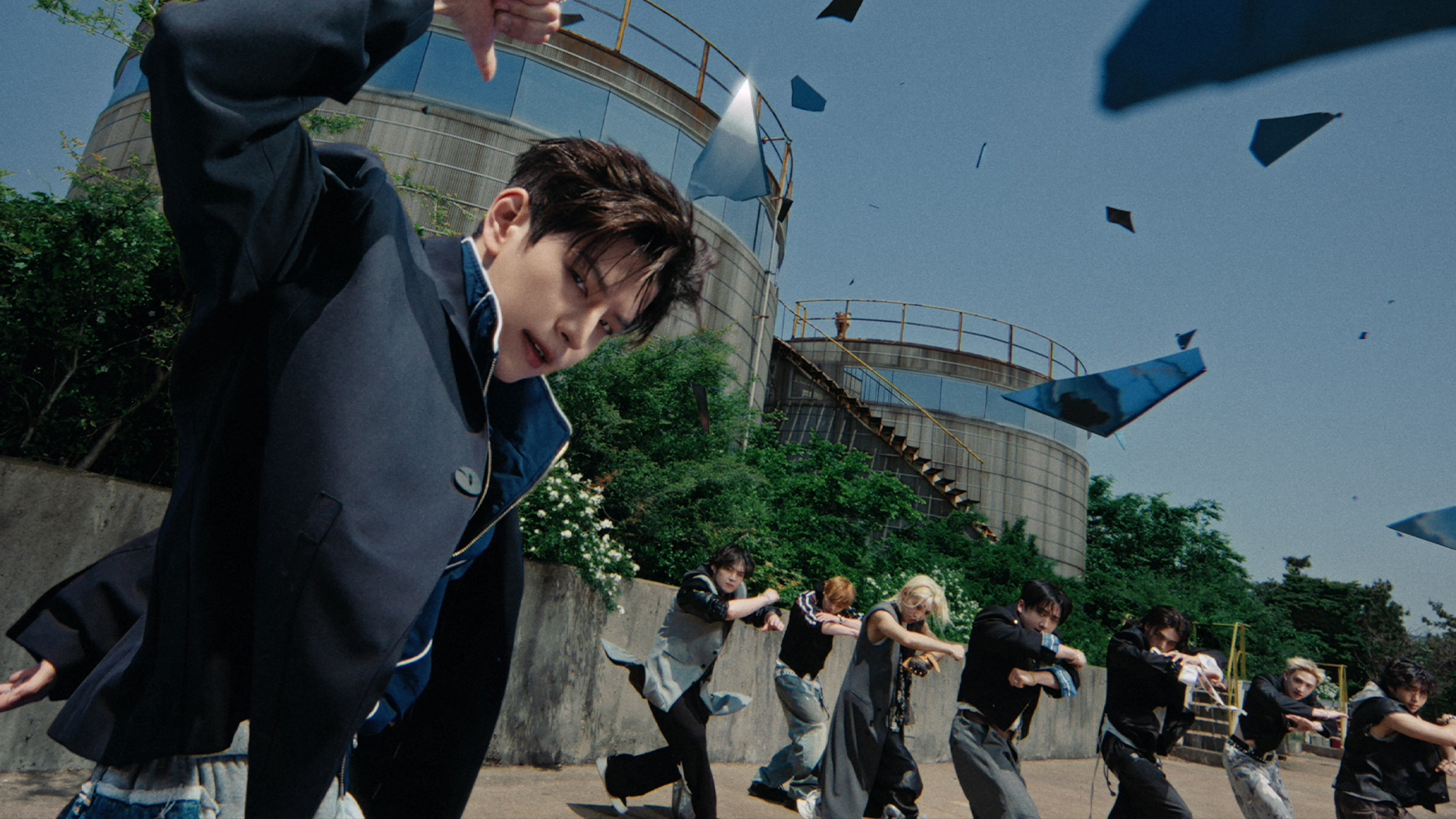
A good example arrived with 2020's “God's Menu.” Its kitchen conceit was funny, forceful and infinitely extendable. The production behaved like cookware dropped down a stairwell, while the choreography chopped, stirred and served. Felix's deep-voiced entrance became a calling card, but when Teen Vogue praised his performance, he redirected the compliment: “I think everyone put their all into this song and into the album.” Bang Chan broke the earnestness by singing a scrap of Kendrick Lamar's “HUMBLE.” Teamwork, then a joke. The rhythm of the group appears even in conversation.
Specificity learns to travel
“God's Menu” did not simplify Stray Kids for a broader audience. It made the group's peculiarities easier to recognize. This is a more durable kind of accessibility. The listener may not anticipate the next switch, but soon understands who is doing the switching. The follow-up era expanded that language through IN LIFE, NOEASY and ODDINARY. The songs moved among bravado, doubt, speed and sentiment without becoming polite about the transitions.
In March 2022, ODDINARY entered the Billboard 200 at No. 1. MAXIDENT followed that October. Two more releases topped the chart in 2023, two more across 2024, and another pair in 2025. In August 2026, THIS & THAT became the ninth. Every Stray Kids entry on the chart had debuted at No. 1. A run that tidy is tempting to describe as destiny. It was closer to logistics joined to loyalty: multiple formats, precise campaigns, a large fan community and a catalog whose authors could keep feeding the machine.
Chart success can flatten an artist into arithmetic. Stray Kids are better understood as a sequence of translations. A demo becomes an eight-person recording. The recording becomes a choreography. The choreography becomes a tour arrangement sturdy enough for a stadium. Korean wordplay travels through subtitles, fan explanations and the physical wit of performance. None of these versions is identical, yet each retains the same accent.
The catalog learned new languages without treating language as a replacement for character. The group made its Japanese debut in 2020, recorded English versions of existing songs, and placed music in worlds that came with their own audiences. “Top” and “Slump” accompanied the anime Tower of God. “Slash” appeared on the Deadpool & Wolverine soundtrack, while “Come Play,” made with Young Miko and Tom Morello, entered the animated world of Arcane. Each assignment changed the frame around Stray Kids. None required the center to disappear.
That continuity has a contractual dimension too. In July 2024, JYP Entertainment announced that all eight members had renewed their agreements before the original contracts expired. Contract news is rarely romantic, and perhaps it should not be. Here it registered as evidence that the working arrangement still made sense to the people inside it. The group could plan the dominATE tour and the releases that followed with continuity already settled, a practical vote for the team they had spent years becoming.
The audience supplies the missing letter
The fandom is called STAY. Remove the letter R from “stray” and the word appears, an elegant little edit that lets the audience complete the name. “You make Stray Kids stay” became the recurring formulation. It is sentimental, certainly. It is also good architecture. The fan is given a role inside the sentence rather than parked outside it.
That relationship has accumulated its own customs: chants, light sticks, fan meetings, translated clips, character mascots and the affectionate chaos of the group's variety content. SKZOO, a set of animal avatars tied to the members, gives the severe stage personas a cuddly afterlife. A wolf, rabbit, pig-rabbit, ferret, quokka, chick, puppy and fox can sell out a pop-up without asking anyone to understand a production credit. The serious point is that a career needs more than one doorway.
The members have become adept at opening those doors without pretending every room is the same. Bang Chan and Felix, both raised in Australia, often bridge English-language interviews. Dance-focused members explain songs through movement. Vocal combinations soften the edges of the rap line. Subunits rearrange the chemistry. Onstage, individual spotlights are brief arguments for returning to the group.
Nine No. 1s, then back to rehearsal
By 2025, the scale was hard to miss. JYP reported 56 dominATE tour performances across 35 regions by that October. The industry's global trade body IFPI ranked Stray Kids second on its 2025 artist chart, measuring consumption across formats and countries. The itinerary widened again in 2026: a new RUN IT tour, five Seoul dates, Japanese stadium shows and a September headline set at Rock in Rio.
Those milestones change the practical work. A whisper has to hold attention across concrete. A formation has to read from the far tier. The members must preserve spontaneity inside a show coordinated to the second. Yet scale also clarifies the original wager. The group did not need to exchange its fingerprints for reach. Its fingerprints became the reason to travel.
THIS & THAT, released in August 2026, is an almost cheekily casual title for the release that delivered a ninth Billboard 200 No. 1. Its title track reached No. 38 on the Hot 100, then the group kept moving through its tour calendar. Records invite ceremony; careers require another soundcheck.
This may be the most revealing Stray Kids habit. The grand statements are real, but they sit beside process videos, studio talk, teasing and the visible labor of eight people adjusting to one another. The machine roars because someone keeps tightening the bolts. Creative control, in this version, is not the romantic image of a solitary genius. It is a room full of people with enough shared history to disagree quickly, laugh, revise and go again.
The group's old slogan promised “Stray Kids everywhere all around the world.” It once sounded like the bravado a young act is entitled to try on. Now it reads rather like a boarding pass. The interesting question is no longer whether the music can travel. It is how far Stray Kids can carry the room where it began.