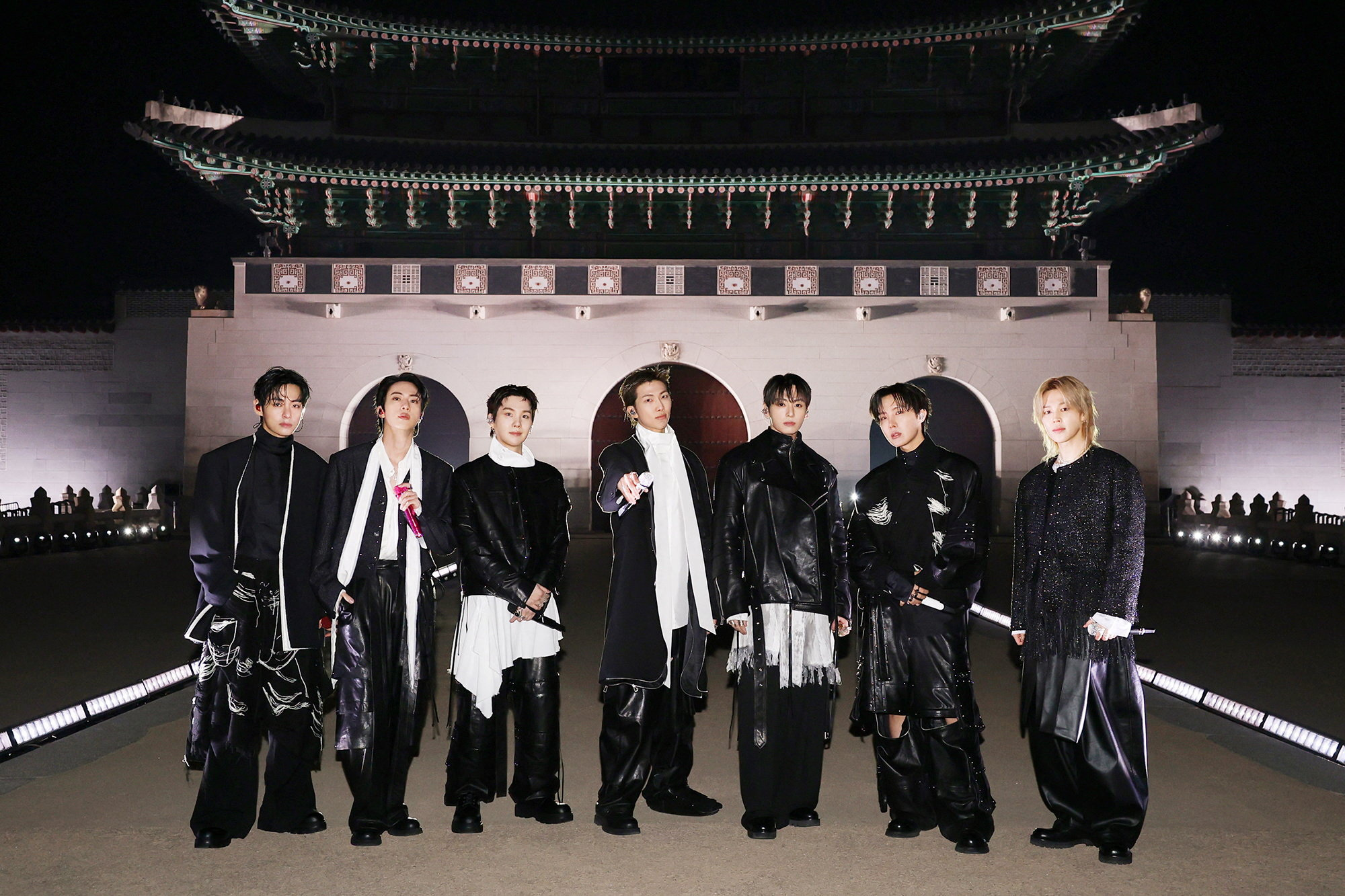
At eight o'clock on a cold March night, the gates of Gwanghwamun glowed purple and red. Seoul had lent its ceremonial front room to seven performers in black. “Annyeonghaseyo! We're back,” RM said, which was both perfectly obvious and not quite enough. BTS had not simply returned to a stage. The group had returned to the grammar that made it: seven names arranged into one subject.
The free concert carried the logistical heft of a state occasion. Streets closed. Thousands of police formed a perimeter. Twenty-two thousand people held seats in the viewing zone, while more watched nearby screens and a live stream. The scenery did its own eloquent work. Behind the choreography stood a palace gate; beneath the new album stood Arirang, a folk song known across Korea for carrying separation, longing and endurance in a melody simple enough to survive generations.
Pop reunions usually trade in the warm currency of recognition. Here are the old songs. Here are the familiar gestures. BTS did play “Dynamite” and “Butter,” but the evening opened another account. The first song was “Body to Body,” from a 14-track record made after the members had spent years apart as working artists. Nostalgia was present, certainly. It simply had to share the room with change.
Before the records, there was a small room and an unfashionable amount of honesty
BTS debuted on June 13, 2013, from a company that did not yet possess the gravitational pull of today's HYBE. The name Bangtan Sonyeondan is commonly translated as Bulletproof Boy Scouts. It sounded defensive because it was: the idea was to resist the bullets of judgment aimed at young people. Their early songs took school pressure, rigid expectation and adolescent frustration seriously. “No More Dream” asked what a dream looks like when somebody else has chosen it for you.
The lineup was built from useful differences. RM, SUGA and j-hope supplied three distinct rap instincts. Jin, Jimin, V and Jung Kook supplied four distinct vocal colors. All seven danced. Offstage, the differences became comedy: solemn thought interrupted by a joke, neatness meeting chaos, the leader losing something again. Onstage, difference became an arrangement. Precision did not erase personality; it gave personality a count of eight in which to land.
Their rise is often narrated through records because the records are pleasantly enormous. The more revealing technology was conversation. The members posted diaries, casual videos and live broadcasts. Fans translated lyrics and jokes before institutions learned how much cultural infrastructure volunteers could build overnight. ARMY was less an audience waiting at the end of distribution than an active relay network. Intimacy, multiplied by translation, turned out to be highly portable.
By 2017, that relay had carried BTS to the Billboard Music Awards, where they won Top Social Artist. The prize name sounds faintly corporate; the moment did not. A Korean group had arrived in an American pop telecast powered visibly by organized affection. Later that year, BTS and Big Hit launched LOVE MYSELF with UNICEF. The partnership joined album themes about self-regard to a campaign supporting young people and opposing violence. By March 2021, it had raised $2.98 million.
“Love yourself. Speak yourself.”RM at the United Nations, 2018
At the United Nations in 2018, RM spoke of growing up in Ilsan, imagining himself a superhero, and gradually going quiet under other people's opinions. The polished pop leader described mistakes and fears without pretending they had been conquered. His closing invitation was to speak your own name and voice. It was a shrewd summary of the group: self-expression offered less as a triumph than as a daily practice.
The leap / Korean at No. 1The wider the world became, the more useful specificity looked
In 2020, “Dynamite,” BTS's first song entirely in English, became the first track by a K-pop act to top the Billboard Hot 100. The achievement was historic and slightly comic in its timing: a maximal song arriving while much of the world was confined indoors. Later that year, “Life Goes On,” sung primarily in Korean, also reached No. 1. One song opened the door in English; the next walked through without changing clothes.
IFPI named BTS its Global Recording Artist of 2020, making the group the award's first Korean winner and its first winner to perform primarily in a language other than English. “Butter” followed in 2021, setting a then-record of 108.2 million YouTube views in 24 hours. Guinness placed the group in its 2022 Hall of Fame with 23 records across music and social media. The numbers made a clean argument: language was not the ceiling executives had imagined it to be.
Debut. “No More Dream” makes youth pressure the first subject.
Breakthrough. A Billboard award and LOVE MYSELF turn fandom into public force.
No. 1. “Dynamite” and “Life Goes On” top the Hot 100 in two languages.
Seven paths. Solo records and service obligations pause the group chapter.
Return. ARIRANG, Gwanghwamun and an 82-show tour begin act two.
Success enlarged the stage but did not simplify the people on it. BTS could be solemn at the UN and gloriously silly in a variety episode. Their music moved between social criticism, diary entries, exuberant pop and labyrinths of self-reference. There were collaborations with Halsey and Coldplay, stadium singalongs and songs quiet enough to feel addressed to one listener with headphones. The coherence came from recurring questions: Who am I under all this expectation? How do we stay close? What is ambition for?
Intermission / Seven laboratoriesA pause can be compositional
The 2022 anthology Proof looked backward just as the members prepared to step away from full-group work. National service obligations set the calendar, but the interval developed an artistic logic of its own. Instead of treating solo releases as side quests, each member established a separate center of gravity. RM wandered through art, language and collaboration. SUGA sharpened the Agust D persona. j-hope chased rhythm and stagecraft. Jin, Jimin, V and Jung Kook each found different routes through pop, performance and intimacy.
This mattered because groups are often preserved by freezing people inside the roles that first made them legible. BTS chose motion. Seven people could acquire tastes, techniques and audiences without requiring the original form to disappear. When all seven appeared together on a livestream in July 2025, the pleasure came partly from familiarity and partly from evidence of distance traveled.
Debut2015-19
Youth becomes global2020-22
Chart peak2022-26
Solo paths, reunion
They said the new group record would contain everyone's thoughts and ideas and that they were approaching it with the mindset they had at the beginning. This is the sort of sentence returning artists are obliged to say. BTS made it more interesting by choosing a title older than pop itself.
Act II / The road bends homeARIRANG is a reunion word with centuries behind it
Arirang is not one fixed song so much as a family of versions carried across regions and history. Its best-known emotional weather includes parting, yearning and resilience. For BTS, the title connects several separations at once: members from group, fans from performers, Korean artists from a global circuit they had helped redraw. It also avoids the sterile language of the “comeback.” Nobody returns unchanged. The road bends; the traveler accumulates miles.
The album arrived on March 20 with 14 tracks. HYBE said it sold nearly four million copies on its first day. Spotify reported that it became the platform's most-streamed K-pop album in a single day and the most-streamed album of 2026 at that point. Those statistics resumed the old velocity. The more telling choice came a day later: the first full-group concert in nearly four years would be free, outdoors and placed at the symbolic center of Seoul.
“We wanted to show who we are and how we can come together.”RM at Gwanghwamun Square, 2026
SUGA explained that both the album name and the Gwanghwamun setting were about identity. RM described the music as an attempt to feel true to the group. The seven performed new songs, including “SWIM,” beside the hits. Some grew tearful while thanking the fans who had waited. Then they held hands and bowed. The gesture was formal, familiar and strangely tender. Four years of separate calendars collapsed into one horizontal line.
An 82-show world tour followed, crossing Asia, North America and Europe. The operation is massive. The motive remains surprisingly conversational. BTS's strongest work has always made an immense audience feel addressed rather than counted. That task becomes harder after records, absence and myth. It may also become more necessary. Seven mature solo artists now have to create a plural that does not flatten any of them.
This is why the second act is more interesting than a victory lap. The first BTS story concerned ascent: a small-company group found a global public without disguising where it came from. The next story concerns return: whether people can come back to a shared form with their new edges intact. ARIRANG offers an early answer. Togetherness need not mean sameness. Home need not mean standing still.
At Gwanghwamun, the old gate remained behind the lights, older than the charts and patient with spectacle. In front of it stood seven men who had once sung about borrowed dreams. They had achieved ambitions too improbable for their younger selves to phrase. Then the music stopped, hands joined, and they bowed toward the people who had kept the conversation alive. Pop rarely gets a neater ending. Fortunately, this one was a beginning.