Elizabeth Gooch built a business around making work visible. The awkward discovery came later: a founder can spend decades understanding an organisation and still be surprised by what happens inside her own boardroom. She returned to lead eg solutions after a difficult change of leadership, then faced a different departure when the company was acquired in 2017. A sale worth £26.3 million gave the story a tidy financial ending. Gooch has spent the years since explaining why the personal ending was considerably less tidy.
Today she works with founders on growth, investment and the decisions that become harder as a company gets larger. Her experience makes those conversations specific. She has been the person who wanted help, the person who felt pushed aside, and the person who had to accept that shareholders could reasonably want something different from their founder. In her version of entrepreneurship, owning the original idea does not settle every subsequent argument.
The original idea was usefully unromantic. Gooch started her career in industry, then worked at Forward Trust and Birmingham Midshires Building Society. She became interested in bringing industrial production-management methods into service businesses. An office might have carpets rather than conveyor belts, but work still arrived, waited, moved between people and sometimes accumulated faster than anyone could finish it. The furniture was different. The queue was familiar.
She established eg in 1988. Its eventual operational intelligence software embedded those techniques in the daily running of service organisations. That origin matters: the business began with an understanding of operations, rather than a piece of software in search of an office to occupy. Gooch was interested in what managers and their teams needed to get done. Technology became a way to make that understanding repeatable.
A simplified view of the operational thinking behind the software.
A customer helped write the next chapter
Her account of the early product is refreshingly communal. After working with customers through spreadsheets, she wanted a reusable solution. A colleague developed an early version; Gooch has explicitly said she did not personally write it. A customer, Clerical Medical, then wanted it to work on a network. The customer funded further development, helping turn an initial tool into a more substantial software product.
In her recollection, fees from customers supplied the working capital for development. Customers supplied ideas, too. The product grew through requests from people who had to use it. That is a less cinematic founding scene than a solitary inventor at midnight, but a rather useful arrangement for enterprise software: the prospective buyer has already explained the problem, and has a reason to care whether the solution works.
By February 2017, eg was describing a global base of more than 100,000 software users. Its purpose-built back-office offering combined work, people and processes across locations. Forecasting, scheduling, real-time work management and operational analytics were part of the proposition. A manager could see demand and capacity together, then make decisions about who should do which work and when.
The practical attraction is easy to understand. A polite conversation with a service company cannot finish a task that is still waiting in another department. Back-office software concerns itself with that second part of the experience. Gooch had chosen a business whose achievements could be hidden inside an ordinary working day: a task allocated, a deadline met, a queue brought under control. There was plenty to do without giving the paperwork a glamorous name.
The founder returns to the office
Growth brought a different kind of machinery. eg listed on AIM in 2005. In 2012 Gooch received an MBE. She also received recognition from the West Midlands Women of the Year awards for her contribution to technology, and was included among The Telegraph’s disruptive entrepreneurs. Public recognition was accumulating around a business devoted to the less public parts of other businesses.
Inside eg, the question was how to grow further. In her account of the events of 2013, Gooch welcomed additional experience at board level, but found herself moved away from executive leadership. She later returned to the chief executive role. Her description of the episode is a founder’s recollection of a contested period; the useful part is the concrete work she described doing on her return.
She reinstated daily cash-flow forecasting, sought clearer information from departments and contacted customers. She also described spending time working with incoming chairman Duncan McIntyre before his appointment, to test whether the relationship would work. After an unhappy experience with a recommended appointment, compatibility had become something to establish through practice. A distinguished career elsewhere could open the conversation. It could hardly conduct the conversation for them.
“We were creating the market as we went,” she said in 2014, recalling the earlier years. The same willingness to admit difficulty ran through her account of the return. She undertook leadership training and questioned whether founding a company automatically qualified someone to run it. That is a demanding question to ask after having built the place. It also makes her subsequent advice more interesting than a victory lap.
- 1988Business established
- 2005AIM listing
- 2012MBE awarded
- 2013-14Return to leadership
- 2017Acquired by Verint
112.5 pence, and a very abrupt goodbye
On 3 November 2017, the acquisition of eg by Verint became effective. Shareholders were entitled to 112.5 pence in cash for each scheme share. Gooch and several fellow directors tendered their resignations, to take effect following cancellation of trading. The legal process had a definite sequence: court approval, registration, payment and the end of the quoted company’s independent life.
The deal valued eg’s issued and to-be-issued share capital at approximately £26.3 million. That number belongs to the company’s transaction, rather than a calculation of Gooch’s personal wealth. The distinction is particularly relevant to her own later explanation of the sale. Once a business has outside investors, the founder’s preferences have to sit alongside the interests of everyone else who owns it.
Looking back three years after the acquisition, she described having been unhappy when it happened. She loved the company, its customers and its people; the change demanded an adjustment to a new career. By then, she had come to regard the decision as right because it allowed her to put her experience to work helping others. Her account leaves room for both reactions, separated by time.
“It belongs to all the shareholders,” she explained. There is a whole boardroom education inside that short sentence. A founder can understand the principle intellectually long before encountering the particular transaction that makes it personal. Investors may be making an appropriate portfolio decision while the person who started the business is contemplating the disappearance of a daily routine, a set of relationships and a familiar answer to the question of what she does.
“It belongs to all the shareholders.”
Elizabeth Gooch, reflecting on ownership and the sale
The factory now works on founders
The Tech Growth Factory became the next vehicle for her work. Gooch describes its purpose as helping startups and growing companies develop and secure investment, using experience gained as a founder and chief executive. Her stated ambition is to reduce the failure rate among startups. The emphasis is on giving founders practical help through the difficult stretch in which a promising business still has to become a durable one.
That work has taken her into classrooms as well as boardrooms. In April 2023, she visited founders on the University of Birmingham’s UoB Elevate incubator programme at The Exchange. A subsequent Career Talk conversation covered her own journey and advice on investment. It is an appropriate setting for someone whose product was shaped by customers: a roomful of founders has rather more specific questions than an inspirational poster can answer.
Her writing also shows how much the work still interests her. In an August 2024 essay, she argued for innovation in business processes as well as products, and for continued learning across the organisation. A new product can age; an organisation can stop learning how to deliver it. Her attention keeps returning to what people actually do together after the announcement has been made.
In another public reflection, she identified several revenue plateaus in her own business, from around £1 million to £8 million-£10 million. She described founder dependence, unclear responsibilities and the need for specialists as obstacles that emerged at different sizes. The implication is uncomfortable but practical: the habits that once made a founder indispensable may eventually keep colleagues waiting for permission. Even the person who designed the process can become part of its bottleneck.
A board seat, with the volume turned up
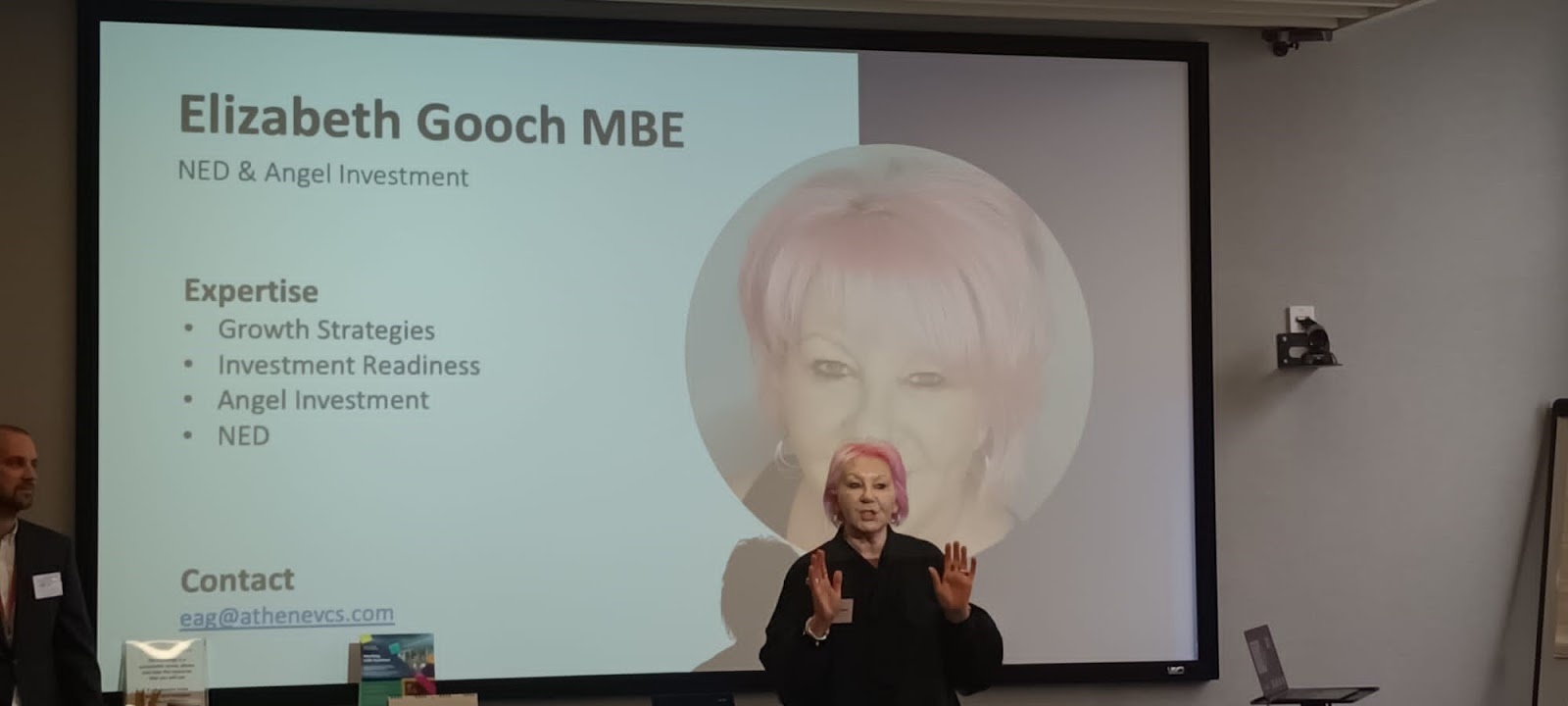
Her current work extends beyond software founders. At Braemar, which advises the shipping and energy markets, she is a non-executive director, senior independent director and chair of the remuneration committee. She joined the board on 1 August 2021. Shareholders re-elected her in July 2026. Her responsibilities now include the governance, financial reporting and investor relationships that once arrived as new complications in the life of her own company.
There is still room for a joke. Introducing herself to a professional network, she said she tried to act her shoe size, choosing between six and 39 as circumstances required. She also recalls playing music loudly before difficult results-day meetings, including Mr Brightside and tracks by the Sex Pistols. The latter is an entertaining accompaniment to a career spent learning the obligations of a public-company board.
Gooch’s story resists the usual stop at the acquisition price. She built something, needed help with it, regained responsibility for it and eventually had to leave it. The next business grew from what those experiences taught her. For the founders she now works with, that offers a useful kind of company: someone who knows why you want to grow, and why getting what you wanted may require another conversation altogether.