Elizabeth Emmons was sitting in a doctor's office when the television said the quiet part loudly and incorrectly. On a familiar homebuying show, someone announced that buyers were required to put 20 percent down. Emmons, who had spent years inside the mortgage business, nearly called out at the screen. She knew the missing clause: private mortgage insurance can give qualified buyers another route. What sounded like a small error in a waiting room was, to her, a consequential piece of folklore. A person can spend years saving toward a threshold that is not always the only threshold.
The scene gets at the unusual communications problem at the center of Emmons's career. Radian sells to housing professionals, but the effect of its products eventually reaches people making one of the largest financial decisions of their lives. Those people may never know the names of the systems, insurance products or risk models operating behind the transaction. Marketing, in that environment, is less about making noise than making an option legible.
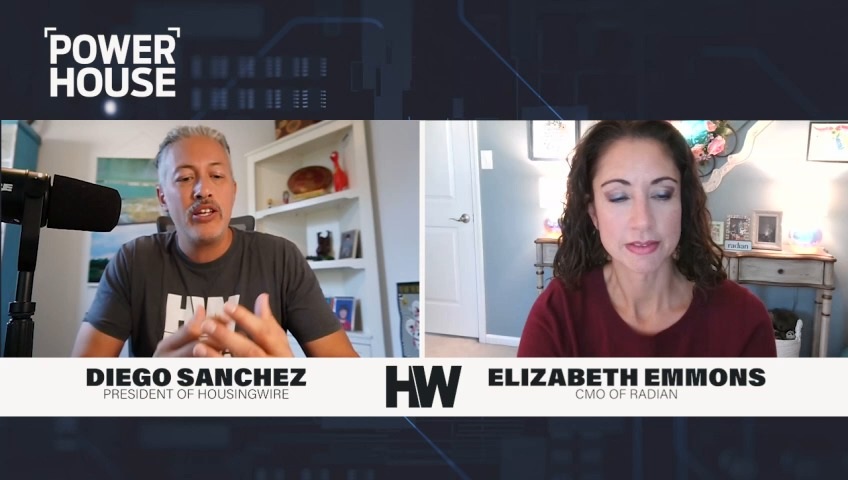
Emmons has had time to learn where the confusion accumulates. At Radian's 2023 investor day, she was introduced as a 23-year company veteran. Her responsibilities then covered digital experience, demand generation, lifecycle marketing and product marketing across mortgage insurance and the homegenius business. By the time she appeared on HousingWire's Power House in August 2025, her title was chief marketing officer and her description of the job had widened: marketing, corporate and internal communications, and the company's philanthropic efforts.
A copy editor enters the mortgage business
There is a clue to Emmons's method in her college record. She attended Shippensburg University of Pennsylvania from 1997 to 1999 and worked as a copy editor for The Slate. The job of a copy editor is to notice what a sentence assumes, what it leaves out and how a reader might misunderstand it. That is useful training for any marketer. It is particularly useful when the subject is mortgage insurance, where one omitted option can change what a prospective buyer thinks is possible.
Her public career record does not offer a neat sequence of annual promotions. It offers something more revealing: expanding scope. Around 2000, she joined Radian. By 2023 she was helping present the company's data and analytics story to investors while overseeing the customer-facing machinery that turns products into messages and digital experiences. In 2025, she described a role that reaches inward to employees and outward to communities as well as customers.
That breadth makes sense when marketing is treated as a translation layer. Product teams know what a service does. Salespeople know what customers are hearing. Employees know where a mission feels concrete and where it feels like a poster. Philanthropic work shows which community needs are not abstract. Put those signals together and the CMO becomes a custodian of coherence.
“Trust is earned.”Elizabeth Emmons, on customer confidence
The useful friction between sales and marketing
Emmons is direct about one corporate habit she does not want: “It can't be a marketing versus sales.” In her description, the two teams form a feedback loop. Sales brings back the questions, objections and opportunities it hears in live customer conversations. Marketing returns engagement signals about which explanations people actually use. The work gets better when neither department treats the other as a delivery service.
The down-payment myth is a good stress test for this system. An advertisement can announce that private mortgage insurance exists. A lender still has to explain how the option applies to a particular borrower. An industry association can reinforce the message. A trusted housing publication can put it into context. No single messenger owns the full journey, so the marketer's work is partly orchestration: give each participant something accurate and useful to pass along.
Emmons joked in the interview about whether Radian should simply buy a Super Bowl ad to make everyone aware of the option. Then she returned to the less cinematic answer: keep working with customers and partners, keep supplying information, and keep showing up where people look for trusted guidance. Durable myths rarely yield to one grand reveal. They wear down through repetition.
People behind the platform
Radian's work is full of technology: digital experiences, underwriting systems, property data, valuation models and services that support different stages of a mortgage. Emmons does not pitch technology as a substitute for accountability. Her sharper line is that “if the technology fails, you need to trust the people behind the technology.” The sentence draws a boundary around digital transformation. Convenience can begin on a screen. Confidence still depends on someone standing behind the result.
That view was earned across cycles. A 23-year tenure by 2023 means Emmons's Radian career passed through the housing boom, the Great Recession, the long recovery, a pandemic-era disruption and a later affordability squeeze. In the 2025 interview, she used the company's survival across those conditions as part of the case for credibility. The point was not that age automatically deserves trust. It was that customers have watched the institution operate when the market was easy and when it was not.
Her internal-communications remit completes the thought. If employees do not understand how their daily work connects to the mission, customers will feel the gap eventually. Emmons likes the familiar anecdote about President Kennedy meeting a janitor at NASA. Asked what he was doing, the worker connected his task to putting someone on the moon. For Radian employees, her equivalent is helping make homeownership possible. The claim works only if teams can trace the line from their own role to that outcome.
This is why philanthropy belongs in the same portfolio, too. It is another place where institutional language meets lived experience. Marketing expresses what a company says it values. Internal communication asks employees to act on those values. Community work tests whether the promise can become visible beyond the office.
Thinking newly without forgetting the old lesson
Long tenures are often described as stability. Emmons's recent public posts suggest a more active relationship with continuity. In 2026, she wrote from Radian's New York Stock Exchange celebration of its acquisition of Inigo, a move into specialty insurance. A few months later, she responded to the planned transition from CEO Richard Thornberry to Mike Weinbach. Her note about Thornberry was specific: he had encouraged her to think newly, push boundaries, challenge assumptions and step into new ways of leading.
“Think newly” is an interesting instruction for someone carrying decades of institutional memory. Experience can turn into a list of reasons an idea will fail. It can also become pattern recognition: knowing which principles should stay fixed while products, markets and leadership change around them. Emmons's public career points toward the second use.
The distinction matters in housing because the customer problem can stay recognizable while the machinery changes. Buyers still need a comprehensible route through price, risk and paperwork. The tools around that route can become more digital, the data more granular and the organization more diverse. A veteran operator can remember why an earlier message worked without assuming it will keep working. Emmons's expanding remit suggests that kind of adaptation. Demand generation is close to the campaign. Lifecycle marketing follows a relationship over time. Internal communication asks whether colleagues understand the promise they are helping deliver. Corporate communication carries the promise through moments of change. Each added layer widens the frame while preserving the same editorial question a copy desk teaches early: what does the audience need to know, and what could this wording cause them to miss?
The fixed principle is clarity in service of trust. In the early homegenius work, that meant helping explain a reimagined brand and digital experience. At investor day, it meant connecting customer data to product and lifecycle marketing. On Power House, it meant describing mortgage insurance without losing sight of the household trying to buy a home. During a corporate acquisition and CEO transition, it means helping a familiar organization narrate a less familiar future.
The product can be technical. The next decision still has to feel human.The operating idea beneath Emmons's work
There is no public manifesto from Emmons, and she does not need one. The doctor's-office story is more useful. She hears a sentence that could make an already difficult goal seem further away. She notices the missing option. She wants the industry to correct the record. Then she goes back to the patient work of equipping the people closest to the buyer.
That is a grounded definition of executive marketing: not merely being memorable, but helping someone remember the right thing at the moment it matters. For a homebuyer, the right thing might be that 20 percent is not the only doorway. For a lender, it might be that technology has accountable people behind it. For an employee, it might be that a small task belongs to a larger purpose.
Emmons has spent much of her career working in the middle, between product and customer, system and person, institutional history and the next chapter. The middle is rarely glamorous. It is where mistranslations happen, departments drift apart and familiar myths harden into rules. It is also where a careful operator can make a complicated path easier to see.