Jason Lavender remembers a corporate training announcement that sounded promising. There was a new product feature. Then came the reveal: the fast-forward button on the videos had been disabled. In his telling, he spent roughly four hours watching. The ingenuity had gone into preventing escape. Somewhere in that small indignity sat a business opportunity.
- Live experts teach workplace skills; employees can choose classes through Membership.
- AI simulations let people rehearse feedback, conflict and other difficult conversations.
- People teams get help with programming, logistics and measuring learning.
A mountain in the meeting room
Lavender and Krikor Dzeronian met at MIT Sloan. A guest lecturer who had led multiple Everest expeditions gave them a different experience of learning: teamwork, decisions and project management explained through situations where the consequences were unmistakable. The founders trace Electives to that contrast. Why could a mountain make management interesting when the workplace so often made it dull?
They launched in 2020. The first difficulty was selling. In an October 2021 interview, Dzeronian recalled companies preserving cash during the pandemic and declining new services. Without immediate market validation, the founders questioned viability. They persisted because they regarded development as an employee benefit companies would need to keep defending. That was their conviction, rather than a guarantee the market owed them.

By March 31, 2022, Electives announced an $8 million Series A led by Accomplice and G20 Ventures, with Boston Seed Capital participating. The announcement described more than 100 teachers, including athletes, professors, improv comedians and FBI agents. The variety was the point: useful expertise can arrive wearing something other than a corporate trainer’s badge.
The instructor is only half the purchase
Electives occupies the space between an instructor marketplace and a managed learning program. Employers buy access; employees learn. HR, People and learning teams are the practical buyers, particularly when they want development without assembling a small production company to deliver it. Curation, calendar invitations, follow-up materials and reporting are part of the proposition.
Its customers include Puma, Clari and LinkSquares, whose learning leaders appear in company testimonials. The problem they describe is partly capacity. A lone learning leader needs help designing and rolling out a program. Electives offers the teachers and the machinery surrounding them. An engaging session is useful; remembering to invite everyone is less glamorous and equally necessary.
Membership, launched June 1, 2023, added employee choice. People browse live sessions and select what interests them. Current Membership classes run 60 to 90 minutes and include leadership, communication and AI. Certificate pathways add structure. Private classes serve a different purpose: a company can build a shared program around its own objectives rather than send everyone shopping separately.
“We’re very excited to give employees more choice in what they learn.”
Jason Lavender · Membership announcement, May 2023
That distinguishes the offer from browsing a recorded course library such as LinkedIn Learning or Coursera, although those remain sensible procurement alternatives. Live learning offers interaction and a scheduled commitment. It also asks for a scheduled commitment. A video can wait until midnight; a visiting instructor usually cannot.
Meet Greg. Try again.
The next step addresses a familiar embarrassment. You understand feedback in principle. Then someone becomes defensive, and your beautifully prepared sentence falls apart. Electives announced AI Simulations in March 2025 to give employees a practice environment for precisely this kind of workplace encounter.
In a company product screenshot, the exercise involves an employee named Greg and a conversation about underperformance. Learners work through a scenario, receive personalized feedback and try again. Organizations can customize scenarios and personalities to reflect their needs. The service is available on demand and in multiple languages, adding repetition without requiring an instructor at every attempt.
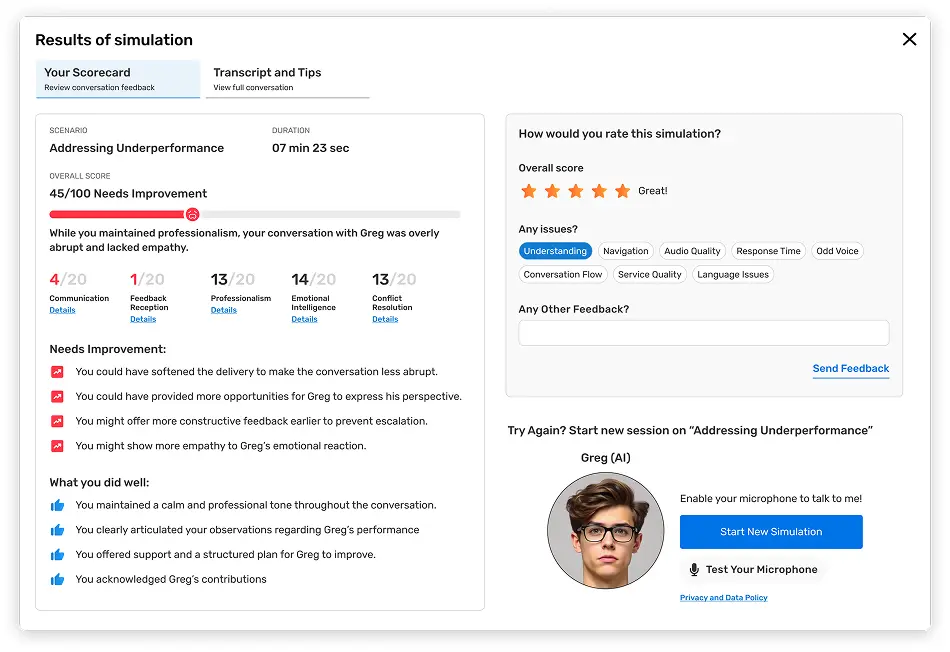
This is a meaningful extension of the original premise. A memorable teacher can supply a mental model; a simulation supplies another turn at using it. The company now also offers AI training organized around workforce assessment, role-specific instruction and application at work. In July 2026, its published manager-training approach connected AI fluency with coaching, delegation and review habits.
- 01Assess
- 02Learn live
- 03Rehearse
- 04Apply
- 05Measure
A diagram of the company’s approach, not a promise that every learner completes the loop.
The manager who stopped being the answer
A June 2026 learner spotlight makes the proposition more concrete. Tyler Winn, a Technical Support Engineering Manager at ActivTrak, described beginning with occasional classes, then finding direction in certificate programs. His account identifies a recognizable managerial habit: when colleagues needed help, he would simply do the work for them.
After classes with instructor Sharon Danzger, Winn said he began stepping back and teaching people how to do things. He also described a practical routine with his manager and a co-manager: each took class notes, dropped them into a shared folder and used AI to combine the perspectives into a team learning document. The account is company-published testimony, with a specific behavior readers can understand.
That routine is worth copying. Pick one habit you want to change. Learn an approach, rehearse the awkward part and put it into a real meeting. Compare notes with colleagues afterward. The shared document gives the lesson somewhere to live beyond the person who attended.
Buy the time as well as the training
The economics involve more than a software license. Memberships and private programs are employer-funded, with fees set through customer agreements. The buyer must also budget employee attention. Sixty to ninety minutes on a calendar is a real resource, even when the invoice belongs to another department.
Electives provides analytics for participation and learning impact. The sensible buying question is what changed afterward. A simulation score measures performance in that simulation; attendance measures attendance. Neither alone establishes a financial return. Buyers should connect practice to their own observable work, such as clearer feedback or better delegation.
The model needs protected time, relevant scenarios and permission to use new skills. If managers reward speed by taking every task back, a delegation class faces a formidable opponent. Electives’ most interesting wager is that corporate learning can earn its place in the working week. The evidence to watch is the next conversation.