A prediction has an awkward last mile. Somewhere between the analyst who understands a model and the manager who has to act on it, an explanation must become a choice. Who gets attention first? Which possibility deserves investigation? Eigenatics LLC put that problem at the center of its proposition. Its product, EOS, was described as an easy-to-use scoring platform for extracting insights from corporate data. The interesting word in that description is “use.” A company can possess a great deal of information and still have trouble deciding what to do on Monday.
- The product: EOS, a predictive analytics scoring platform.
- The audience: businesses in finance, retail, telecom, health care and utilities.
- The proposition: put analytical tools into ordinary business decisions.
A number with somewhere to go
Eigenatics described its work as advanced analytical solutions for better business decisions. That places it where software meets consulting: the business has a question; analytical work gives that question a more disciplined answer. EOS supplied the named product around which that proposition could be organized. The company's stated emphasis was accessibility and everyday application, a useful distinction in a market where the sophistication of a method can receive more attention than the person expected to use it.
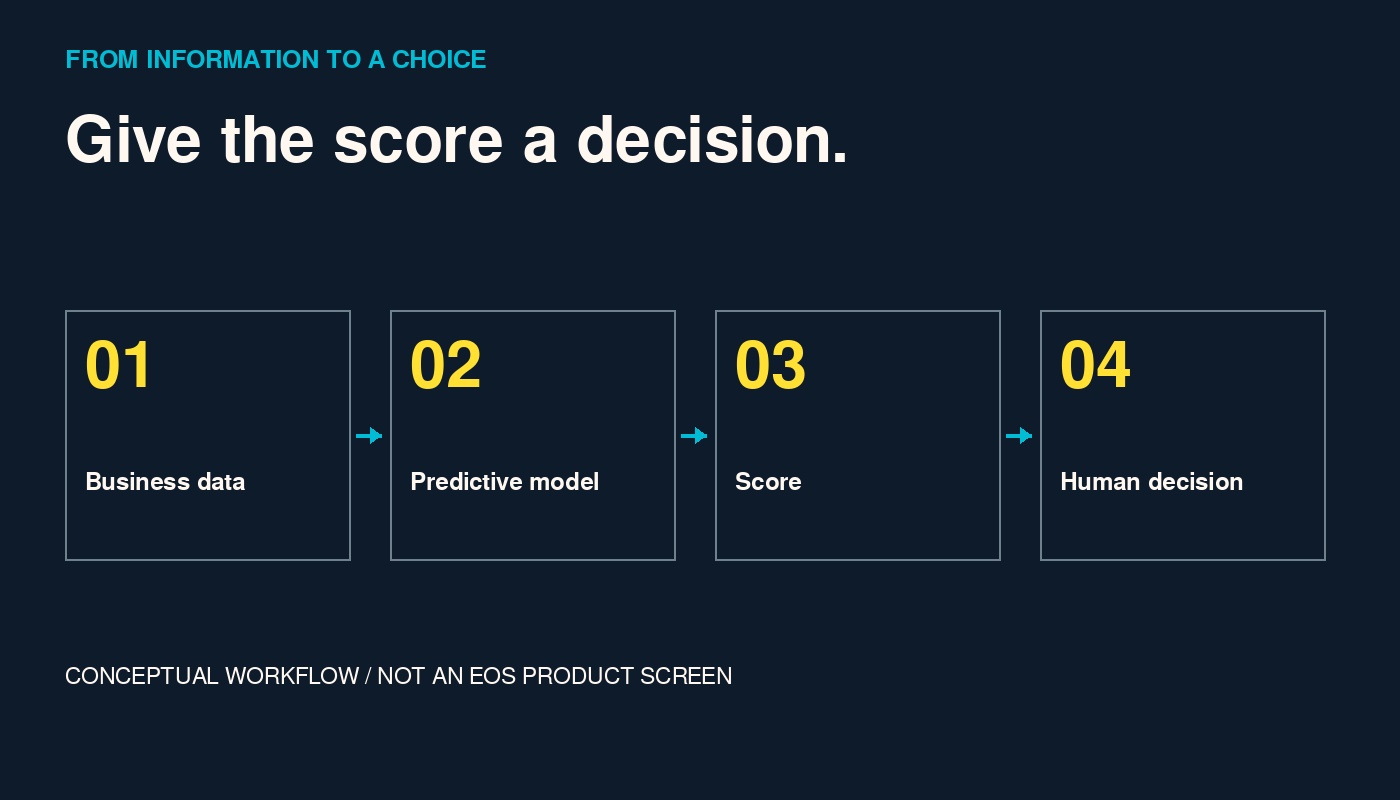
Scoring has a specific meaning in predictive analytics. A model takes information about a new case and produces an output. That output might be a probability, a category or another value useful to the decision at hand. Building the model and applying it are separate activities. IBM's documentation makes this distinction explicit. Think of a recipe and tonight's dinner: having worked out the recipe does not, by itself, put food on the table.
Here is an illustrative retail situation, rather than a reported EOS customer deployment. A business has more customer records than its staff can examine individually. A score could help order the queue for attention. The manager still needs to decide what attention means, how much it costs and whether the resulting action helps. The number earns its place only when it changes a choice that somebody can actually make.
Five industries, one recurring question
Eigenatics named financial services, retail, telecommunications, health care and utilities as industries that could apply predictive analytics with EOS. Read that list carefully. It describes the market the company wanted to address, rather than a roster of named clients. Its breadth is revealing nonetheless. The proposition was organized around a recurring kind of business problem, not a single industry's specialized application.
Consider a hypothetical telecommunications business choosing which accounts to review, or a utility prioritizing cases for investigation. Both may benefit from ranking possibilities when attention is limited. Their data, obligations and definitions of success will differ. A useful score must reflect those differences. This is why the shared word “analytics” tells a buyer less than a precise answer to a smaller question: which decision are we trying to improve?
The company fits most naturally in enterprise decision support. Its public description joins an analytical services proposition to a named scoring platform. That combination suggests a product-and-expertise approach; it does not establish a particular licensing arrangement. Buyers comparing such an offering would reasonably consider established scoring software, including IBM SPSS tools, as well as the option of having an internal analytics team build the workflow.
“Our mission is to make advanced analytical tools part of everyday corporate business decisions.”Eigenatics company description
The economist behind the pitch
Professional directories identify Abhijit Bhattacheryya as Eigenatics' founder and CEO, listing his tenure from October 2009 to October 2014. His earlier career included credit risk roles at HSBC and work at American Express and GE Capital. His LinkedIn profile lists study at the Delhi School of Economics. These are clues to the company's analytical orientation, rather than evidence of any particular EOS algorithm or customer outcome.
The distinction matters. A background in risk analysis makes the emphasis on scoring intelligible: numbers are useful when they help people make repeated decisions under uncertainty. But a founder's résumé cannot stand in for product validation. The sound reading of Eigenatics is therefore quite specific. It offered an approachable route from corporate data toward decisions, with EOS as the named vehicle and analytics as the underlying expertise.
Give the score a decision
The transferable idea is a design brief: start with the decision, then ask what information would improve it. Before choosing any scoring platform, a team could write down the action, the person responsible and the outcome that would count as progress. A score without an owner can become one more column in a spreadsheet. A score linked to a clear action has something testable to contribute.
Cost belongs in that same brief. For a prospective analytics project, the relevant calculation includes preparing data, fitting the result into work, reviewing recommendations and maintaining the model. This is a framework for evaluating the category, not a statement of EOS pricing. An apparently useful prediction can still be a poor investment if acting on it costs more than the improvement it produces.
There is also a practical limit to the promise. Google's production machine learning guidance describes problems such as label leakage, differences between training and live data, and models aging as conditions change. Those are general deployment risks, not reported Eigenatics failures. They explain why ease of use must be accompanied by continued checking. A clear screen cannot rescue an answer built from information that will not exist when the decision arrives.
For a buyer, the useful demonstration would follow one case all the way through: available inputs, resulting score, proposed action and eventual outcome. That exercise would reveal more than a screen full of predictions. It asks whether the product belongs inside a real working day.
Eigenatics' proposition is memorable because it puts the destination in the mission: everyday corporate decisions. For anyone building analytical products, that is a useful constraint. Make the output understandable, give it an action and check what happens afterward. The most consequential part of a scoring system may be the moment a person decides whether its answer deserves to change the next move.