- ECL lends roughly $100,000 to $5 million to post-revenue B2B SaaS and AI companies, often against up to 60% of annual recurring revenue.
- Its niche is cross-border underwriting: one operating business may span U.S., Indian and Singaporean entities and borrow in USD, INR or SGD.
- The company publishes typical annual fees of about 10-12%. It takes no equity, warrants or board seat.
- The model fits predictable revenue and a measurable use for the money. It fits volatile sales, thin margins and emergency borrowing much less neatly.
Imagine a perfectly ordinary software company with a peculiar-looking passport. Its customers pay dollars into a U.S. account. Its engineers draw salaries in rupees. A Singapore entity signs regional contracts. The founder sees one business. A conventional lender may see three partial businesses, none quite complete enough to love.
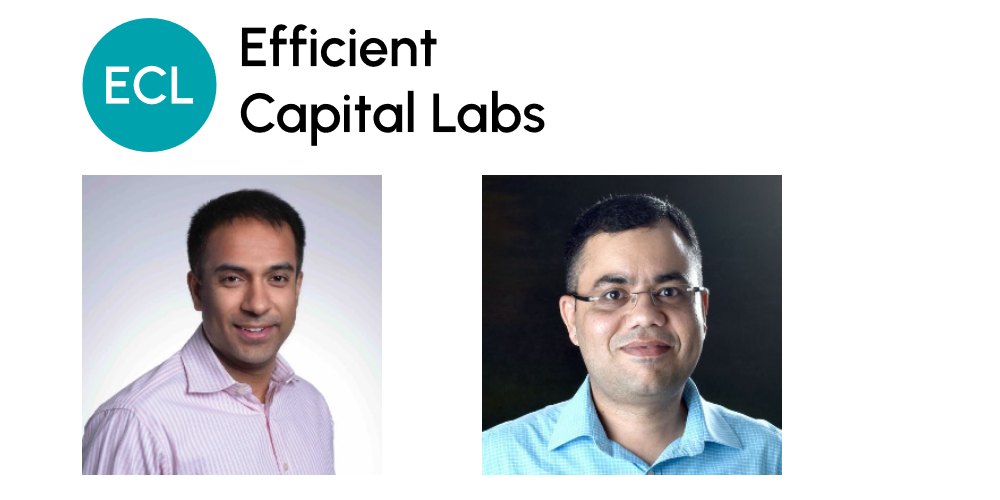
This is the small bureaucratic absurdity on which Efficient Capital Labs has built a company. Founded in New York in 2022 by longtime risk executive Kaustav Das and B2B software operator Manish Arora, ECL makes non-dilutive loans and merchant cash advances to recurring-revenue companies. The headline offer is quick: apply in minutes, connect financial data, get an offer in about three days if eligible, and borrow between $100,000 and $5 million without surrendering shares.
The deeper offer is translation. ECL tries to read the American parent, the Indian operation and the Singapore revenue as parts of the same machine. That sounds obvious. In lending infrastructure, obvious can be a product.
The border was the bug
Das spent more than two decades in commercial and consumer risk, including at Kabbage and American Express. The idea sharpened after the chief executive of another revenue-based financing company asked him to advise. Das delayed, watched the category grow, visited India and decided that Indian founders selling into the United States were being charged for geography as much as risk.
ECL's first principle followed: underwrite the global organization, not a pile of local fragments. In 2024, Das offered a clean example. A SaaS company might earn $2 million in America, $2 million in India and $1 million in Singapore. A U.S.-centric lender could still size it as a $2 million company because its APIs and risk rules could not see the other $3 million. ECL connects to local financial systems and performs a combined assessment.
“Our North Star is to bridge the cost of capital gap across different geographies.”Kaustav Das, co-founder and CEO
That difference matters most to a narrow customer: a post-revenue B2B SaaS or AI company, generally above $500,000 in annual recurring revenue, with predictable collections and operations linked to the U.S., India or Singapore. ECL says its customers now operate across 20 countries. It reports more than $200 million deployed to over 250 companies, with 80% returning for repeat financing.
What failed first
For customers, it was often the bank conversation. Discover Dollar sells AI software that finds procurement leakage for large enterprises. Its problem was not demand but time: Fortune 500 receivables take a while to arrive. Founder Subu R. said the company went to banks for working capital and disliked the available offers. After meeting Arora, Discover Dollar shared data with ECL; the review and funding, he said, took a couple of days. The thing that changed his mind was not a new theory of finance. It was pace attached to a structure that matched recurring revenue.
Then ECL encountered its own version of the same problem. Cross-border diligence generated paperwork on an industrial scale. A typical application could include more than 120 bank-statement PDFs across ten accounts, plus tax returns, contracts, KYC records and financial statements in several national formats. According to a technical case study by ECL's partner a21.ai, skilled underwriters were spending more than 80% of their time collecting, classifying and validating documents. Existing data connections covered only about one-fifth of cases. The rest arrived as stubborn, unstructured files.
The response was Nanodoc, an agentic document workflow built with a21.ai on AWS, and AURA, ECL's broader decisioning layer. The system classifies files, extracts transactions, checks its own work and turns incompatible records into structured inputs. The implementation report claims bank-transaction extraction accuracy around 96.7%, a five-to-tenfold lift in underwriter throughput and a reduction from days of extraction to hours. AURA does not make the final decision alone. ECL says it organizes evidence and explains the drivers; people remain in the loop.
The price of keeping the cap table quiet
Non-dilutive is a wonderfully soothing adjective. It does not mean free. ECL's current materials put typical pricing around 10-12% in annual fees, paid monthly with principal, with the exact rate shaped by growth, revenue stability and risk. Older reporting described a 10-13% fee range. The company may advance up to 60% of ARR, usually in tranches.
ECL's published typical annual-fee range. The useful comparison is not “free equity” versus “expensive debt.” It is the certain repayment burden versus the uncertain future value of ownership you would otherwise sell.
The business model is straightforward. ECL lends from its balance sheet and related debt facilities, then earns the contracted fee as borrowers repay. Equity investors financed the platform: a $3.5 million seed round, a $7 million pre-Series A and an $11 million Series A co-led by QED Investors and 645 Ventures in 2024. Debt facilities supplied the money to lend, growing from $15 million in 2022 to a reported $150 million in 2025.
This places ECL between several familiar doors. It competes with SaaS lenders such as Capchase, Pipe, Lighter Capital and Founderpath; with venture debt and receivables finance; and, indirectly, with venture capital itself. Its distinction is neither debt nor speed alone. It is the combination of direct lending, multi-currency funding and an underwriting model designed for businesses whose legal map is messier than their product.
The part worth copying
A founder cannot copy ECL's balance sheet. The transferable lesson is its way of assigning money to uncertainty. Use equity for the experiment whose outcome cannot yet be forecast. Use debt for the repeatable motion: hiring salespeople against proven conversion, bridging a signed enterprise receivable, expanding a product line with visible demand, or buying runway before a milestone that the current engine can plausibly reach.
The other useful habit is to arrange debt while the company is healthy. ECL generally wants predictable revenue and about three months or more of runway. That is not lender fussiness; it is the central paradox of borrowing. Capital is most available when it is optional, and most dangerous when desperation has already removed every option.
When the machine fits
- Recurring revenue is stable
- The use of funds has a visible payback
- Gross margins can absorb repayment
- Ownership is strategically valuable
When it fights the business
- Revenue is pre-launch or volatile
- Cash is covering an unresolved leak
- Margins are thin or collections uncertain
- The bet may take years to pay back
Under those second conditions, the same fixed payment that preserves ownership can shorten runway. A startup with shrinking revenue does not need a faster obligation. It may need cheaper bank credit, patient equity, customer prepayments, a smaller plan or no new capital at all. The elegance of revenue-based finance depends on the quality of the revenue beneath it.
ECL is now stretching beyond the loan. ECL Flex combines capital management, cross-border payments and financial insight for existing customers. Partner benefits add software and professional-service discounts. The ambition is to become the financial dashboard for globally distributed startups, not merely the emergency fuel stop.
There is a pleasing contradiction in the brand. ECL calls its team a pit crew, talks about acceleration and signs off with “Fuel Without Friction.” Das once admitted that after 19 years in the United States he still had no driver's license. Perhaps that is appropriate. The company's real subject was never driving. It was learning how to see the whole vehicle when the paperwork insists on showing you three unrelated boxes of parts.