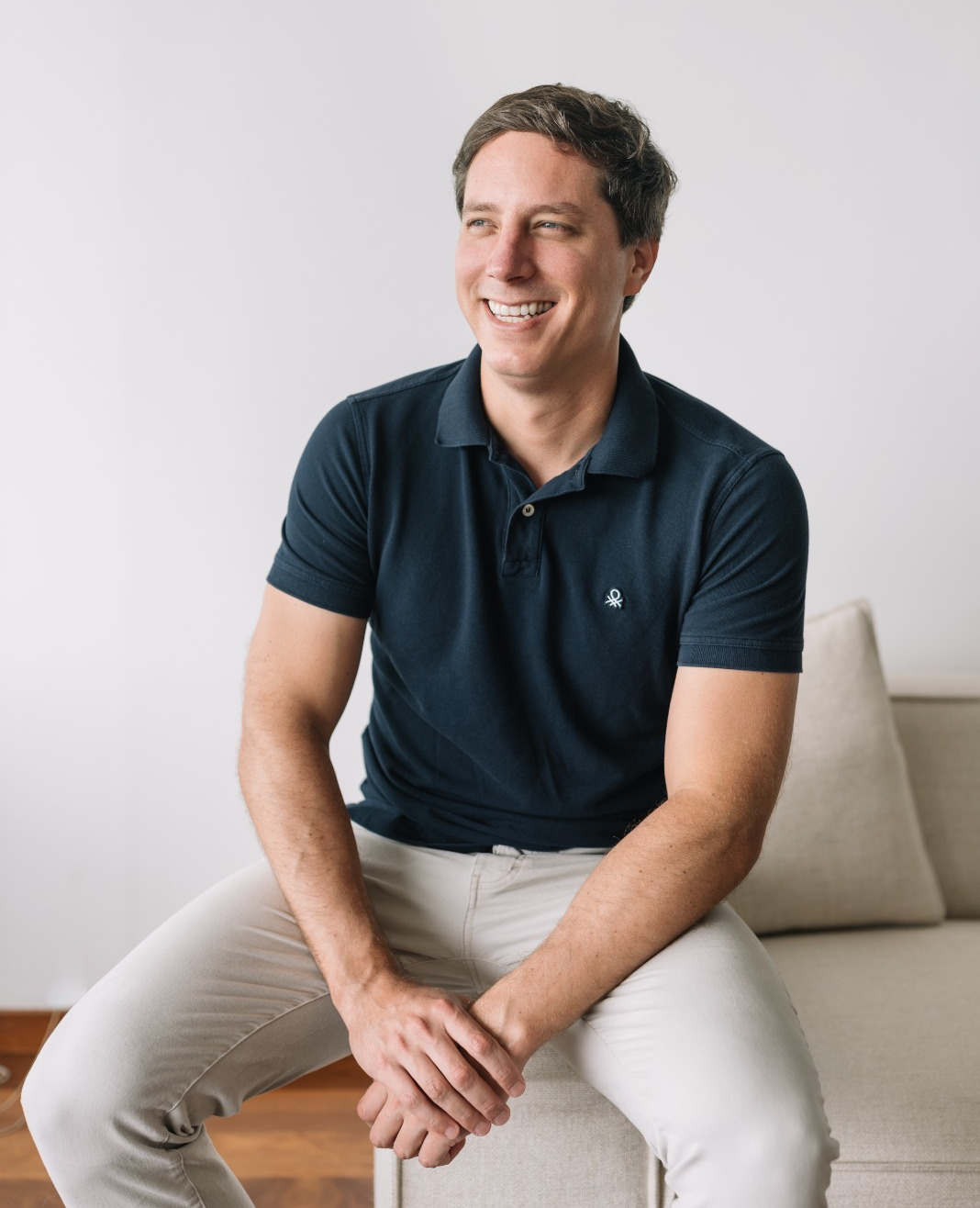
The Tesla He Couldn't Buy
The year was 2011. Elon Musk's car company was public, the share price sat around $12, and Dusko Kelez - an economist in Lima, Peru - was convinced it was worth buying. He opened Robinhood. Then E*TRADE. Then every other platform he could find. None of them would let him in. Wrong country. Wrong documentation. Wrong everything.
That rejection didn't sting like a door slamming. It stuck like a splinter. Kelez filed it away and moved on - through PwC's tax practice, through private equity at Nexus Group, through a fashion brand called DUKE that he later described as "nearly ruinous," through the controlled chaos of running operations for Taximo in Colombia. But the splinter remained.
Then came Grin Scooters. As COO, Kelez managed 2,100 people across seven Latin American countries, zigzagging between capital cities, watching the same story repeat itself: bright, financially curious people who could name the S&P 500 constituents but had no mechanism to own any of them. High commissions. Staggering paperwork. Platforms designed for users in zip codes they didn't live in.
The complexity of entering U.S. stock markets is gone. We built Hapi so that investing in the world's most liquid exchange is as simple as ordering a coffee.- Dusko Kelez, Founder & CEO, Hapi App
In 2020, he called two software engineers - Piero Sifuentes, who had shipped code at Rappi and BBVA, and Billy Caballero - and told them they were going to build the thing he had wanted a decade ago. Not a copy of Robinhood. Something purpose-built for the 600 million people in Latin America who didn't have a Robinhood.
Building the Plumbing First
Most consumer app founders start with the app. Kelez started with the license. Getting an SEC-registered broker-dealer designation is the part of fintech that doesn't make it onto pitch decks - the legal filings, the compliance infrastructure, the FINRA membership, the SIPC insurance coverage up to $500,000 that actually protects client assets. Hapi spent two years becoming a real brokerage before it became a slick mobile experience.
That sequence matters. When Hapi's users in Venezuela, Colombia, or Argentina send money into the platform, it lands inside a structure built to the same regulatory standards as a U.S. brokerage. Not a workaround. Not a gray zone. A licensed broker-dealer under Hapi Securities, LLC.
Latin American investors have been burned before - platforms that vanished, fees that multiplied, protections that existed only in the fine print. Kelez bet that trust would be a competitive advantage. He was right. "We're proud of our strict procedures and regulatory compliance, giving our clients peace of mind."
Y Combinator accepted Hapi into the Winter 2021 batch. The $125,000 check was less valuable than the signal: one of the world's most respected startup filters had looked at a Latin American fintech and said yes. After YC, Hapi raised a $2.5M round, then a $1.6M seed in November 2023 led by Utec Ventures, alongside Unpopular Ventures, Softeq Ventures, and Mural Capital. Total raised: $4.3M.
The Number on the NASDAQ Tower
In the summer of 2024, Hapi crossed 500,000 users. Kelez marked the occasion by putting the milestone up on the NASDAQ tower in Times Square - the symbolic heart of the market that once refused to take his money.
The symbolism was deliberate. This was a platform built for people who had been told, in a thousand small ways, that markets like this weren't for them. Seeing it on a screen in Manhattan - that had a specific gravity.
The platform now processes 15,000 to 20,000 daily transactions. Users have collectively executed over $2 trillion in total transaction volume. The average investment ticket sits at $250. Seventy percent of the user base comes from seven core markets: Chile, Argentina, Colombia, Mexico, Ecuador, Venezuela, and Peru.
What He's Building Next
The roadmap Kelez describes has two sharp edges. The first is a portfolio-matching tool that would let users mirror the holdings of investors like Warren Buffett and Bill Gates - turning financial wisdom that used to require a private banker into something accessible from a phone in Bogota. The second is a credit product: U.S.-rate loans backed by assets held on Hapi.
Neither is incremental. Both assume that Latin American retail investors deserve the same financial infrastructure as their counterparts in New York. Kelez doesn't frame this as charity. He frames it as an obvious market opportunity that everyone else missed.
If you have a project in mind, simply do it. Don't overthink execution. The complexity only looks real until you start.- Dusko Kelez
The Man Behind the Ticker
Kelez graduated from Universidad del Pacifico in Lima with a degree in Economics, specializing in Regulation and Public Policy. He later did continuing studies in Computer Science for business professionals at Harvard. The combination - economics, regulation, technology - maps almost exactly onto the problems Hapi had to solve.
He's a long-term investor by practice, not just philosophy. He bought Tesla at $12 in 2011 and held. He identifies trends early and conducts personal research before entering a position. His advice to investors echoes his own track record: look for structural shifts, ignore short-term noise, and don't let geography determine your options.
The ambition now is 1 million users. After that, the full financial stack - investing, credit, education, and eventually whatever the next structural shift looks like. Kelez has a habit of spotting those early. The splinter in his memory since 2011 has, at this point, generated half a million accounts and counting.