In Detroit in 2016, the future of Duránd F. Davis Jr.'s company had to fit inside a car ride. UberPITCH offered founders ten minutes with an investor, a brisk little theatre in which optimism wore a seat belt. Davis arrived with LavLabs, a three-person consumer internet company, and a music service called iLodRadio that was still in production. He wanted money to hire engineers. He explained a feature that would let listeners mark a place with a song: a “hear-in” instead of a check-in. The phrase was a touch corny, which is often the price of trying to name a habit before it exists. It also revealed the idea that would keep returning in his work. Technology, for Davis, should make taste social.
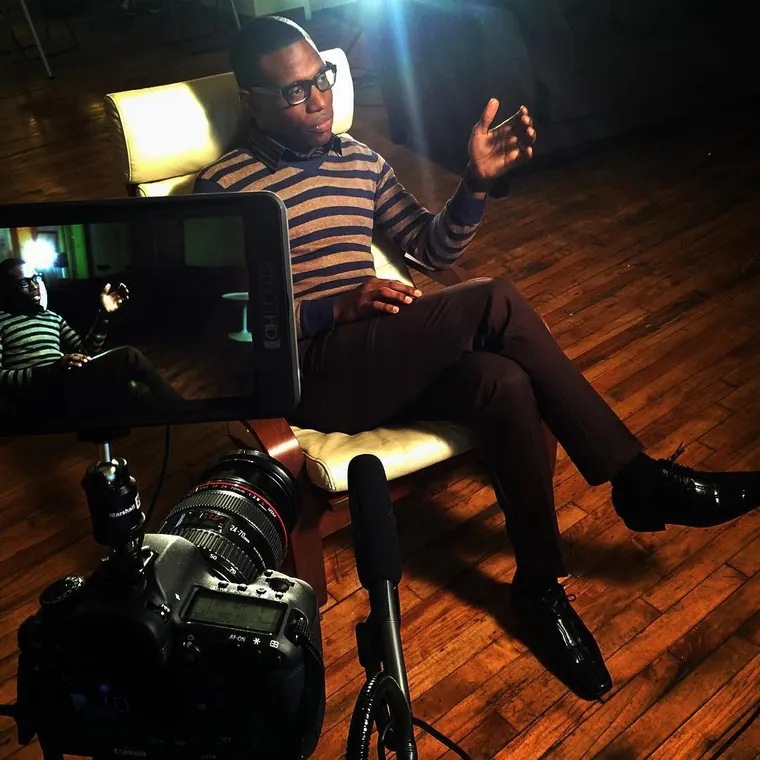
He was 29, a music-scene regular who said he had started playing drums at six, DJing at nine and working in Los Angeles at 19. The biography matters because it supplies a better key to Davis than the imposing corporate vocabulary that surrounds him now. He thinks like someone accustomed to arranging a room. A DJ rarely creates every sound being played. The craft lies in choosing, sequencing and moving between distinct parts without emptying the dance floor. Davis's current company, Labs, proposes much the same trick at institutional scale.
Track oneA founder learns to hear the room
LavLabs had been founded in 2013. Its proposed flagship was a pay-as-you-play music platform with social video and location features, plus streaming products for businesses. At Detroit Startup Week, Davis made an argument larger than his app. He wanted local software engineers to have a reason to stay rather than leave for Silicon Valley. It was an unvarnished founder moment: the product was unfinished, the team could fit around a café table, and the civic ambition had already outrun both.
The company did not become a familiar consumer music brand. Davis kept revising the frame. LavLabs evolved from music venture into startup studio, then became one piece inside a new parent company. In the official telling, the pandemic years prompted Davis and his wife, Maya Elz Davis, to rethink the organization around specialized laboratories rather than a parade of unrelated products. Maya brought her own background in food, fashion, product creation and design. Their shared life became part of the operating premise: two creative disciplines, one family, one increasingly elaborate company.
“I was always in the music industry... started playing drums at 6, DJing at 9.”Duránd F. Davis Jr., 2016
There is a neat temptation to treat the musician chapter as charming prelude and the technology chapter as serious adulthood. Davis does not make that separation. He still records and performs as DJ DEVO. Labs describes both founders as coders, designers and builders whose artistic lives shape the work. The vocabulary moved from songs to systems, but the concern with experience remained. iLodRadio asked what a place might sound like. Yuhmmy, the consumer app now associated with Labs, asks what a community might taste like.
LavLabs begins in Detroit with music technology at the center.
A three-person team pitches iLodRadio and argues for keeping engineers in the city.
Duránd and Maya revisit the company as a family of specialized labs.
Labs Companies launches in its current form with LavLabs inside it.
The public architecture expands through product, research and infrastructure previews.
The arrangementSeven rooms, one mixing desk
Labs Companies formally appeared in its current form in 2025. Davis serves as founder, executive chairman and chief executive; Maya is co-founder, executive vice chairwoman, president and chief ecosystem strategy officer. The founders hold majority economic interest and governance control. Beneath the parent sits a set of seven “Core Labs” spanning artificial intelligence, spatial computing, distributed systems, financial technology, scientific research, consumer experiences and physical systems. Additional groups cover investment, media, entertainment, real estate and other functions.
On paper, it is wide enough to make a conglomerate feel underdressed. The company calls the design a multilab structure and argues that the parts should compound one another: a model developed in one lab can support a product in another; a consumer experience can generate questions for research; capital and media groups can support the technical work. The distinction is important because much of the public map includes work in research, preview or planning stages. Labs itself acknowledges that its roadmap is not all commercially available and that several initiatives remain early.
The financing record supplies firmer coordinates. Two federal Form D notices signed by Davis reported $22.5 million and $35 million sold in exempt offerings during 2025, an aggregate $57.5 million. A further filing in September 2026 reported $1.5 million sold toward a much larger proposed offering. These notices establish that transactions were reported and identify Davis's executive role. They do not, by themselves, validate every valuation, product forecast or claim wrapped around the company. In a story crowded with horizons, this is the useful discipline of the ledger: it tells us which numbers have arrived and which remain scenery.
The public record, from concrete to prospective
The duetA company built inside a partnership
Davis's central professional connection is also his partner in life. He and Maya are spouses, co-founders and parents of nine children. Their 2025 introduction to Labs presented the company as something built with the next generation in view. The family language is neither incidental nor merely sentimental. It appears in the ownership structure, in the couple's shared authorship and in a stated preference for long-term founder control.
Their complementary biographies give the business its clearest product idea. Davis came through music; Maya through food and design. Yuhmmy joins those sensibilities around “social taste,” a category the company uses for conversations and recommendations organized around food, flavor and preference. The details have changed across announcements, and the rollout has taken longer than early dates suggested. Yet the lineage is easy to follow. A man who once proposed letting people “hear-in” to a location now wants software to understand what they crave. The medium changes; the social ritual stays.
That partnership also softens the usual founder mythology. Davis's public story is not a solitary genius fable. The current architecture is explicitly co-designed, and the company speaks in the plural. Even the essay that best captures its aspiration, “Humane Superintelligence,” is co-authored by Maya and Duránd. It argues that powerful AI should preserve dignity and human agency, placing governance within the system rather than adding it later like an apologetic sticker.
“The future of intelligence should advance civilization without diminishing it.”Maya and Duránd Davis, 2026
What comes nextThe set is larger than the stage
By September 2026, Labs was publishing a steady run of announcements: a voice-to-video AI research preview, an Impact hub, a foundation, an events arm, a physical-intelligence lab and a proposed computing campus. Davis's appetite for architecture has not diminished. If anything, every new box on the diagram seems to produce two more. Corporate minimalists may wish to avert their eyes.
Breadth is both the signature and the wager. A single-product startup enjoys the mercy of a simple question: does the thing work? Labs invites a more difficult examination. Can a small, centralized leadership team turn a field of research ideas, products, funds and institutions into an operating whole? Can a company pursue several frontiers without treating focus as an antique? Davis's answer is the design itself. He believes orchestration is a capability, not overhead.
The clearest evidence for that belief is not yet a mass-market product. It is endurance. The 2016 pitch did not vanish; its components were rearranged. Music became experience design. The Detroit talent argument became a company culture pitch. The tiny LavLabs team became an origin point for a broader structure. Davis kept the old record in the crate and found somewhere else to mix it.
His aspiration is easy to state and hard to grade: build advanced technology that expands what people can do without making people secondary to it. The phrase “human enhancement” can sound clinical, while Davis's route into it has been stubbornly cultural. He starts with the way people listen, eat, gather, choose and make. The charm of that approach is also its test. Humanity is not a vertical. It is an unruly audience with poor timing, contradictory tastes and a habit of leaving before the encore.
Back in Detroit, ten minutes was enough to tell an investor about a music app. A decade later, Davis has built a story that requires a map. The gap between those two scenes is filled with revisions, renamed entities, delayed products, filed financings and a marriage functioning as an executive office. What unites them is not scale. It is sequence. Davis keeps listening for the transition between one idea and the next, convinced the room will hear a single composition. The beat has started. The proof will be whether the parts arrive on time.