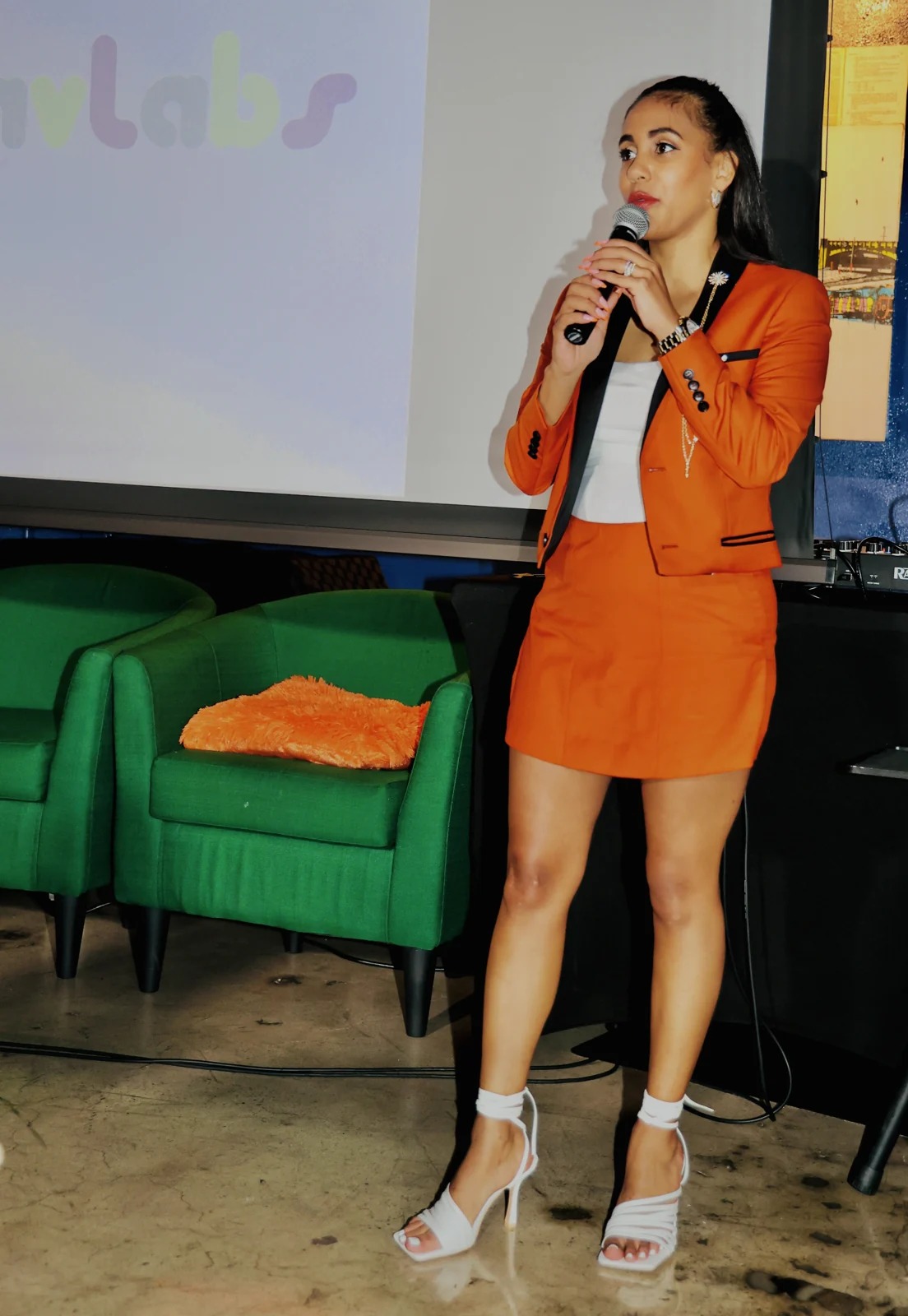
There is a photograph from a Yuhmmy event that explains Maya Elz Davis better than a conventional résumé can. She is standing with a microphone in an orange suit, beside two green chairs, beneath the soft-edged logo of a social-taste app. The room is arranged for a technology conversation. Later, it will become a dining room, and Davis, known in the kitchen as Chef Elz, will help turn the presentation into a meal. Founder, presenter, product designer, professional chef: nobody has been asked to leave a credential at the door.
This is the governing fact of Davis’s work. She does not have several unrelated careers so much as one stubborn objection to professional borders. A computer scientist by training, she managed technology-transformation programs across United States federal agencies through a company called PowerBridge. She moved through private equity and debt funding, built an asset-management group, co-founded a financial-services holding company and, with her husband Duránd F. Davis Jr., constructed the company now called Labs. Along the way came sketching, fashion design, cooking, product work and an idea she calls omnology: the practice of examining knowledge as a connected whole.
Plenty of people describe themselves as multidisciplinary. Davis has arranged her operating life so the disciplines have to sit through the same meetings. At Labs, where she is co-founder, executive vice chairwoman, president and chief ecosystem strategy officer, the connective tissue is literally her brief. She is responsible for how the company’s labs, products and partners meet, and whether those meetings compound into something useful.
“Omnology begins where disciplines end - the study of everything is how we learn what being human can become.”Maya Elzein “Elz” Davis
A career shaped like a web
Davis was born in Washington, D.C., in 1988 and raised in Maryland. She describes herself as American-born Sudanese-Hungarian. Her official biography says her involvement in private equity and debt funding began in her early teens, an unusually early apprenticeship in the machinery of ownership. Her technical career later took her into federal work through PowerBridge, where the task was transformation rather than novelty for novelty’s sake. Government systems are useful teachers. They are full of dependencies, accumulated rules and people who still need the lights to stay on while the future is installed.
That experience offers a practical key to the scale of her current thinking. Davis tends to speak in ecosystems, architectures and pathways. The words can float away in less careful hands. In her case they are rooted in an old operational problem: how to change one part of a system without pretending the other parts do not exist.
PowerBridge manages technology-transformation work across federal agencies.
Davis and Duránd F. Davis Jr. co-found the financial-services holding company MDFG.
Yuhmmy is presented through a founder-funder gathering built around technology, conversation and food.
LavLabs is restructured into Labs Companies, with Davis leading ecosystem strategy.
Labs expands public work in AI, learning, company creation, events and investment infrastructure.
In 2021, Davis and her husband co-founded MDFG, describing it as a multilayer financial-services holding company. They also work together across a group of investment vehicles, including M&D Ventures, Elz Ventures and Davis&Davis Venture Partners. The pair are parents of nine children. Their public posts suggest a household where company architecture and family life do not occupy separate planets. One birthday tribute from Davis began with affection, arguments, laughter and dreams, then opened three new doors into the Labs landscape. It is a love letter with release notes.
Taste is a technology problem, too
Yuhmmy is the most vivid expression of her instinct to connect categories. It is described as a social-taste app, a place for discovery and expression organized around food and drink. That proposition sounds simple until taste is treated as an interface. Taste contains memory, culture, place, chemistry, preference, language and commerce. A sandwich can be lunch, identity and data before anyone has finished chewing.
At the 2024 Taste Flavor Crave Founder-Funder Feast, Davis and her co-founder presented the product, hosted conversations about venture capital and then served a culinary experience curated by Chef Elz. The event did not merely market an app about taste. It let taste do the explaining. This is Davis’s creative side operating as a product method: make the abstract encounter a body, a room and a mood.
Her other creative practices fit the same pattern. Sketching trains the eye to find structure before detail. Fashion makes identity physical. Cooking turns systems thinking into timing, sequence and sensation, with nowhere to hide a bad result. Each discipline gives Davis another language for product design. The charm of the Yuhmmy gathering was that the languages became mutually intelligible for an evening.
The company as a floor plan
Labs is harder to fit on a menu. The company presents seven core labs spanning forms of intelligence, spatial computing, distributed systems, financial technologies, science, experience and physical technology. Around them sits a widening collection of products, research programs, media projects, educational work, events and planned investment vehicles. Davis once teased readers to keep up with the floor plan, calling its organizational chart a “modest little” one. The joke lands because modesty is not the diagram’s most conspicuous feature.
Most startup advice begins with a wedge: make one thing, earn a market, expand later. Davis has publicly explained that Labs reversed that sequence. Its founders designed the architecture first and are now trying to scale through it. The choice makes ecosystem strategy unusually consequential. A narrow startup can survive with a few excellent corridors. Labs is proposing a building in which every corridor is supposed to lead somewhere.
strategy
The wager is interesting precisely because it is unfinished. Several Labs projects and publications are announced or forthcoming. Its investment group has discussed future funds rather than completed raises. Its podcast slate is waiting to be heard. Davis is candid enough to say, “For now, we’re still a startup.” A large map does not shorten the road; often it reveals several more roads than expected.
Her role is to keep breadth from becoming sprawl. The company’s public language imagines products, partners and labs reinforcing one another. In practice, that means deciding which connections deserve resources and which are merely attractive lines on a slide. Ecosystems are fashionable because they promise abundance. They are difficult because every new organism also needs feeding.
Who keeps the memory?
One of Davis’s sharper recent ideas is much smaller than the full Labs blueprint. She calls it Model-Origin, User-Custodied Memory, abbreviated MUM. The premise begins with a familiar AI problem. A person builds context with one model over weeks or months: assumptions, corrections, unfinished arguments, small preferences and a shared line of reasoning. Move to another model and much of that useful history stays behind.
Davis argues for memory formed through conversation with a model but held by the user, who can inspect, correct and carry it elsewhere. She predicts memory will become a keystone product. The significant word is not memory but custody. Her proposal shifts the question from what a model can recall to who controls the interpretation it has assembled.
“My forecast is that MEMORY will become a keystone product.”Maya Elz Davis on user-custodied AI context
MUM also reveals the political thread running through her technology work. Davis often writes about sovereignty: systems able to operate without concentrating all control in a single node, and people able to retain agency inside intelligent infrastructure. Portable context is a neat test of that principle. A user who cannot take a digital history elsewhere may own an account, but the relationship remains rented.
The idea is still a concept, not an established standard. Its value lies partly in how plainly it frames the stakes. AI companies compete on models, features and subscriptions. Davis asks what happens to the accumulated conversation when the customer walks out. The question is practical, commercial and personal at once, which makes it especially characteristic of her.
A steady eye across the whole
Davis’s forthcoming essay series, The Study of Everything, gives her method a grand title. Omnology, as she describes it, refuses to treat any subject as too minor, revered or settled to be re-examined. The danger of studying everything is obvious: everything is a famously generous scope. The useful discipline is relation. A steady eye must do more than gather topics; it must show why their proximity matters.
This is where the orange suit and green chairs return. Davis is at her most legible when the wide theory touches an ordinary scene. A taste app becomes dinner. An ownership principle becomes a memory file a person can carry. A complicated company becomes a floor plan, complete with the implied warning that somebody must still know where the doors lead.
Her career is not a ladder and does not pretend to be one. It is a web whose strength will depend on the quality of its joins. Some strands lead to public-sector technology, some to finance, some to a kitchen, some to AI research and some to projects not yet released. Davis’s ambition is to make the web feel less like a collection and more like an organism. The measure will not be how much fits inside it. The measure will be whether the parts make one another more alive.