Douglas Turner’s sixteen-year-old daughter had a question. Would he regret not running? It was the sort of question a political consultant might spend a meeting carefully approaching. His daughter got there rather faster. Turner later credited her with helping him decide to enter New Mexico’s 2026 race for governor.
By then he had spent decades helping other people make their case. He had worked on winning gubernatorial campaigns, advised politicians overseas and founded Agenda, a strategic communications and public affairs firm with international clients. He could offer an unusually long answer to the question of what qualified him. Voters still had their own question to answer.
In June, they chose Gregg Hull for the Republican nomination. Turner finished second. He subsequently congratulated Hull, accepted the result and wrote about his continuing ambitions for New Mexico. A career in persuasion had produced another encounter with its limits. Knowing how a campaign works does not give anyone ownership of the outcome.
That tension runs through Turner’s working life. Long before he put his own name before voters for a second time, he had gone to Japan to investigate why minority parties lose. The subject has followed him across countries, companies and ballot papers. The interesting part is what he keeps doing with the question.
Before his name was on the ballot
Turner first helped someone else reach the governor’s office. He served as state director for Gary Johnson’s 1994 New Mexico campaign and managed Johnson’s 1998 reelection campaign. He also worked as a general consultant to both administrations. These were practical political jobs, with an election at the end and a government to advise afterward.
His subsequent work included serving as a deputy political director for Steve Forbes’s 2000 presidential bid. His campaign experience extended to congressional and state legislative races. Alongside politics, he built DW Turner, a communications business advising corporate, government and nonprofit clients. Electoral strategy and commercial counsel became neighboring parts of his career.
The education behind that career was international. Turner earned a bachelor’s degree from American University’s School of International Studies and a master’s in international relations through the Centre Européen de Recherches Internationales et Stratégiques, associated with Université Libre de Bruxelles and Université de Paris Sud XI. He had studied institutions before making a business of helping people navigate them.
Japan, and the losing side of the argument
For the 2005-2006 fellowship year, the Council on Foreign Relations sent Turner to Japan as an International Affairs Fellow. His research topic was unusually direct: why minority parties in Japan lose. His host was the office of Diet member Motohisha Furukawa. The question concerned an opposition’s difficulty converting its position into political power.
It is an appealing detail in a consultant’s biography because it begins with failure. Campaign histories tend to arrange themselves around victories. Here was an American political practitioner taking a fellowship to examine the other column. The research topic makes no promise that the answer will be flattering to the people asking it.
During the first six months of 2007, Turner provided campaign and strategic guidance to the Democratic Party of Japan. His writing on Japanese politics appeared in publications including Time, the Financial Times and the Far Eastern Economic Review. The overseas work gave his career a second geography, with a different political system and different audiences to understand.
The connection remains useful for understanding the founder he became. Agenda’s later international work did not begin with an overseas office appearing on a map. Turner already had experience working with political institutions abroad. The biography contains an actual passage between places: New Mexico campaigns, a Japanese parliamentary office, and eventually a communications firm serving clients across borders.
- 1994 / 1998New MexicoGary Johnson’s campaigns
- 2005 / 2006JapanResearch into opposition parties
- 2012AgendaA new public affairs firm
- 2024Taos Ski ValleyElected to village council
Three partners, one Agenda
Agenda announced its formation in July 2012. Turner joined Craig Pattee, formerly president of Dutko Worldwide, and Max Hamel, formerly a partner at Allied Public Affairs. Each brought a different operating background. The founding announcement described a group drawn from both political parties and from corporate public affairs.
The combination matters more than the firm’s name. Pattee brought experience engaging governors on federal issues; Hamel brought experience organizing campaigns across states; Turner brought his state and national political work and the business he had already led. Their new firm offered advocacy built around campaigns, drawing on people who had organized them.
Today Turner is Agenda’s founder and CEO. The company’s services include audience research, communications planning, creative production and stakeholder engagement. Its work spans government and defense, corporate affairs and advocacy. Its own account of how it operates emphasizes access to senior people, including founding partners. For a client, that is a fairly concrete proposition: the experienced people remain reachable.
The geographic center is still New Mexico. Agenda identifies Albuquerque as its headquarters, even as its contracts and assignments reach much farther. Turner’s career has repeatedly combined the local and the international. One address can be in Albuquerque while the institution on the other end of the assignment is an alliance in Europe.
A contract is a different kind of vote
In 2015, Agenda first won a NATO strategic communications framework contract. In 2021, it announced a second five-year agreement. The scope included research and polling, assessment, design, advertising, digital work and stakeholder engagement. Turner described working across the alliance as rewarding for the team, following a lengthy competitive process.
The relationship took another form in May 2026, when Agenda announced a multi-year NATO contract for strategic communications education and training for Ukrainian defense personnel. The program was to take place largely in Ukraine, adapting NATO requirements to Ukrainian operational needs. Agenda’s responsibilities included instructors, materials, logistics and reporting on participants’ performance.
The detail is worth pausing over. Training requires more than delivering a message on someone else’s behalf. It requires explaining a discipline so that another organization can practice it. For Turner’s firm, the assignment extended an established institutional relationship into teaching, with a stated requirement to assess what participants learned.
Other recent business developments include Agenda’s June 2025 OASIS+ award and its September 2026 announcement of a NASA SEWP award. Both concern government procurement. They give federal customers routes to buy services and capabilities; they are not, by themselves, a statement of revenue. In a founder’s career, such agreements are part of the less photogenic work of making a company eligible for its next assignment.
“Working for NATO and across the Alliance has been extremely rewarding for our team.”
Doug Turner · 2021 contract announcement
The workshop next door
Turner’s business interests also have wheels. He is involved in Heritage Driven, the Albuquerque company specializing in importing, restoring and modifying classic Land Rover Defenders. He and Chris Taylor are partners in the property entity associated with that business. Here, the work product can be parked outside.
In January 2022, plans for Agenda and Heritage Driven to move to the 1700 block of Fifth Street NW in Albuquerque’s Wells Park neighborhood came before the city’s development commission. The two businesses pursued facilities in the same area. Communications and vehicle restoration make an unusual pair of neighbors, even when they share business connections.
The Wells Park move brings a useful change of scale to an international résumé. There are buildings to acquire, construction decisions to make and a neighborhood address to establish. A company can advise a large institution overseas and still need to sort out its own premises. The Land Rovers add a pleasantly literal version of building something: at the end, it has to drive.
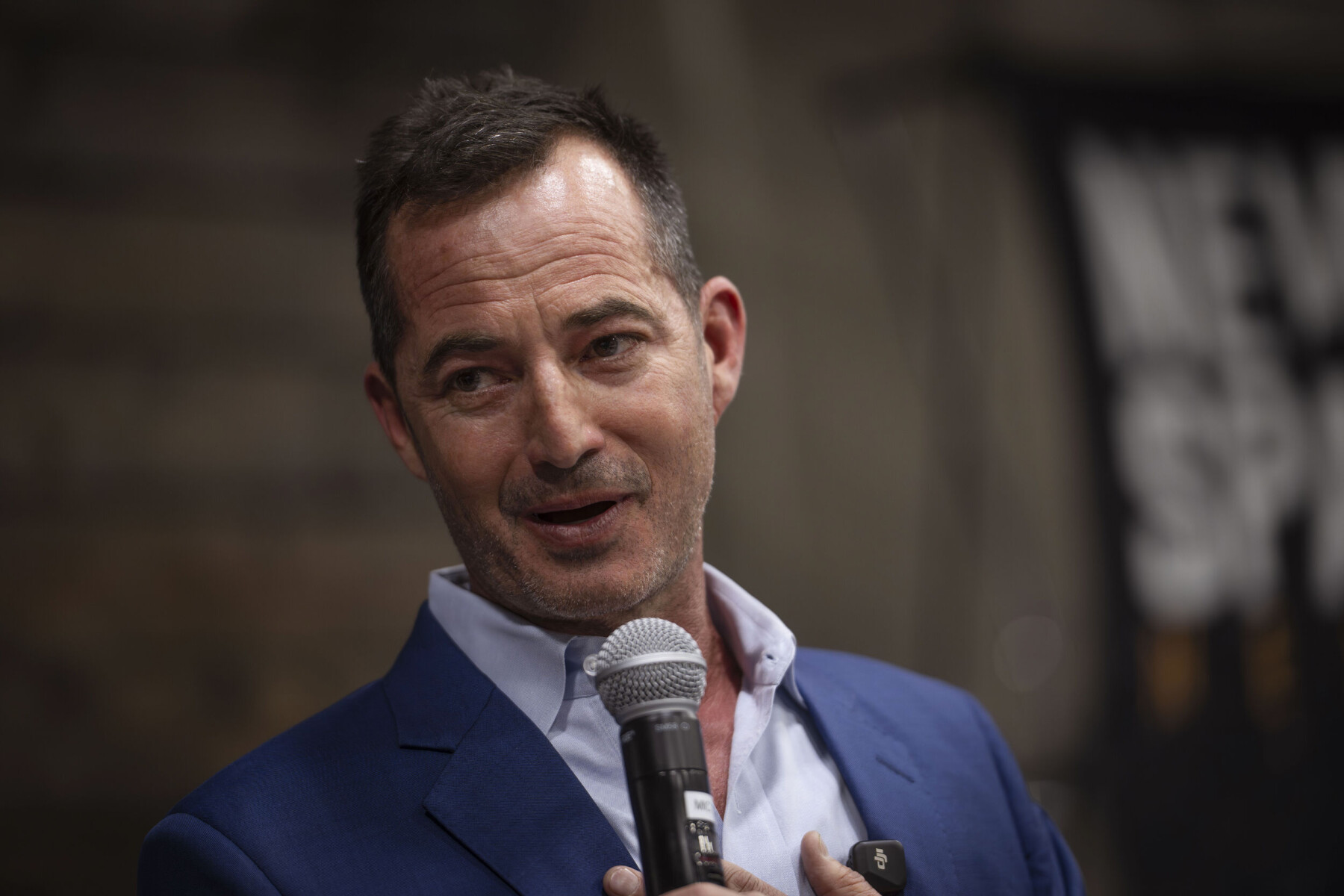
Back on the other side of the microphone
Turner had first sought the Republican nomination for governor in 2010. His return in 2026 came after another public role: election to the Taos Ski Valley village council in 2024. His council term ends in 2028. Local government gives his public career an ongoing setting beyond a statewide campaign.
Education was central to his 2026 pitch. He pointed to years of work on school choice and charter schools, including his service chairing Public Charter Schools of New Mexico. In an interview with New Mexico PBS host Nash Jones, he argued that his professional work on energy, utilities and other public policy questions had prepared him for the governor’s job.
His economic argument was especially revealing of the business owner. Rather than concentrating every hope on attracting a single enormous employer, he described the cumulative effect of smaller firms adding staff. He called large prospective employers “unicorn employers.” He wanted more attention paid to permitting and the everyday difficulties of running a small company.
The electorate did not give him the nomination. Hull won the June primary, while Turner’s support was particularly strong in southeastern counties including Eddy, Lea and Chaves. The distribution was a reminder that a statewide electorate contains several audiences. Turner’s message found voters; another candidate assembled the larger coalition.
Turner’s listed term on the Taos Ski Valley village council ends in 2028.
What he wants to build here
Afterward, Turner’s public response returned to his home state. In a June opinion essay, he imagined a New Mexico where entrepreneurs could grow without feeling they had to leave for Austin or Phoenix, and where children in different communities had access to educational opportunity. He also identified energy, data infrastructure, manufacturing and defense as areas of possibility.
He framed those ambitions as work that should outlast his own candidacy. The daughter’s question also resurfaced in his account of why he ran. The decision had exposed him to a result he could neither script nor negotiate. He wrote that he did not regret taking part. For someone whose profession involves advising others about public judgment, that is a meaningful personal answer.
Turner’s record now holds several kinds of persuasion together: a governor’s successful campaigns, research into opposition parties, a firm’s contracts, a council seat and two unsuccessful bids for a statewide nomination. None cancels the others. They show the different tests facing a person who spends his working life asking institutions and audiences to move.
The next village meeting will have an agenda. So will the next client assignment. The governor’s race has its own result. Turner continues with a company to lead and a council term to serve, carrying a question that has proved portable: what makes people choose, and what do you do after they have?
Follow the work
Explore Agenda, Turner’s LinkedIn, X, Instagram and campaign Facebook page.