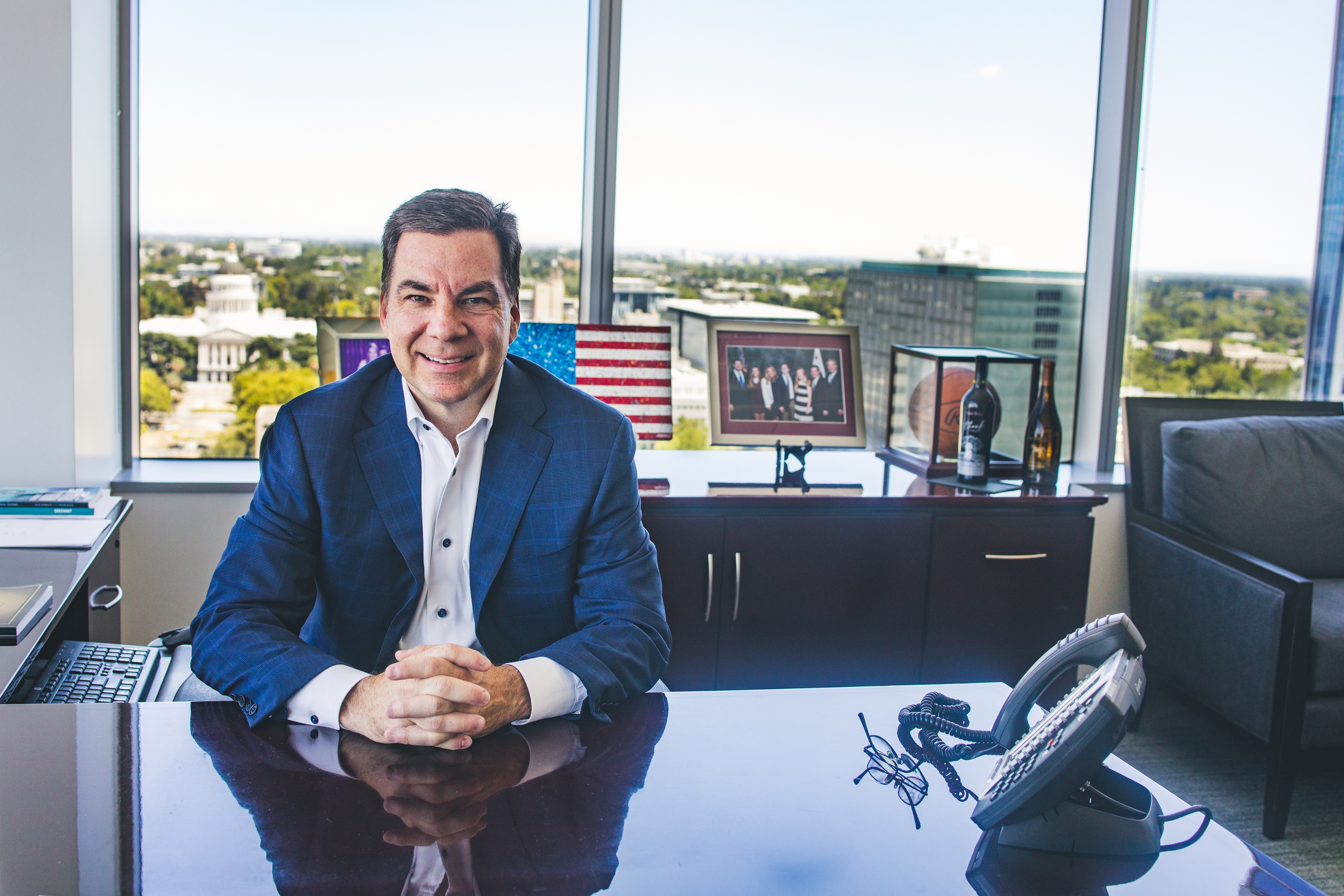
On Tuesdays, Jeff Randle’s staff meeting makes room for the weekend. Family news comes before work priorities. In an occupation devoted to getting to the point, the detour is deliberate. Half an hour for the people, half an hour for the business. A communications firm can hardly object to a little communication.
By 2026, that weekly gathering had been part of Randle Communications for 25 years. Employees now come into the Sacramento office two days a week. Randle has responded by thinking harder about what those days should contain: time together, direct feedback, mentoring, a chance to hear something that would never warrant a calendar invitation.
His career supplies plenty of more conspicuous material. Governors. A recall election. A company with his surname on the door. Yet the Tuesday meeting offers a useful way into the story. Randle has spent decades assembling people around a purpose. Keeping them interested in one another is part of the assignment.
A political education, before the company name
Randle’s roots are in La Mirada, in Los Angeles County. His early political experiences included the 1980 Republican National Convention and an internship with U.S. Senator Pete Wilson. The public career that followed grew out of those encounters with the machinery behind political life.
There is a particular education available in a campaign or a senator’s office. A message must reach a person with a reason to care. Enthusiasm needs an organization. Somebody has to follow up. The glamorous portion tends to be photographed; the follow-up usually has to settle for a working telephone.
Randle graduated from UCLA and went on to serve as Wilson’s deputy chief of staff during his governorship, from 1991 to 1998. His responsibilities included politics, communications and coalition building in support of the governor’s agenda. That combination would remain recognizable in his subsequent work.
Government also gave him relationships that lasted beyond a single officeholder’s term. His connection to Wilson became part of a longer California Republican career, with later assignments involving Arnold Schwarzenegger and Meg Whitman. His working world crossed the boundaries between governing, campaigning and advising organizations that wanted to be heard.
Deputy chief of staff to Pete Wilson.
Co-founds Randle Communications with Mitch Zak.
Political director for Arnold Schwarzenegger.
Continues as founder and CEO.
A launch date with unfortunate timing
Before launching the firm, Randle worked at Stoorza Communications. He and Mitch Zak started their own public relations and public affairs business in 2001. The company opened in August. The September 11 attacks followed little more than a month later, confronting the new venture with national upheaval almost immediately.
The founders were learning how to run a business while trying to keep one moving. They drew advice from Inc. magazine and lessons from earlier jobs. It is an endearingly practical detail: people who advise other people still need advice, sometimes delivered through a magazine subscription.
At the firm’s twentieth anniversary in 2021, the business had about two dozen employees and reported a revenue high of $6 million during the preceding period. Those numbers belong to that anniversary, rather than serving as a claim about today’s head count or income. They do show that the precarious opening had become a continuing enterprise.
Randle also found a management reference point in Jim Collins’ Good to Great. The emphasis on assembling a capable team gave him a way to think about the organization taking shape around him. A founder can sell his own experience. Building a firm requires other people to develop experience worth selling, too.
When the candidate was Arnold
Two years into the company’s life, Randle became political director of Schwarzenegger’s successful 2003 recall campaign. The assignment placed a young firm’s founder inside an election that was unusually difficult to compare with any ordinary campaign calendar.
Schwarzenegger’s celebrity supplied attention. A political operation still needed building. Randle worked on the coalition behind the candidacy, a job that connected the spectacle visible to voters with the organizations and relationships required to support it.
The association continued after election night. Randle served as a senior political adviser during Schwarzenegger’s first term and as a senior consultant for his 2006 reelection campaign. His work therefore extended beyond the singular circumstances of the recall into the more sustained business of supporting an incumbent governor.
He also advised Whitman’s unsuccessful 2010 gubernatorial bid. That result belongs in the account alongside the wins. A political résumé becomes more informative when it includes the occasions on which a considerable effort failed to produce the desired vote.
In 2026, he was still being invited to discuss campaigns, endorsements and the changing media landscape. Experience in this field has a curious shelf life: an old campaign can illuminate a new one, provided its veteran remembers that the audience and the channels have moved.
Letting other people lead
One concrete test of Randle’s team philosophy arrived in March 2023. Julie Phillips became president and partner, while Randle remained CEO. Phillips had spent 11 years at the firm. Her expanded responsibilities included agency operations and a larger strategic role with major clients.
The promotion accompanied a broader expansion of the leadership team. Lindsey Goodwin, Erin Dunlay and Nanette Farag moved into senior vice president roles across public affairs, public relations and political affairs. The structure gave more of the firm’s work an identifiable leader beyond its founder.
Phillips had joined in 2012 and helped build its digital public affairs practice. She created and launched the Digital Influencer Report in 2018. The distinction matters in a profile bearing Randle’s name: the company’s development includes work conceived and led by colleagues.
Today’s team brings together communications specialists, digital strategists, creative staff and former journalists. Its range makes the founder’s role more interesting than the lone expert image a surname can suggest. He is responsible for an organization whose capabilities extend across several kinds of work, and whose continued development depends on people having room to exercise judgment.
“Culture is a big investment in time, yet the dividends are priceless.”
Jeff Randle, 2021
The meeting is part of the work
Randle has argued that workplace culture needs daily attention. In his 2021 writing on the subject, he emphasized hiring people who put the group first, showing employees where the organization is going, and giving team members at different levels opportunities to lead.
There is some useful impatience in that position. A retreat or a mission statement can make an organization sound coherent for an afternoon. Daily decisions have a much longer speaking engagement. Who gets responsibility? Who receives feedback? Who is allowed to contribute before acquiring an imposing title?
At the Fair Oaks Boulevard office, the formal conference room has become a more relaxed meeting space with deep sofas. Monthly learning lunches and mentoring sessions supply other reasons to gather. The furniture is a small change; the allocation of time is the more revealing one.
In 2026, the company again received a Sacramento Business Journal Best Places to Work recognition. The assessment used confidential employee feedback covering leadership trust, communication, engagement and culture. For a founder who repeatedly talks about the team, an employee survey offers a particularly relevant audience response.
An hour designed to keep colleagues acquainted as well as informed.
The audience has moved
Randle’s firm now combines public affairs and public relations with digital content and creative production. Its in-house capabilities include video. The practical consequence is a wider assignment: organizations need material they can publish and distribute themselves, alongside coverage they hope someone else will produce.
Phillips’ digital program illustrates that expansion. So does the company’s work with the California Association of Realtors on Homeownership Matters, which brought a housing message into the 2026 gubernatorial conversation through advertising, a website, media activity and a candidate forum.
The forum put candidates in a setting where they could state their positions publicly. That is a familiar political skill applied to an association’s objective: create an occasion, bring the relevant people together, and give an issue a place on the agenda. The event and its distribution belong to the same communications effort.
Another assignment, welcoming the Athletics to West Sacramento, required a different emphasis. The city needed to express its own identity amid attention surrounding the team’s arrival. Randle Communications worked with the city on the Welcome to West Sac message, using event production, media relations, design and video.
The two projects reveal a continuing concern with the setting around a message. A candidate forum and a baseball press event call for different arrangements. In each, the organization paying for the work needs a clear role in a crowded conversation.
Still taking the call
Randle’s personal routine has its own mixture of speed and habit. In 2022, he described checking messages early, reading widely across political and general news, and commuting to country music. His preferred task system was a pen and notebook. Some technology earns its longevity by requiring very little explanation.
At home, he and Kellie share a UCLA connection. He follows the Angels and UCLA basketball, and makes an effort to keep up with their three adult children. These details put the campaign veteran back into ordinary time: a game, a conversation, another item to cross off tomorrow.
His public conversations continue. A May 2026 interview explored modern campaigns as the company marked its twenty-fifth year. In July, he joined Assemblyman Josh Hoover to discuss the primary election, the top-two system and independent redistricting, alongside memories of Schwarzenegger’s race.
The subjects have changed since his first encounters with politics. So have the tools available to explain them. The Tuesday meeting survives all of that. Before asking a group to carry the next message, Randle leaves a little time to hear how everybody’s weekend went.
Keep the conversation going
- THE FIRMJeff Randle’s official biography ↗
- FOLLOWJeff Randle on X ↗
- LISTEN · MAY 2026Modern campaigns and 25 years of Randle Communications ↗
- LISTEN · JULY 2026Point of Order: California’s primary and election reforms ↗
- IN HIS OWN WORDS · 2021Why Workplace Culture Matters ↗
- THE WORKDAY · 2022The Way We Work: Jeff Randle ↗
- THE OFFICE · 2026Sacramento companies rethink time together ↗