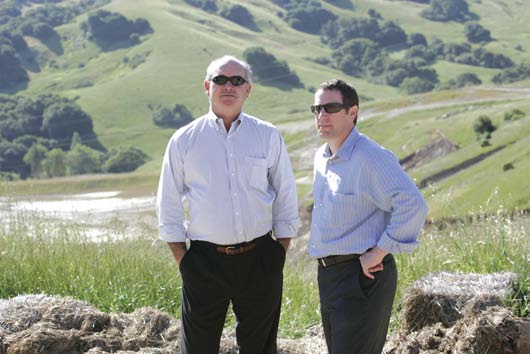
In 2007, Jason Keadjian stood on a hillside in Orinda with a housing project behind him and a hometown in front of him. A photograph from that spring shows him in sunglasses and a blue striped shirt beside project manager Michael Olson. The setting was green, sunny and under construction. It was also a place where a spokesperson could expect the word “neighbor” to carry some weight: Keadjian had grown up in Orinda.
He was speaking for Orinda Gateway, the development being renamed Wilder. Its history already included lawsuits, settlement negotiations, public hearings and a golf course that had appeared in the plans and subsequently disappeared. The project had been taking shape for approximately twenty years. A person could grow up, leave town and begin a career while this particular neighborhood was still clearing its throat.
Keadjian's firm was considerably younger. He had founded Keadjian Associates in 2005. Yet the work visible in that hillside photograph would remain recognizable across his career: explain what an organization intends to do in a place that other people already know, use and care about. In such work, the scenery is never merely scenery. Someone has an opinion about every acre.
A hometown is a demanding audience
The details Keadjian emphasized at Wilder were things a resident could picture using. He talked about access to trails and additional recreation. The 2007 plan included protected open space and public playfields alongside the proposed homes. Development language can become abstract very quickly; a walk or a baseball game brings it back to a scale people recognize.
His position was straightforward: he represented the project. Growing up locally did not remove that responsibility or make him a spokesman for every resident. It did give this assignment a particular geography. The town whose future he was describing was also part of his own past.
That distinction matters in understanding his profession. A spokesperson has a client, a defined role and an argument to make. Residents have their own interests, which may overlap with the client's, conflict with them or change as a plan develops. Familiarity with a place cannot settle those differences. At most, it offers somewhere more useful to begin the conversation.
Other Wilder assignments required a less picturesque vocabulary. In 2008, Keadjian explained the proposed Geologic Hazard Abatement District, a mechanism intended to fund long-term maintenance of slopes, retention ponds and storm-water systems. The subject offered limited opportunities for glamour. It did offer a practical question: who would pay to look after these things over time?
In June 2009, his public role included explaining negotiations over the project's mortgage note. The sequence is instructive. A development spokesperson may discuss the landscape one year, maintenance arrangements the next and financing after that. The job follows the project into whichever room has become consequential.
The shipyard with another chapter to write
Across the water, Mare Island supplied another long-running assignment. Keadjian was publicly speaking for Lennar there by 2004, before founding his own firm. The former naval shipyard in Vallejo was being remade for civilian uses after the Navy's departure in 1996. Its future involved homes, businesses, old buildings and the infrastructure needed to make the pieces work together.
For a communicator, a former shipyard presents an unusual brief. There is an existing identity to respect and a proposed one to explain. The word “reuse” sounds economical on paper. On the ground it can mean years of decisions about buildings, land, access, investment and the relationship between a developer and a city.
In 2005, Keadjian explained the purpose of proposed special taxes for Mare Island improvements and services. The idea was for the island to support its own costs rather than draw on Vallejo's general fund. His explanation connected the financial machinery to ordinary infrastructure: utilities, lighting and bridge improvements. Those are the parts of a new community that rarely feature in its brochure and invariably turn up in its bills.
Two years later, he was describing a commercial district whose development and environmental remediation were proceeding together. The timetable depended on regulatory signoff. By 2008, he was discussing the process for a potential return of ship-related activity to the dry docks. The island's past kept reappearing inside its proposed future.
- 2004Speaking for Lennar at Mare Island
- 2005Founds Keadjian Associates
- 2007Represents Orinda Gateway as Wilder takes shape
- 2014Welcomes Blu Homes' headquarters move to Mare Island
- 2024Firm records 90 companywide employees in an industry list
There were harder announcements, too. In 2008, he spoke for Lennar Urban when the company sold its ownership interests in two Richmond condominium developments. His public explanation identified the exit as a business decision. A communications career built around property will encounter both the announcement of an arrival and the explanation of a departure.
The Mare Island connection continued. When Blu Homes moved its corporate headquarters there in 2014, Keadjian spoke about the continuity between the area's industrial history and its new manufacturing activity. He described the city as a place where creativity and skilled work had a history, and welcomed Blu Homes into that continuing story.
That sentence is doing the work of a development spokesman in miniature. It gives an incoming business a local context. It allows an old industrial place to retain its identity while making room for a different product. And it puts people, rather than acreage, at the center of the announcement.
“Vallejo has always been a place where creative ideas and hardworking people have come together to build great things.”
Jason Keadjian, on Blu Homes at Mare Island, 2014
Putting a surname on the business
Keadjian Associates gave that work an organization of its own in 2005. Based in Walnut Creek, the firm now offers strategic communications and management consulting to corporations and public agencies. Keadjian remains its founder and CEO. The surname on the door belongs to someone whose work has often required him to speak on behalf of somebody else.
The firm's assignments extend across energy, land use, infrastructure, environmental work and education. Its services include public affairs, crisis communications, community relations, executive preparation and creative production. These are related activities, though they require different kinds of attention. Preparing an executive for a difficult conversation is an intimate exercise. Coordinating a campaign across multiple audiences requires a larger apparatus.
The business has grown large enough to make that organizational question tangible. An August 2024 industry ranking recorded 90 companywide employees, including 70 in the five-county Bay Area. It placed Keadjian Associates second among the listed advertising and public-relations agencies by local employee count. The ranking measured staffing, a useful measure of scale rather than a verdict on the quality of anyone's counsel.
Bay Area employees / companywide employees
Five-county Bay Area definition used in the industry ranking.Listening has to become a decision
The firm's published process begins with listening, then moves through identifying, solving and mobilizing. The progression puts a recognizable shape around Keadjian's kind of work. First establish who cares about an issue and what positions exist. Then determine what can be addressed, develop communications and carry out the campaign.
The order has consequences. Asking for feedback creates work for the organization receiving it. Someone must decide which concerns can alter a plan, which require explanation and which remain unresolved. For a consultant, listening is useful only when the people making decisions are prepared to do something with what they hear.
Keadjian's public record offers concrete settings for those questions. A neighborhood requires long-term maintenance arrangements. A redevelopment needs regulatory clearance. A business departure calls for an explanation. Each brings a different audience and a different set of facts. A polished sentence can help make the facts comprehensible; the facts still have to support the sentence.
The distinction between advice and execution also appears in how a longtime client described working with him. Keith Stephens, writing in 2022 after eight years of collaboration, praised both the team's counsel and its willingness to handle practical details. His description, “counselors, strategists and truth sayers,” suggests the value he placed on direct advice as well as delivery.
The audience inside the firm
By 2022, Keadjian was also publicly associated with a client- and employee-first approach to running the business. At that point, the firm reported growth of more than 50 percent over the preceding two years and a staff that was 70 percent female. Those figures describe that period, rather than a promise about today's headcount or composition.
Growth gives a founder a second communications problem. Clients need attention, but so do the people providing it. The organization's ability to carry out its promises depends on how work travels between colleagues, how decisions get made and how much authority extends beyond the founder. A business offering counsel has to organize the counselors.
Keadjian's current leadership group includes executive vice president Ed Moser and chief operating officer Leah Marney, alongside senior practitioners in account leadership and creative work. The arrangement makes the scale of the founder's task easier to see. He leads a firm with multiple disciplines, while its public offering still rests on the close attention associated with individual advice.
The photograph on the Orinda hillside remains a useful place to leave him. There is no lectern, ballroom or ceremonial ribbon. There are two people beside land being changed, with plenty left to explain. Keadjian's career has repeatedly returned to that situation: a client ready to describe a future, and a community entitled to ask how it will work.