Erik Smith learned communications in rooms where a sentence could become policy, panic or television before lunch. On Capitol Hill, the rooms were crowded with elected officials, aides, reporters and clocks that never displayed enough time. At a Democratic National Convention, the room became an arena, and the audience became a country. Later, when he founded a firm, the room filled with partners whose political reflexes did not always match his own. Smith's career has been a long experiment in what happens to a message once it leaves the person who wrote it.
That sounds like a technical concern. In practice, it is almost domestic. Can a complicated idea survive an impatient listener? Can a corporation speak during a crisis without sounding like it learned empathy from a laminated card? Can political opposites improve a piece of advice rather than merely lengthen the meeting? Smith built Seven Letter around those questions. The firm's name is tidy. Its origins are usefully untidy.
The farm before the message shop
Smith grew up on a tobacco farm, in a house built by his great-grandfather. His official biography offers that detail beside two others of a slightly different register: he once appeared in a commercial for the first John Madden Football video game, and he spent a summer “captaining” a Swan Boat in Boston Public Garden. The quotation marks around “captaining” do a little comic work. The boats travel a placid, predetermined loop. Washington would provide rougher water and far less reliable steering.
Before private practice, Smith spent more than a decade as a strategist, spokesman and media trainer for members of Congress and national party committees. He served as communications director for the House Democratic Leader. That put him near the machinery of congressional messaging during the aftermath of September 11, the anthrax attacks and a shooting at the Capitol. Roll Call repeatedly placed him among the 50 most powerful staff members in Congress. Influence, in this case, meant translating unprecedented events while they were still unfolding.
The work later grew cinematic. Smith advised the Obama-Biden campaigns on advertising and message development in 2008 and 2012. He helped develop and place television, radio and print advertising, and worked on the half-hour network broadcast watched by more than 35 million people shortly before the 2008 election. He produced the Democratic National Conventions in 2008, 2012 and 2016, and served as creative director for the 2009 and 2013 presidential inaugurations.
Convention television is an odd craft. It must feel spontaneous while obeying the clock, intimate while filling an arena, and politically coherent while accommodating a party's entire extended family. Smith later described the central problem of a largely virtual convention in 2020 as one of getting through the filter. The people most open to persuasion were also the people least likely to seek out every speech. Attention could not be assumed; it had to be earned in transit.
“In life you don't get a second opportunity to make a first impression. But for the vice president, that's what this is.”Erik Smith, on Kamala Harris's rapid 2024 introduction as the likely nominee
A one-person firm learns to disagree
In 2006, Smith founded Blue Engine Message & Media as a sole proprietor. A solo practice suited the trade's mythology: the trusted counselor, a telephone and a good sentence. It did not suit the direction the work was moving. Clients needed research, paid media, digital targeting, crisis planning, corporate counsel and the ability to understand audiences with incompatible assumptions. One clever adviser could not plausibly be all of those things before breakfast.
So Smith assembled the firm in pieces. Blue Engine combined with JDA Frontline in 2018. Blue Engine's roots were Democratic; JDA Frontline brought Republican experience. The resulting business adopted the Seven Letter name in 2019 and made bipartisanship part of its method. More operating mechanism than decorative centrism, it gave the firm a built-in objection desk. If a message collapsed when someone with a different political reflex touched it, better to discover that around a conference table than on television.
How the room got bigger
Blue Engine begins
JDA Frontline and Tessio Labs
Boston and research
Five US cities
The firm then acquired Tessio Labs to add digital strategy. In 2020, it combined with the strategic communications practice of O'Neill and Associates, bringing a Boston office and lifting the combined staff above 40. The following year, work with Matt George Associates created Seven Letter Insight, adding public-opinion research to the mix. Each deal answered a practical absence: another political lens, digital delivery, regional depth or evidence about what an audience actually believed.
Smith also co-founded Bully Pulpit Interactive, a digital marketing company, and The Analytics Media Group, an advertising-measurement business that later became 605. Those ventures belong to the same argument. Message craft matters, but distribution and measurement decide whether craft escapes the conference room. A phrase may sing in a memo and still perish in the feed.
The photograph at the exchange
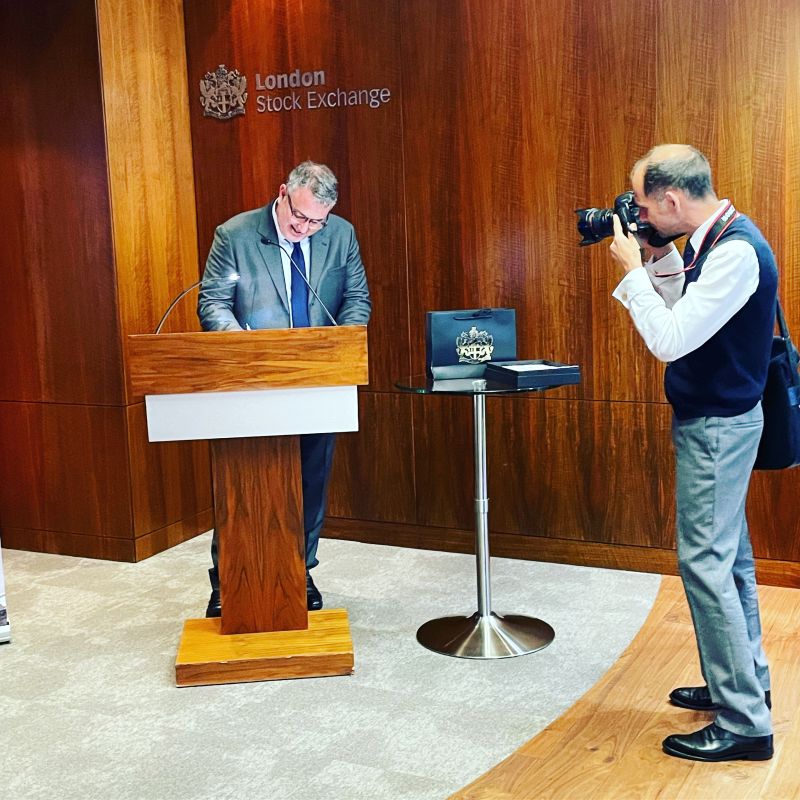
In 2022, Smith posted a photograph from the London Stock Exchange. Public Policy Holding Company, which includes Seven Letter, had been admitted to trading. In the picture he stands at a wooden lectern under the exchange's crest, looking down and smiling while a photographer closes in from the right. It is an unusually neat founder image: institution, occasion, proof.
His note about the day was less polished and more revealing. Smith called the moment exciting and emotional. He thanked his partners and colleagues, then singled out his wife, Edith, for her unwavering support and enthusiasm. Company histories tend to turn into diagrams of transactions. Gratitude restores the people who carried the diagram when it was still only a plan.
That milestone did not end the assembling. By early 2026, Seven Letter announced offices in Los Angeles, New York City and Huntsville, adding them to Washington and Boston. The expansion placed practitioners nearer entertainment, finance, defense and other sectors shaping the firm's work. Smith described it as strategic rather than merely geographic. The distinction matters. Opening pins on a map is easy to announce. Building local judgment into a national firm is the actual assignment.
“Seven Letter isn't just growing geographically, but strategically.”Erik Smith, announcing the firm's 2026 expansion
Keep the grown-ups close
Seven Letter's recurring promise is that senior advisers remain involved. Agency clients have heard versions of this before, often shortly before the person who made the promise disappears and a junior team learns the account in real time. Smith's firm treats senior access as an operating principle: experienced practitioners help frame the problem, stay near the work and adjust the message when circumstances change.
The clients described in Smith's portfolio rarely arrive with a cheerful, isolated request. They face litigation, regulation, leadership changes, public-policy fights or a reputation moving in the wrong direction. The industries vary from energy and financial services to consumer products, entertainment and philanthropy. The common feature is consequence. A message has to satisfy the lawyers without becoming legal paste, answer the public without inventing certainty, and give the person delivering it enough room to sound like a person. Smith still collaborates on that client work while leading strategy and business development for the firm.
That principle joins the episodes of Smith's career. In a national emergency, hierarchy cannot replace judgment. In convention production, the final broadcast depends on hundreds of people who understand the whole. In a merger, culture cannot be delegated after the contracts are signed. Smith has said his colleagues genuinely enjoy the craft and pursue what he calls an impeccable culture. PRNEWS named him an Outstanding CEO among its 2025 People of the Year, recognition tied to both leadership and the culture built across nearly two decades.
His public service beyond the agency draws the same circle a little wider. Smith was a founding board member of Business Forward and of President Obama's Organizing for Action, and he previously served on the board of the Washington Nationals Youth Academy. For four years he joined a China-US exchange program. He has also spoken about communications at universities and professional institutions in the United States and Paris. These roles extend the same career into further rooms, each with its own vocabulary and its own reasons for distrusting an easy answer.
There is also a modest lesson inside the grand productions. Smith's most useful public observation may be his line about second first impressions. It contains a political insight, but also a founder's one. Blue Engine became Blue Engine plus JDA, then Seven Letter, then a larger Seven Letter again. Every combination required an established organization to introduce itself anew without pretending it had no past.
The tobacco farm, the congressional office, the convention floor and the agency boardroom look like separate chapters. They are four versions of a shared problem: people with different jobs and histories must understand what to do next. Smith's work has been to find the words, the evidence and, increasingly, the colleagues that make that possible. The message survives not because everyone in the room agrees. It survives because they did the disagreeing before it left.