On January 13, 2025, Andy Blunt stood at a lectern outside the Missouri Capitol during Mike Kehoe’s inauguration. Behind him, guests sat bundled in winter coats and blankets. The photograph has the familiar furniture of public office: microphones, a state seal, pale stone, a gathering waiting for the next speaker. Blunt was there as chairman of the inaugural committee. Once again, his work had helped bring him to the opening of somebody else’s administration.
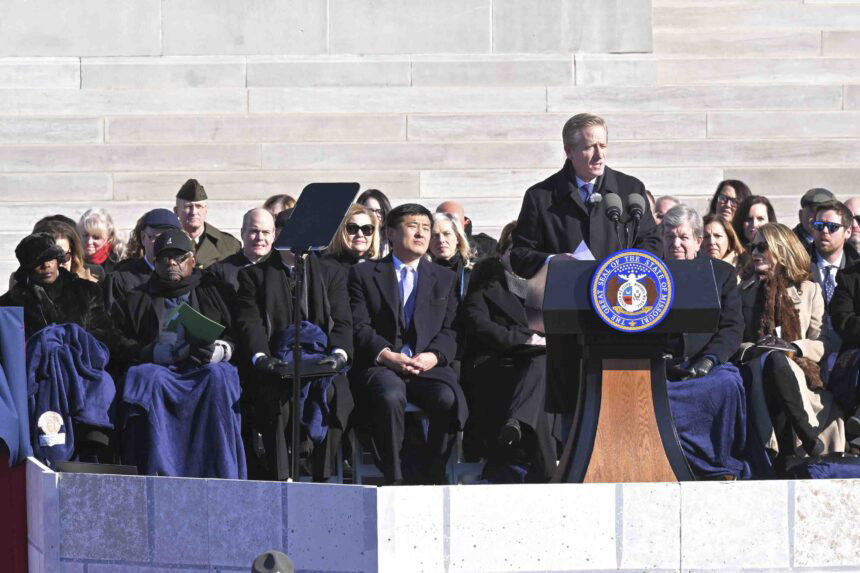
Twenty years earlier, he had chaired another Missouri gubernatorial inauguration, this one for his brother Matt. A governor takes an oath and begins a term with an expiration date. The person who helps organize the occasion can remain part of the state’s political life for considerably longer. Blunt’s career has crossed campaigns, law firms, polling and lobbying. His employers have changed; Jefferson City keeps appearing in the return address.
By the time Kehoe took office, Blunt was also chief executive and executive chairman of HB Strategies, the national government affairs firm he co-founded with Gregg Hartley in 2018. He had spent years helping other people win offices. Increasingly, his own assignment was to make a collection of offices work together. That distinction matters to the next chapter: building a business whose future does not depend on his being present at every important conversation.
The family name came with a job to do
Blunt was born in Springfield, Missouri, and moved to Jefferson City when his father, Roy, became secretary of state. Politics supplied the setting before it supplied an occupation. He earned undergraduate degrees at Southwest Baptist University in Bolivar and a law degree at the University of Missouri in Columbia. The formal preparation was legal; the family’s working life offered a continuing education in elections.
In 2000, he managed Matt’s successful campaign for Missouri secretary of state. Four years later, he led the campaign that made Matt governor. He subsequently managed Roy’s Senate campaigns in 2010 and 2016. These were separate elections with different stakes, rather than one inherited job description. They also put Andy in an unusual position: campaign results became part of the family history as soon as they became public history.
The surname has invited scrutiny along with introductions. In 2015, while his lobbying work and his father’s reelection campaign drew criticism, Blunt defended helping Roy and said his father did not weigh in on state issues. The family connection belongs plainly in the account of his career. So does the work itself. Managing a statewide campaign means a candidate’s connections still have to be converted into a functioning campaign and, eventually, votes.
A taste for the difficult afternoon
His early ambition was to practise law. Lobbying gradually drew him toward legislative work, and he became a founding partner of Schreimann, Rackers, Francka & Blunt. In a 2014 interview, he described enjoying the variety of policy questions and the pace of the Capitol. He also recalled preferring printed books and magazines even while managing campaigns that spent heavily on digital advertising. The strategist understood the audience could live somewhere he preferred not to.
“I like having the ball during crunch time,” he said. It is a revealing choice of language from someone who ran track and cross country at school. Legislative sessions offered pressure, moving pieces and consequential decisions. He wanted involvement in the questions that would shape the rest of the session. The appeal, as he described it, lay in the work of resolving them.
By 2016 he had established Statehouse Strategies. In January 2017, he joined American Viewpoint as director of strategic development, working to expand its polling and advisory business. Advocacy and audience research occupied adjacent spaces in his career. One concerned what decision-makers might do; the other helped clients understand what people thought. His later executive work would bring multiple kinds of advice under the same organizational roof.
“I like having the ball during crunch time.”
Andy Blunt, 2014
Three practices, then a different scale
The 2018 venture combined the government affairs practice of Husch Blackwell LLP, Statehouse Strategies and Cloakroom Advisors. It joined state-level work in Missouri with a federal practice in Washington and a law firm’s government affairs operation. Blunt and Hartley were assembling capabilities that already had histories, clients and people attached. A merger announcement could put their names together in a day. Making the combination useful was a longer assignment.
Blunt initially served as chief operating officer and helped build the network of state lobbying offices. Expansion meant finding people who understood their own legislatures and political environments. Washington expertise could be useful across the country, but it could hardly substitute for knowing what was happening inside a particular statehouse. The national ambition depended on local competence, an arrangement that gave recruitment a central role in the business.
On January 8, 2024, the founders exchanged operating roles: Blunt became CEO and Hartley became COO, while Blunt retained the executive chairmanship. The same announcement put Rochelle Mallett in charge of state government affairs and Stacy McBride in charge of federal government affairs. The company was giving its growing practices defined leadership. Blunt’s promotion came with an organization chart that distributed responsibility rather than simply adding another title to his business card.
- 2018Put the practices togetherCo-founds Husch Blackwell Strategies with Gregg Hartley.
- 2024Take the CEO’s deskBecomes chief executive on January 8, retaining the chairmanship.
- 2025Operate independentlyThe firm separates from Husch Blackwell in February.
The map needed people on it
In June 2024, the firm launched HBS 50 State, led by Blunt, Mallett and managing principal Dusty Brighton. The service coordinates national objectives through local engagement with lawmakers, regulators, governors and attorneys general. The proposition is easy to picture: a client has one policy concern, but that concern may arrive at several different desks, in several different forms, on several different legislative calendars.
A map makes jurisdictions look reassuringly orderly. The people inside them are entitled to complicate the picture. A coordinated service has to preserve local judgment while giving the client a coherent view. For Blunt, that extended the network-building work he had done as COO. The commercial question became how to make coverage across states usable to an organization with its own priorities and limited time.
In January 2025, Nashville’s Harris Frazier Government Relations became HBS Tennessee, the firm’s eleventh state-capital office. Blunt singled out Estie Harris and Meagan Frazier when announcing the addition. That detail makes the expansion tangible: behind a new dot on the map were professionals with existing careers and relationships. A firm can acquire an address quite easily. An address cannot introduce you to a committee.
An editorial rendering of his “three Ps” framework.
When growth changes the sign outside
February 2025 brought independence from Husch Blackwell and the HB Strategies name. Both sides described growing businesses and the difficulty of accommodating their expanding client relationships within the affiliation. Blunt’s announcement put the firm at thirteen offices and more than 400 clients. Independence followed seven years of expansion. It was a decision about how the firms could operate as their work became more extensive.
The scale figures are snapshots, not a permanent census. The 2025 independence announcement counted thirteen offices; the Tennessee announcement distinguished eleven state-capital operations from the wider organization. Those categories matter. Blunt’s business combines state lobbying, federal representation, public affairs and senior counsel. Its footprint is more varied than a row of interchangeable branch offices.
Family and business had also converged more visibly. After leaving the Senate, Roy Blunt joined the firm in 2023 to chair its Leadership Strategies advisory group. Hartley had previously worked as Roy’s leadership chief of staff in the House. The relationships predated the company, then became part of its professional structure. Andy’s career cannot be understood by removing those connections. Nor does naming the connections explain every task involved in running the firm.
A dated snapshot from Blunt’s independence announcement.
The forecast still has a deadline
The executive role has left room for election analysis. In July 2024, Blunt began a series of campaign reports as the presidential contest changed following Joe Biden’s decision to leave the race. He also moderated an October election panel with analysts Jim Ellis and Zac McCrary, later released as a podcast. Campaign experience had become something clients and listeners could use without hiring him to run a campaign.
On March 13, 2026, his report The Lines That Could Decide 2026 examined redistricting developments in sixteen states. On October 15, he released Midterms Outlook 2026, setting out competing House scenarios and a Senate assessment. The work kept returning to the conditions under which elections happen: district boundaries, competitive seats and the timing of decisions. A forecast gives the reader a way to organize uncertainty, even when it cannot remove it.
An October 22 panel was announced with Andy and Roy hosting Republican analyst Jim Ellis and Democratic analyst Doug Sosnik. That format placed different political perspectives in the same conversation. Blunt’s public role now includes convening people to explain a contest, alongside the less visible work of leading the firm between contests.
The work after the founder leaves
Blunt describes the business through “people, platform, and product.” In practice, his account includes taking invoicing, technology, insurance and contracts off practitioners’ desks so they can concentrate on clients. It is a wonderfully unglamorous inventory for a profession often imagined through receptions and private meetings. Somebody must make the systems work before somebody else can make the introduction.
His stated goal is to “build an enduring company.” He says he still gets to know everyone who joins and now spends more time recruiting, developing colleagues and opening opportunities for future leaders. The test implied by that ambition is demanding: people must be able to keep delivering when the founders eventually stop coming in. Hiring becomes a decision about the firm’s future character as well as its immediate capacity.
In 2025, The Hill’s Top Lobbyists list included Blunt alongside McBride, Eric Lausten and Rocky Fox. Recognition was shared across the organization he leads. Elections still offer him a date, a count and an outcome. An enduring company asks for confidence on a different timetable. The work continues through an ordinary week, in choices about colleagues and clients, long after the inaugural guests have folded their blankets and gone home.
Follow the work
Explore his writing, conversations and professional background.