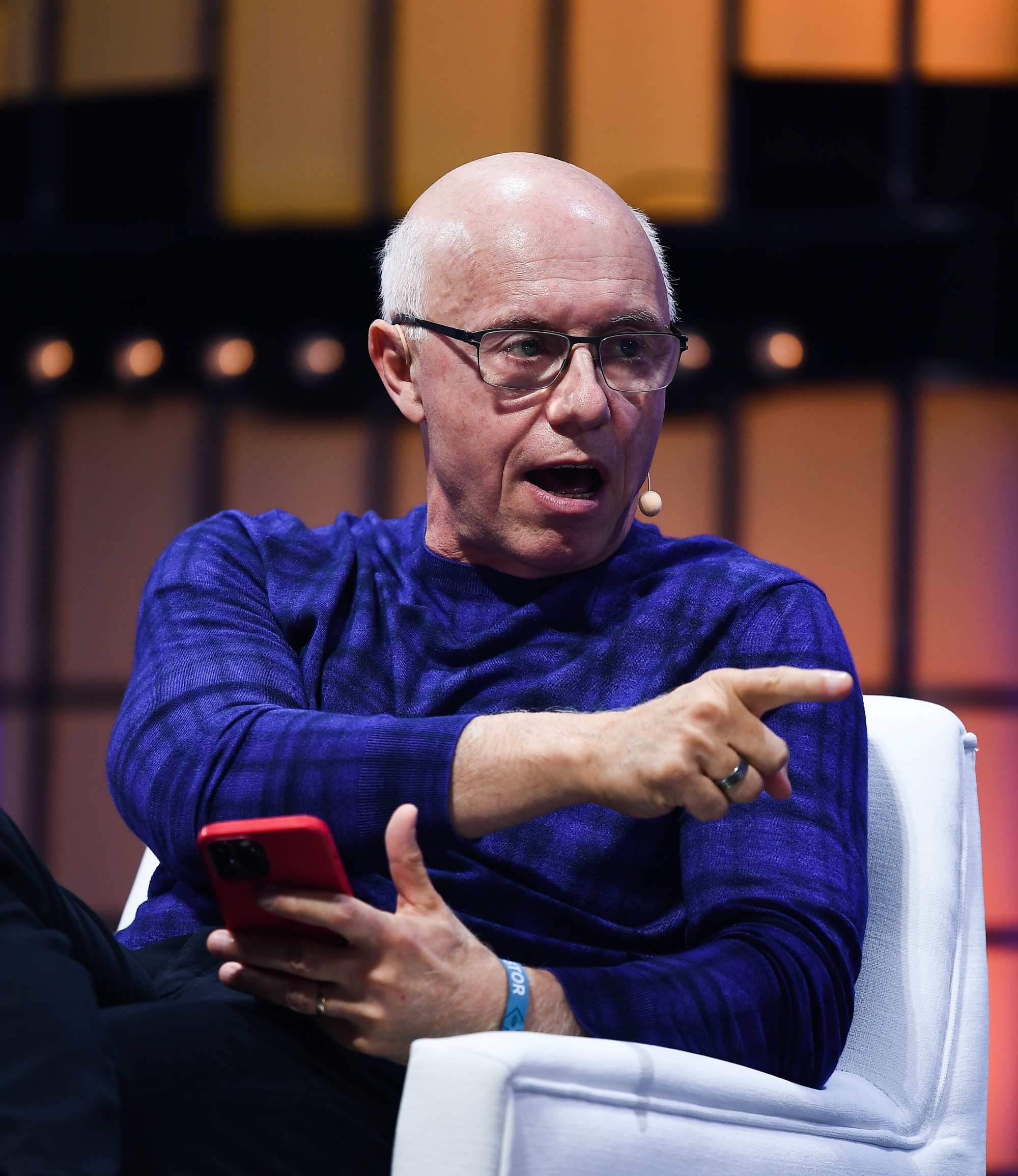
The Man Who Never Stopped Being Afraid
He wakes up at 4:30 in the morning. Not because he has to. Because he's afraid someone will get there first. This is a man worth $10.8 billion, chairman of the firm that funded Apple, Google, Cisco, and Oracle. And he still has a pit in his stomach every single morning.
That is Douglas M. Leone. Born July 4, 1957, in Genoa, Italy. He arrived in America at 11 years old, not on a plane - on a boat. He couldn't speak a word of English. He landed in Mount Vernon, New York, a working-class suburb that had no use for an Italian kid with a strange accent and a stranger name. They bullied him. He learned. He adapted. He stored every bit of that experience like compressed fuel, and has been burning it for six decades.
At Sequoia Capital, where he spent 34 years - rising from General Partner in 1988 to Global Managing Partner by 2012 to Chairman in 2026 - he applied the immigrant's fundamental insight: no one is coming to save you. You have to want it more than the person across the table. He did, and so did the founders he backed.
The Silicon Valley origin story usually goes: Stanford dropout, garage, billion-dollar idea. Leone's version is different. He was a mechanical engineer from Cornell who sold workstations at Sun Microsystems. He was a salesman. He will tell you that himself, without apology. When he joined Sequoia, Don Valentine didn't hire him for his pattern recognition or his MBA from MIT Sloan - he hired him because he could close deals. Leone turned that into something nobody expected: a philosophy of venture capital as enterprise sales. You don't just pick winners. You win them.
It paid off in ways that are difficult to fully comprehend. His firm led a $39 million round in ServiceNow when most VCs were skeptical. That company is now worth north of $170 billion. He backed Wiz - an Israeli cybersecurity startup whose founders hadn't even settled on their product idea yet - and Google paid $32 billion for it in 2025. He helped build Sequoia China and Sequoia India into fund franchises that, at their peak, were among the most consequential in the world. ByteDance. Alibaba. Meituan. The architecture of the modern tech economy runs partly through investments Leone helped engineer.
Milestones That Matter
Green Ink on a Conference Table
Shortly after joining Sequoia, Doug Leone sat in a partner meeting and did what he'd always done: interrupted with a sharp, aggressive question. Don Valentine, who founded Sequoia and had a reputation for bluntness that made investors flinch, said nothing in the moment.
After the meeting, Leone found a handwritten note on the conference room table. Green ink. Three words: "Doug - not fit to listen to founders."
He didn't quit. He didn't argue. He taped it to his brain and worked on nothing else for 12 months. That note - and what he did with it - tells you everything you need to know about Doug Leone. Feedback is fuel. Criticism is data. The only response to being told you're not good enough is to get better until the room can't ignore you anymore.
Three decades later, Leone would become the person who ran the room. And when he stepped back in 2022, he handed that room to people he had personally developed. The note wasn't a setback. It was the syllabus.
He Wants the Shunned Ones
Ask Leone what kind of founder he looks for and he won't say "visionary" or "product genius." He'll say: someone who has been shunned. Someone with trauma. Someone who has had their system shocked. Not the high school quarterback. Not the homecoming king. The kid who ate lunch alone. The engineer who got passed over. The immigrant who couldn't speak English.
He recognizes these people because he is one. And he has built a $10.8 billion fortune on the correct intuition that people with something to prove are more dangerous than people who've already arrived. The founders who feel comfortable have already accepted their ceiling. The ones who still feel like outsiders keep digging through the floor.
His go-to interview question for founders isn't about the market size or the tech stack. He wants to know what hardship they've endured. What knocked them sideways. Because he believes that how someone handles their deepest loss tells you far more about their capacity to build a company than any slide deck ever could.
This isn't sentimentality. It's pattern recognition from someone who has done the matching exercise thousands of times. He has seen the data. The outlier builders he has backed - the Fred Luddys, the Assaf Rappaports - are people who had something to prove long before Leone wrote a check.
The Bets That Paid Off
Scale of Impact
"The Godfather of Silicon Valley"
They call him The Godfather. He finds the nickname "a little insulting, being that I came from Italy" - but he takes it. The name stuck because of what it implies: someone who makes things happen, who the young and ambitious come to for blessing, and whose no means no.
His approach to venture capital was never academic. He didn't come from banking or economics. He sold computers at HP and Sun. He understands the pipeline, the close, the relationship. When he sized up a founder, he was evaluating a sales pitch, not a business plan. "Crystal-clear thinking" is what he demands - not slides, not decks, not market size analyses. He wants to see through the founder's eyes, and he wants those eyes to be unobstructed.
He also rebuilt himself. Early in his career, he was a self-described control freak - the kind of manager who needs his hands on everything. He learned to let go by watching what happened when he did. The results improved. He credits part of his evolution to deliberately seeking out experiences that didn't come naturally: learning piano in his 60s to force his "linear" mind into unfamiliar territory. He reads Nassim Taleb to articulate what he already instinctively knew about antifragility. He stays teachable.
This is rare. Most people at the top of any field eventually calcify. Leone didn't. He remained curious enough to build Sequoia's international platform in his 50s, expand into new sectors in his 60s, and return to an active chairman role at 68. The fear keeps him moving. The hunger keeps him relevant.
A Fortune Built on Conviction
His wealth isn't stock options from a single company - it's the compounded result of picking correctly, across sectors, across geographies, across three decades of disruption cycles. The Wiz outcome alone - $32 billion for a company that started with a team, not yet a product - validated a bet-on-people philosophy that runs against conventional VC wisdom.
What He Actually Says
Three Degrees, One Worldview
-
1979Cornell UniversityB.S. Mechanical Engineering - the foundational rigor that trained him to think in systems
-
1986Columbia UniversityM.S. Industrial Engineering - bridging physical systems and organizational design
-
1988MIT Sloan School of ManagementM.S. Management (Sloan Fellow) - the year he graduated, he joined Sequoia Capital
What Makes Him Different
He describes himself as "linear" - someone who lacks creative thinking. So he deliberately forces himself into unfamiliar territory: piano lessons in his 60s, relationships with people who see the world differently, books that articulate what he senses but can't quite name. Taleb's Antifragile hit him that way. So did Bill Browder's Red Notice. He recognizes the profile of someone who thrives under pressure and seeks it out.
The thing he won't do is pretend to be comfortable. That comfort, he believes, is how great firms become average ones. Sequoia stayed sharp because Leone made insecurity a cultural value - not anxiety, but the productive kind of hunger that refuses to declare victory.
Two Countries Claimed Him
In 2017, Forbes named him a top-10 technology investor. The same year, the Carnegie Corporation selected him for its "Great Immigrants" award - recognizing naturalized citizens who have made an outsized contribution to American life. He is, by most measures, exactly what immigration advocates point to when they argue for the generative power of the immigrant experience.
In 2021, Italy noticed too. The Italian government awarded Leone the Ordine della Stella d'Italia - Order of the Star of Italy, Officer grade - one of the republic's highest state honors, given to Italian citizens and descendants who have distinguished themselves abroad. The kid who left Genoa on a boat, got bullied in New York, and built a $10.8 billion fortune was, in the end, honored by both countries he belongs to.