Dorothy Ssemanda’s first audit work involved paper and coloured pens. Years later, the chief executive of ATC Uganda was at Harvard Business School, completing an assignment to build an AI tool. Between those two kinds of homework sits a career in which learning has repeatedly preceded the next responsibility. The equipment has improved considerably. The requirement to do the work has stayed.
There is another classroom in her story, with rather more water. In her account of the 2025 Africa Aquatics Zone III Championships in Nairobi, Ssemanda describes moving from the reserve list onto Uganda’s team. She finished fourth in her age group in the 50-metre backstroke, adding 15 points to Uganda’s total. She was also a chaperone and a mother competing alongside her children.
Her chosen instruction to herself was brief: “Do it Afraid!” It is an unusually serviceable motto. It leaves room for nerves and still requires an appearance. Across her work in telecommunications, professional training and community education, she keeps returning to the same practical question: how does someone become ready for the next thing?
The accountant learns a wider language
Ssemanda joined ATC Uganda in 2012. Her work took her through finance operations, supply chain, a finance advisory assignment connected with a Tanzanian start-up and regional treasury responsibilities spanning six countries. Those assignments placed her close to the machinery of a business: what it buys, how it pays, where money moves and what expansion requires.
Before towers, there had been audit at Ernst & Young and PwC, then business planning at Zain Uganda. At Zain she worked on pricing, analysis, budgets and forecasts, and supported the transition to Airtel. These were useful places to learn the difference between a number that balances and a decision that works.
Her academic foundation included a Bachelor of Commerce from Makerere University Business School and an MBA from Edinburgh Business School at Heriot-Watt University. She also became a fellow of the Association of Chartered Certified Accountants. In 2018, she became ATC Uganda’s first Ugandan chief financial officer. On July 1, 2022, she became its first Ugandan CEO.
She has described feeling the limits of her preparation even after she had earned her place in senior conversations. Around colleagues with prominent university pedigrees, she wanted a firmer command of strategy and economic language. Her response was further study. The admission is more revealing than a polished account in which every promotion arrives precisely when its recipient has become entirely ready.
In an April 2026 reflection, she traced part of her discipline to boarding school, which she entered at seven. She remembered early starts and porridge at five in the morning. The lesson she drew concerned responsibility and persistence. Her account gives the later qualifications some texture: formal learning followed an early education in having to manage.
“Realizing your gaps is not weakness. Refusing to act on them is.”
Dorothy Kabagambe Ssemanda
A phone call depends on a power line
Running telecom infrastructure brings an accountant into very physical territory. The conversation may begin with digital services and end with the distance between a tower and an electricity connection. A forecast can describe demand beautifully. It still cannot carry a power cable across a field.
At an April 24, 2025 meeting at State House in Entebbe, Ssemanda sought government support to connect more than 1,000 remote tower sites to the national grid. Some needed extensions of 10 to 15 kilometres. ATC Uganda had already invested UGX 120 billion in extending 2,200 kilometres of power lines. These are distances and bills with considerable authority over a digital ambition.
The meeting also addressed vandalism and the protection of telecom assets. ATC Uganda was described as operating more than 4,500 towers nationwide. For Ssemanda, the task included persuading public institutions to treat the infrastructure behind everyday communication as something requiring coordinated attention.
remote tower sites for which Ssemanda sought support for grid connections
Her environmental argument follows a similarly practical route. She has advocated sharing telecom infrastructure so operators can use common facilities, reducing duplicated steel, concrete and generators. She has also described renewable energy and network optimisation as part of the effort to reduce emissions. Her stated ambition is a carbon-neutral telecom network across Uganda; that remains an ambition, with the work of delivery attached.
The streetlight joins the conversation
In Kampala, infrastructure can have several jobs on the same street. ATC Uganda’s work with the city authority has included smart poles combining telecom facilities with street lighting. By January 2024, Ssemanda reported 87 streetlights deployed across different locations, including additions along Nkrumah Road and Nile Avenue.
A streetlight is a helpful ambassador for a telecom project. People can see what it does. Shared infrastructure, usually discussed in technical or financial terms, acquires an everyday purpose when the same installation contributes to a lit street and a connected neighbourhood.
City growth also creates fresh network problems. Presenting an ATC study in 2023, Ssemanda discussed the need for 400 additional towers for Kampala’s smart-city ambitions. The proposed forms included rooftops, smart poles and structures resembling pine trees. The number described a need identified by the study, rather than a completed building programme. Even a city’s communications infrastructure sometimes has to consider its appearance.
Who gets to build the network?
Ssemanda’s work with women-owned businesses brings the discussion from access to participation. ATC Uganda has partnered in MTN Uganda’s Advancing Women Entrepreneurship programme, which combines opportunities in corporate supply chains with business support and mentoring. The relevant question is concrete: who gets considered when a company needs something built, installed or supplied?
On April 1, 2025, an MTN delegation visited ATC Uganda to recognise her work on women’s empowerment. The discussion included Solar Nation, a women-led business involved in solar-powered telecom installations. Here, the energy programme and the enterprise programme meet at a working site. A supplier has a contract to deliver, with the responsibilities that accompany it.
For a former finance and supply-chain professional, that is familiar ground. Procurement decisions determine who gains experience as well as who receives revenue. Bringing more businesses into a supply chain requires preparation on both sides: suppliers need the capacity to perform, and customers need a deliberate route through which to engage them.
The next CEO needs somewhere to practise
Her interest in teaching has a personal starting point. Recalling those early paper audits, she credited the colleagues who trained her. Experience had arrived through people willing to explain the work. Later, she used that memory to encourage other executives to notice and teach the potential leaders already sitting nearby.
ATC Uganda’s industrial training programme, launched in 2022, gave that idea an organised form. Its first cohort included eight trainees completing a year of practical development. One participant, procurement and supply-chain graduate Sarah Kyomugisha, described rotations through departments and time working with suppliers at the warehouse. She credited Ssemanda’s encouragement with helping her confidence.
Ssemanda has also urged finance leaders to develop commercial awareness, communication, storytelling and self-advocacy alongside their technical skills. In her discussion of a CFO forum convened by ACCA Uganda and Deloitte Uganda, nurturing talent was a central responsibility. Someone has to make the next generation capable of explaining a decision as well as calculating it.
That concern extends beyond an office. During an April 2023 visit to Nakanyonyi Girls’ School in Jinja, she encouraged girls to pursue STEM subjects. The occasion included a donation of computers and books, questions for students and time spent discussing careers. An accountant was asking pupils to imagine becoming the people who could deliver demanding engineering projects.
A carpenter meets a computer mouse
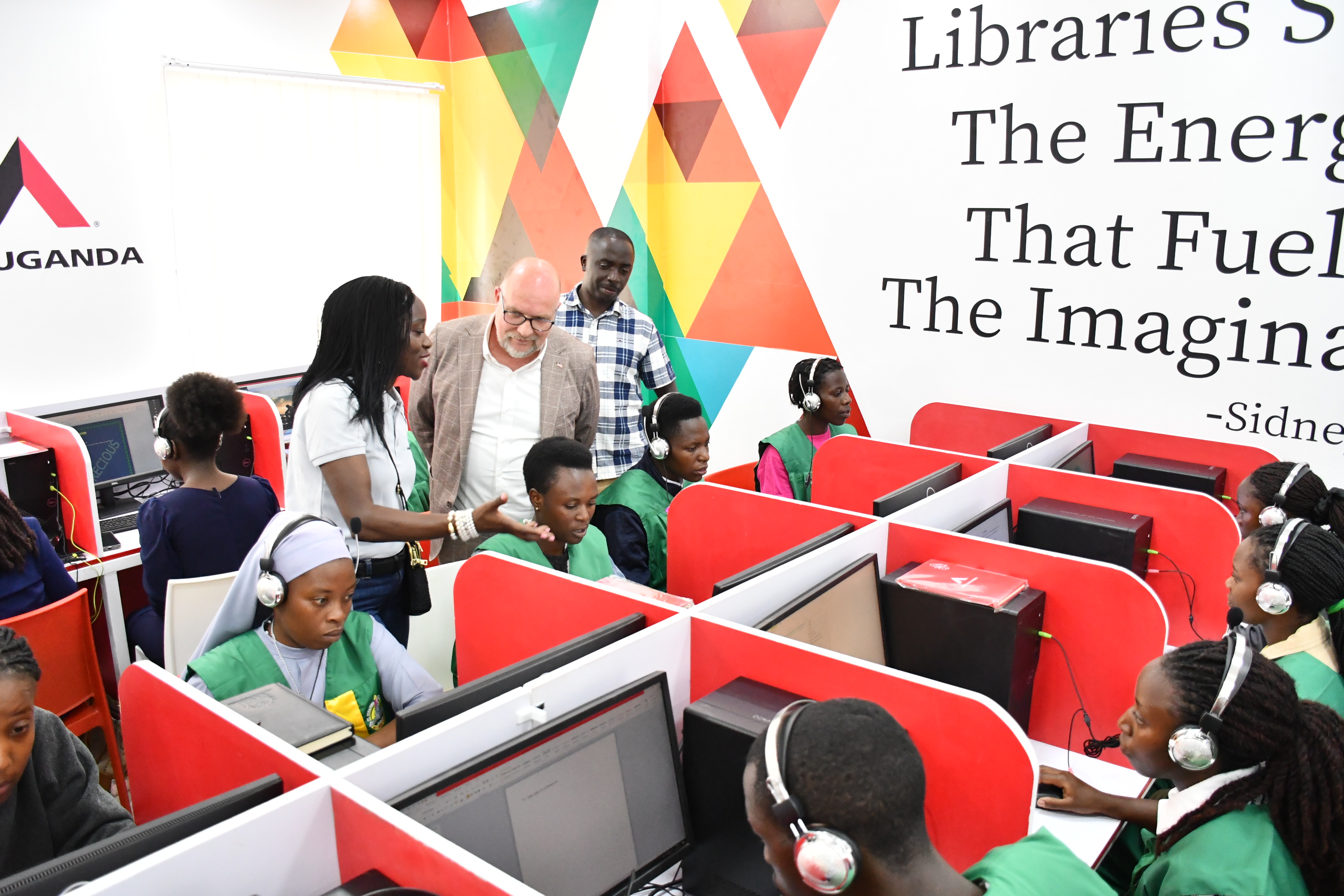
In May 2026, Ssemanda wrote about a digital literacy graduation at St. Peter’s Senior Secondary School Nsambya. The community programme had brought local carpenters into a computer lab. Their existing expertise involved furniture, tools and materials. The new lessons concerned applications that could help them keep records and run their businesses.
She singled out Luzinda Musa, who said he had previously never used a computer mouse. He was among 36 carpenters completing the programme, alongside 291 students. Records, receipts, sales tracking and research into furniture designs supplied immediate reasons to learn. A spreadsheet has a rather stronger claim on someone’s afternoon when it can help make sense of orders.
By September 2026, she was also discussing the reach of the digital community centre at Kabale Public Library, saying more than 3,000 people had benefited since 2024. These centres give her infrastructure work a recognisable destination: a person at a computer, learning something they can use.
Her own learning continues alongside theirs. In her April 2026 account of Harvard’s digital and AI strategy executive programme, she described case discussions in which another participant could overturn her interpretation. Professor Sunil Gupta asked participants to build an AI-powered tool for their work. She reported doing the assignment herself and argued that leaders should support experimentation and skills development within their teams.
There is a pleasing continuity between the audit trainee with coloured pens, the chief executive studying new tools and the carpenter learning to use a mouse. Each has a task that requires instruction before confidence. Ssemanda has accumulated qualifications, responsibilities and experience. She still makes a point of putting something unfamiliar on the desk.