On a July holiday weekend, Accolade Partners needed certificates of good standing for a credit facility. Its existing provider had said the entities were fine. The certificates told a different story. Some entities had fallen out of compliance, and the fund's team had to scramble to repair the record at precisely the moment it needed the record to be boring.
This is the particular cruelty of entity administration: the work is invisible when it succeeds, then suddenly everyone in the room cares about it. A fund can have clever lawyers, careful finance staff and a sophisticated investment thesis. It can still be delayed by a state filing no one thought to check.
- Discern is a registered agent and software platform for managing legal entities across U.S. states.
- It brings state notices, deadlines, filings, payments and proof of good standing into one system.
- Its published base price is $350 per state registration per year; government fees are separate.
Accolade switched to Discern. Its account of the change includes an 80% reduction in time spent on compliance projects and a 90% reduction in its June 1 filing workload. Those are customer case-study figures, not a universal guarantee. Their real value is diagnostic: the old arrangement failed first at visibility. The team could not reliably see whether the promised work had been done.
The multiplication problem
A registered agent is the address where official legal papers and state notices can find a company. For a business operating in one state, that obligation may feel like a formality. Add subsidiaries, special-purpose vehicles and new states, and the formality starts multiplying. Each entity can have separate registrations, annual reports, deadlines, payment methods and documents proving it remains in good standing.
Discern's customer Vestwell illustrates the arithmetic. Its case study describes seven legal entities, including a trust company, registered across 30 states. Finance, legal and operations all needed to know which filings were due. Vestwell had used multiple legacy agents whose records did not speak to one another. The work was less a single compliance task than a recurring search party.
Discern gives the team one entity record, shows state registrations and standing, calculates filing dates and prepares annual reports from information already entered. It also takes on the old agent's literal job: receiving service of process and state mail, then delivering it digitally with a searchable trail. Formations, foreign registrations, amendments, reinstatements and dissolutions sit in the same workflow. Delaware franchise-tax filing and entity-level payment controls extend the platform beyond a pleasant calendar.
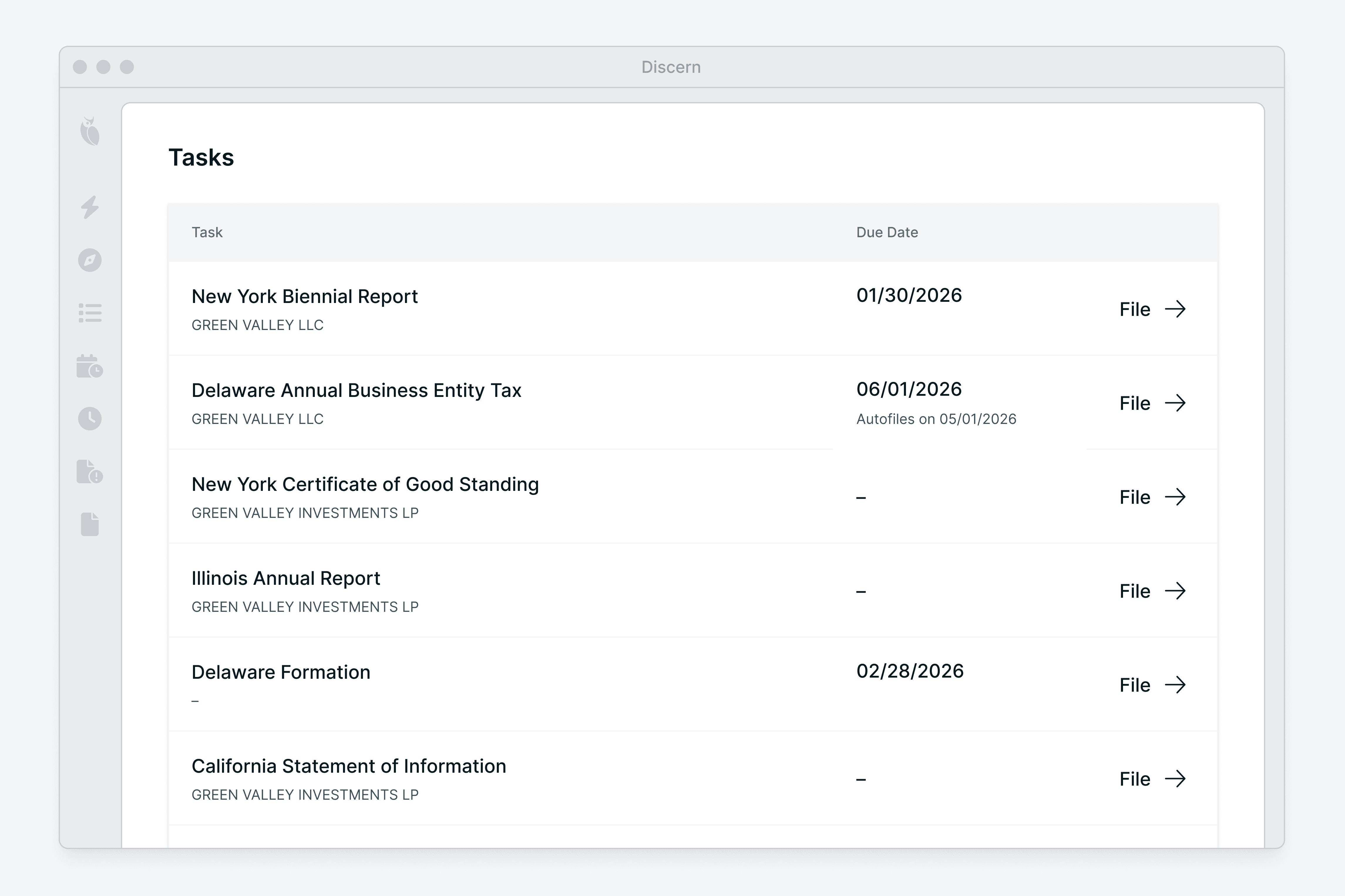
The distinction matters. A conventional provider can accept a letter, forward it and still leave the customer to manage the calendar, prepare forms, arrange payments and chase evidence. Discern sells the whole operating loop. That makes it a direct alternative to providers such as CT Corporation, CSC and Cogency for organizations whose problem is not simply having an address in Delaware.
A product for the person holding the spreadsheet
Co-founder and CEO Raj Patel has described the registered agent business as one built around law-firm referrals. The in-house person managing the entities, he argued, came second. That is the insight behind Discern's interface: the user is often a controller, general counsel or operations lead whose day is already full before an envelope from a Secretary of State arrives.
“The registered agent business has been built around law firms for decades, because that’s where the customer referrals come from.”Raj Patel, co-founder and CEO
Patel founded Discern with Mike Bosserman and Simon Moschou in 2022. The company's stated customers now range from startups to public companies and large asset managers. Its more concrete examples are useful: Vestwell in retirement services; Accolade Partners and IA Ventures in investing; White Wolf across portfolio companies; and RenoFi in lending. Discern also says it powers foreign registrations and multi-state compliance for Stripe Atlas.
RenoFi's story shows what can go wrong before a missed filing becomes a transaction emergency. Its team says emails to its former provider went unanswered, address changes were not properly reflected, and internal audits kept finding errors. It considered bringing the work entirely in-house. Recommendations from peers and investors led it to Discern instead. After the switch, RenoFi estimated that the share of its time spent managing the registered-agent relationship fell from about 25% to about 1%.
The lesson is surprisingly portable. Before buying a new platform, list the questions your current process cannot answer quickly: Which entities are registered where? Which are in good standing today? What is due next? Who pays? Where is the filed evidence? If each answer requires another email, the problem is already measurable.
The cost of quiet
Discern's published subscription price is $350 per state registration per year. It includes registered-agent service and annual report filing; government fees are extra. Standard entity formations are advertised at $99 plus state fees, with a higher fee for certain professional entities. Portfolios of 50 or more entities may receive custom pricing. The model is straightforward to grasp because it follows the underlying obligation: an entity's presence in a state creates a recurring unit of work.
The price alone cannot settle a vendor choice. A one-state business with a simple structure can buy a cheaper agent and handle its own annual report. A multi-entity fund may care more about segregated payments, a single view across jurisdictions and whether an auditor can find the evidence in minutes. Discern's software is strongest where the entity count, state count and number of internal stakeholders make the spreadsheet brittle. It covers the Secretary of State layer; specialized licensing and legal judgment still require the appropriate people and systems.
White Wolf's case describes this division well. Portfolio companies retained day-to-day responsibility while the central team used Discern to see the whole portfolio. Its chief operating officer, Jonathan Satter, put the benefit plainly: “The biggest win has been transparency. We can see everything now.” The firm estimated two to three hours saved a week. The point was not to abolish human ownership. It was to make ownership visible.
Why investors noticed the envelopes
In July 2026, Discern announced a $10 million Series A led by Walkabout Ventures and Bungalow Capital, bringing its disclosed total funding to $17.5 million. The company said annual recurring revenue grew fourfold in 2025 and that it had more than 800 customers at the time. Its current About page lists more than 900. It plans to add operations and engineering capacity, a revealing pair of priorities for a business whose software must still meet the physical and procedural world of state offices.
There is no glamour in confirming that a filing was accepted. There is, however, a business in it. Every ambitious company creates more legal structure as it grows; every new structure creates another small promise to a state. Discern's bet is that the promises deserve the same quality of software as the company's sales pipeline or payroll. Accolade's July weekend supplies the final argument. The most valuable compliance tool may be the one that makes a dramatic story impossible to tell.
Explore Discern
Website · LinkedIn · Resources and customer stories · Series A announcement