Dirk Lueth has the sort of backstory that makes a virtual property game seem less like a pivot than a destination. He wrote a doctoral thesis on private and state-controlled currencies. He helped launch a business newspaper. He built financial technology, ran digital-media companies, and advised founders entering the American market. Then, in 2018, he co-founded Upland: a city-building game laid across a map of the real world, where players acquire addresses, develop neighborhoods, open businesses, and trade with one another.
The colorful buildings and wandering llama mascot are the friendly surface. Beneath them sits Lueth's recurring fascination: who gets to own something, what gives it value, and which rules keep a market from eating the experience it was meant to serve. Plenty of founders reached blockchain through tokens. Lueth reached it by way of economics.
Upland calls him “The Economist,” a nickname so accurate it nearly spoils the joke. At the company he co-founded with Idan Zuckerman and Mani Honigstein, his remit includes brand, business development, finance, investor relations, and the game's three-currency economy. This is not the job of merely drawing the map. It is the job of deciding how life on the map can continue.
A newspaper, a fintech exit, a map
Lueth was born in Heidelberg and raised in Schleswig-Holstein. He studied business administration in Frankfurt and Paris, then earned his Ph.D. at the European Business School. His thesis examined private currencies alongside money controlled by states, with attention to property rights. The topic sounds uncannily tailored to his later work, but it arrived long before a virtual deed could be sold from a phone.
His early career moved through the first commercial internet boom. In 1998, he co-founded Financial Times Deutschland and served as its online publishing director. He later led content and licensing at Lycos Europe. With Forbatec, the fintech company he co-founded in 2002, he crossed from publishing information into moving financial value. SunGard acquired the company, and Lueth stayed on as an operating executive.
Other ventures followed in entertainment and online video, including ENTARENA and Gbox by OnCircle. The logos changed, but the pattern held. Each business joined users, content, and transactions inside a platform. Along the way, Lueth mentored more than 30 startups through international accelerators in Silicon Valley. A recommendation on his public profile credits him with advice on fundraising, monetization, growth, and even the decision to pursue nonprofit status. He appears to enjoy the machinery around a product as much as the product itself.
The game that cannot forget
Upland began with a premise borrowed from the cheerful ruthlessness of Monopoly: what if people could trade digital properties attached to real addresses? San Francisco opened in 2019. More cities followed. The company now describes Upland as a persistent, collaborative city builder, a phrasing that leaves the metaverse era's grander promises politely at the coat check.
Persistence is the important word. Upland says its shared world has never reset. A property minted in its first year can still belong to the player who acquired it. That promise creates a peculiar design burden. A conventional game can rebalance a season, wipe a server, or make yesterday's prizes obsolete. In a player-owned economy, every adjustment lands in somebody's neighborhood.
“We want to build a stable economy, and we're very careful about how we do things.”Dirk Lueth, speaking about Upland's economic model
The caution is notable in a field that once treated volatility as free marketing. Lueth has argued that a game connected too directly to a swinging external token market can remain mechanically intact while becoming too expensive to play. Upland's answer has been to separate functions. UPX supports property trading. Sparklet supplies resources for building and manufacturing. STEM serves its character layer. The acronyms may sound like three municipal departments, which is perhaps fitting.
Lueth's formulation is less about price appreciation than usefulness. “It's about creating value, like in the real world when you design and sell items,” he said in a 2024 interview. The game has shops run by players, property-to-dollar trading for eligible assets, and systems for manufacturing. In 2025, players created more than 355,000 assets and staked more than 5.3 billion Sparklet. Those numbers are less a victory lap than evidence that people had reasons to do things after buying a parcel.
When the guide became a book
In 2022, Lueth published Navigating the Metaverse with Cathy Hackl and Tommaso Di Bartolo. The project began as a modest downloadable guide. As the three compared notes, the chapter list kept growing. A publisher became interested, and their small ebook turned into a 272-page Wiley title about technology, strategy, economies, communities, and digital goods.
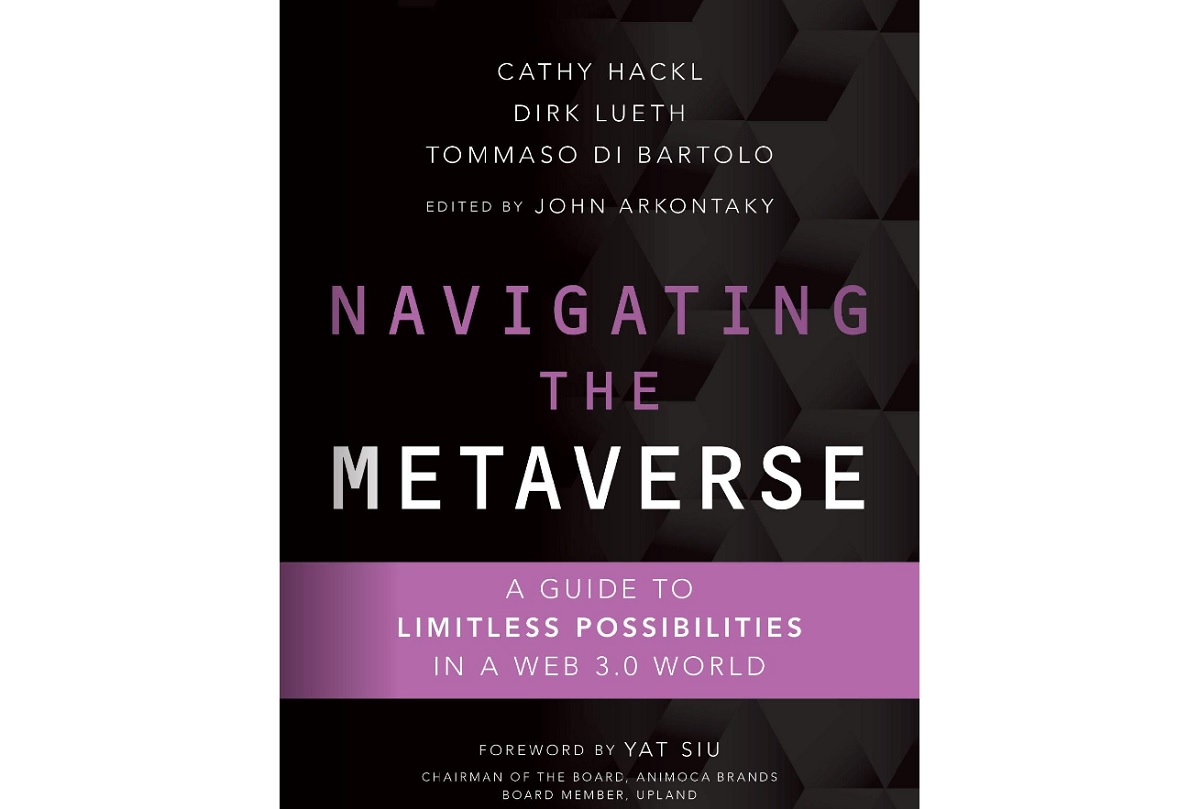
Lueth supplied the serial entrepreneur's definition of the metaverse, describing a parallel, immersive world that blurs with the real one and allows people to assume multiple identities. Yet his more revealing contribution may be his argument about land. Responding to the idea that virtual real estate was inherently absurd, he reached for the economist's toolbox: capital, labor, land, and entrepreneurship. Digital land, in his view, was valuable not as a decorative deed but as a platform where people could build applications, businesses, and social experiences.
That distinction separates an economy from a souvenir shop. Land without activity is a collectible map square. Land with creation, labor, trade, and neighbors becomes infrastructure. It may also become complicated, contentious, and rather full of zoning debates. One suspects the first truly realistic virtual city will eventually need a planning commission.
An open world needs doors
Lueth's ambitions extend beyond Upland. In 2022, he co-founded the Open Metaverse Alliance for Web3, known as OMA3, and became its chairperson. The alliance works on standards intended to let identities, assets, and services move across virtual worlds. It is the plumbing problem behind the poetry of an open metaverse.
Interoperability is easy to praise and hard to implement. A sword from one game may have no sensible power in another. A reputation earned in one community may be meaningless, or dangerous, when exported elsewhere. OMA3's work acknowledges that openness needs shared technical rules and trust frameworks, not just unlocked doors. Lueth's career has repeatedly returned to this point: markets depend on protocols that participants can understand.
His personal geography carries its own quiet duality. German by birth and American by naturalization, he told a German radio host in 2023 that he increasingly felt like a tourist in Germany. By then he had lived around Mountain View for roughly 15 years and enjoyed the rare Californian luxury of bicycling to the office. He speaks German, English, French, and Spanish. Upland's official biography adds, with affectionate mischief, that he also speaks “Economics, and long-term planning.”
After the fashionable word
The metaverse boom receded, as technology booms tend to do once the conference badges are boxed away. Upland kept shipping. Its 2025 recap counted five new international cities and 190 development updates. In 2026, the company announced office structures, trade routes, marinas, boats, fishing, and a progression system built around collectible resources called Troves.
These additions sound pleasantly game-like. That is the point. Lueth has described Upland as a deep city-building game that uses blockchain where it can provide property rights and economic activity, rather than a blockchain product searching for something amusing to do. The distinction is not theatrical, but it is useful. Players generally arrive to play. The ledger should know when to leave the stage.
The thread across Lueth's work is not a belief that every part of life belongs online. It is a conviction that when people do gather on a platform, its rules determine what they can create and keep. A newspaper organizes attention. A financial system organizes value. A virtual city organizes both, then adds neighbors.
His years advising startups add another dimension to that view. Market entry is rarely solved by invention alone. A founder has to explain a product, finance its growth, adapt it to unfamiliar customers, and decide which parts of the company should remain fixed while everything else changes. Those are also the daily questions of a persistent game. Upland has to welcome new players without erasing the advantages earned by old ones. It has to add cities without making the first city feel disposable. It has to make ownership legible without letting a wallet become the whole personality of the place. Lueth's operating range, from investor relations to economic design, is unusually suited to managing those tensions. His job is partly to make a strange world understandable and partly to keep the understandable world strange enough to explore.
Upland remains an experiment, as any living economy must be. Its map keeps expanding, but Lueth's harder project stays mostly invisible: preventing novelty from outrunning trust. The colorful city is what players see. The rules beneath it are what let them come back.