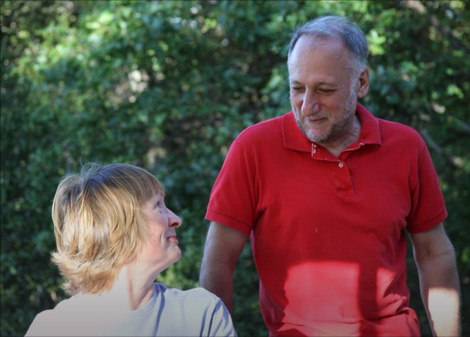
Dino Dina with Corry Dekker — Howell Mountain, Napa Valley — Cimarossa Winery
Physician • Vaccine Pioneer • Vintner
The Genovese scientist who spent 15 years building Dynavax - then climbed a mountain in Napa to grow Cabernet.
The Profile
Dino Dina grew up on a working farm in Genoa, Italy - the kind of place where plowing was still done with oxen and every season had a particular smell. He left for medical school at the University of Genoa, then crossed the Atlantic for a genetics faculty position at the Albert Einstein College of Medicine in New York. The move that changed everything came when he pivoted toward biotechnology and landed at Chiron Corporation in San Francisco, a company then at the center of the emerging molecular biology revolution.
At Chiron, he built the Vaccine Group almost from scratch - overseeing early research into AIDS and hepatitis B at a moment when the field was still learning what vaccines could accomplish against the most stubborn viruses. He rose to President of Chiron Vaccines, and under his watch the company achieved the first-ever regulatory approval of an adjuvanted influenza vaccine in Italy. It was a quiet landmark: the idea that adding a precise immune-boosting compound to a vaccine could amplify its protection without compromising its safety profile. That idea would follow him for the rest of his professional life.
"Dino and I are the 'right' kind of crazy: Equally passionate about wine and the property. You want to be with someone that places quality first. Dino does."- Mia Klein, Winemaker, Cimarossa
In 1997, he joined Dynavax Technologies as President and CEO. At the same time - in a move that reveals something essential about how he thinks - he bought a 60-acre property on Howell Mountain at the eastern edge of the Napa Valley and planted vines. Not as a retirement plan. Not as a hedge. He was in his prime and running a company that was staring down some of the hardest problems in vaccine development. He just also happened to believe in terroir.
The mountain property was a horse ranch when he found it. Piña Vineyard Management tested the soils and told him the land could support world-class grapes. He named the estate Cimarossa - Italian for "red hilltop" - and planted 15 acres of vines across three sites: Riva di Ponente, Riva di Levante, and Rian. In the same year he was steering Dynavax through early clinical development, he was learning what 2,100 feet of elevation on a volcanic ridge does to Cabernet Sauvignon.
Dynavax's core technology was CpG 1018 - a synthetic adjuvant designed to amplify immune response through a specific receptor pathway (TLR9). The hypothesis was that a hepatitis B vaccine using CpG 1018 could generate faster and stronger protection with fewer doses than the conventional three-shot series. The clinical path stretched over more than a decade. Dina ran the company through that whole arc: through early trials, through a partnership with Merck (and its subsequent dissolution), through regulatory reviews, and through the strategic pivots that any biotech CEO will recognize as the real job description.
HEPLISAV-B was eventually approved by the FDA in 2017, four years after Dina had retired. But the foundation he built and the scientific conviction that drove the CpG 1018 program were his. The adjuvant technology that Dynavax developed under his leadership would later become a key component in multiple COVID-19 vaccine candidates worldwide - partnered with Biological E., Medigen, Clover Biopharmaceuticals, and others - when global demand for effective adjuvants surged in 2020 and 2021. CEPI committed $99 million to support CpG 1018 manufacturing for the global COVID-19 response. Not bad for a technology Dina's team was quietly developing in Emeryville while the rest of the world hadn't yet heard of mRNA vaccines.
The Connection
Dino noticed early in his career that the Saccharomyces yeast used in biotechnology - the workhorses of recombinant protein production - are close cousins of the organisms that ferment wine. It is a small observation that opens onto something larger: the disciplines share more than metaphor. Both demand an exacting relationship with biological systems that respond to conditions you can only partially control.
At Chiron and later Dynavax, he applied this mindset to adjuvant technology. CpG 1018 is not a blunt instrument. It activates a specific toll-like receptor (TLR9) to direct the immune system's attention without overstimulating it - precision over power. The same logic that calibrates a vaccine's adjuvant system governs what happens when a winemaker decides how much new oak to introduce and when.
Cimarossa's first vintage dates from 2003. From an initial 300-case experiment, the estate grew to ~1,200 cases of high-elevation Napa Cabernet Sauvignon - the kind of mountain wine that ages differently from valley floor bottles, leaner in texture, more mineral, longer on the finish.
Winemaker Mia Klein joined in 2009 and the collaboration has been central to Cimarossa's reputation ever since. Dino and his wife Corry, who met at Chiron and have lived on Howell Mountain together, also produce olive oil from roughly 1,200 trees planted across the estate - a detail straight from the Ligurian countryside where Dino grew up.
He also published a cookbook pairing seasonal family recipes with estate wines - the kind of project that only makes sense if food, family, and the land are genuinely the same thing to you.
Career Timeline
Legacy
Chiron Corporation
Italy's First Adjuvanted Flu Vaccine
As President of Chiron Vaccines, he led the program that earned the first-ever approval of an adjuvanted influenza vaccine in Italy - proving the concept that adjuvant technology could safely enhance vaccine efficacy.
Dynavax Technologies
15 Years Building HEPLISAV-B's Foundation
Led Dynavax for 15 years through the clinical and regulatory journey that eventually yielded the FDA-approved HEPLISAV-B - a two-dose hepatitis B vaccine that delivers faster, stronger protection than the standard three-shot series.
CpG 1018 Technology
A COVID-Era Global Health Platform
The CpG 1018 adjuvant Dina's Dynavax developed became critical infrastructure for the global COVID-19 vaccine response - licensed to multiple manufacturers across India, Taiwan, and beyond, with $99M in CEPI funding for manufacturing scale-up.
Cimarossa, Howell Mountain
A Mountain Estate Built on Genovese Roots
From a grazing property to a 1,200-case mountain wine estate over two decades, Cimarossa reflects Dino's belief that distinctiveness and terroir are the only competitive advantages worth having - in wine or in life.
Character Notes
His dogs are named Galileo and Tobias - one named for the greatest Italian scientist, the other for reasons known only to Dino and Corry.
Cimarossa sits at 2,100 feet on the Vaca Range - the eastern mountains of the Napa Valley. The elevation changes everything about how the grapes develop.
He planted 1,200 olive trees across the estate alongside the vineyards - a nod to his Ligurian origins, where olive oil and wine are inseparable from the landscape.
He published a cookbook featuring seasonal family recipes paired with Cimarossa estate wines - the project of someone who genuinely believes food, wine, and family are one subject.
Biotech yeast and wine fermentation yeast are closely related - Dino noticed this parallel early at Chiron, and it crystallized something about how two careers could run in parallel without contradiction.
He bought the Howell Mountain property in 1997 - the same year he became CEO of Dynavax. The two projects started together and evolved in parallel for the next 15 years.
He met his wife Corry while both were working at Chiron Corporation in San Francisco, bonding over biotechnology before bonding over mountain vines.
The property was a horse ranch when Dino bought it. Soil tests recommended serious viticulture. He listened to the soil.