A health app can work perfectly and still go nowhere. Someone has to decide whether it solves the right problem, whether the evidence holds up and how it fits into a service already under pressure. DigitalHealth.London has made a business-support programme out of that awkward interval between a demonstration and everyday use. Its most revealing work happens after the applause, when a founder discovers how much remains to be done.
Consider Concentric Health. Its digital consent platform was already in hospitals when it joined the Accelerator. The team understood academic research, but needed help matching its evidence to NHS expectations. Workshops and an NHS Navigator helped it reconsider a planned randomised trial: under the framework used at the time, that extensive study might not be necessary. The useful intervention was a better research question.
A city full of expertise, with a connection problem
DigitalHealth.London emerged in 2016 from a coalition of London health innovation organisations, academic connections and hospital charity support. The London Health Commission had identified a frustrating mismatch: the capital had scientific talent and clinical expertise, yet small companies struggled to access input, money and NHS adoption. Bringing those assets into the same working conversation became the assignment.
The founding coalition included the Health Innovation Network, Imperial College Health Partners, UCLPartners, MedCity and CW+. Today, Health Innovation Network South London delivers DigitalHealth.London, with CW+ among its programme partners. This institutional lineage explains its place in the market. Its product is access to expertise, structured support and relationships within healthcare.
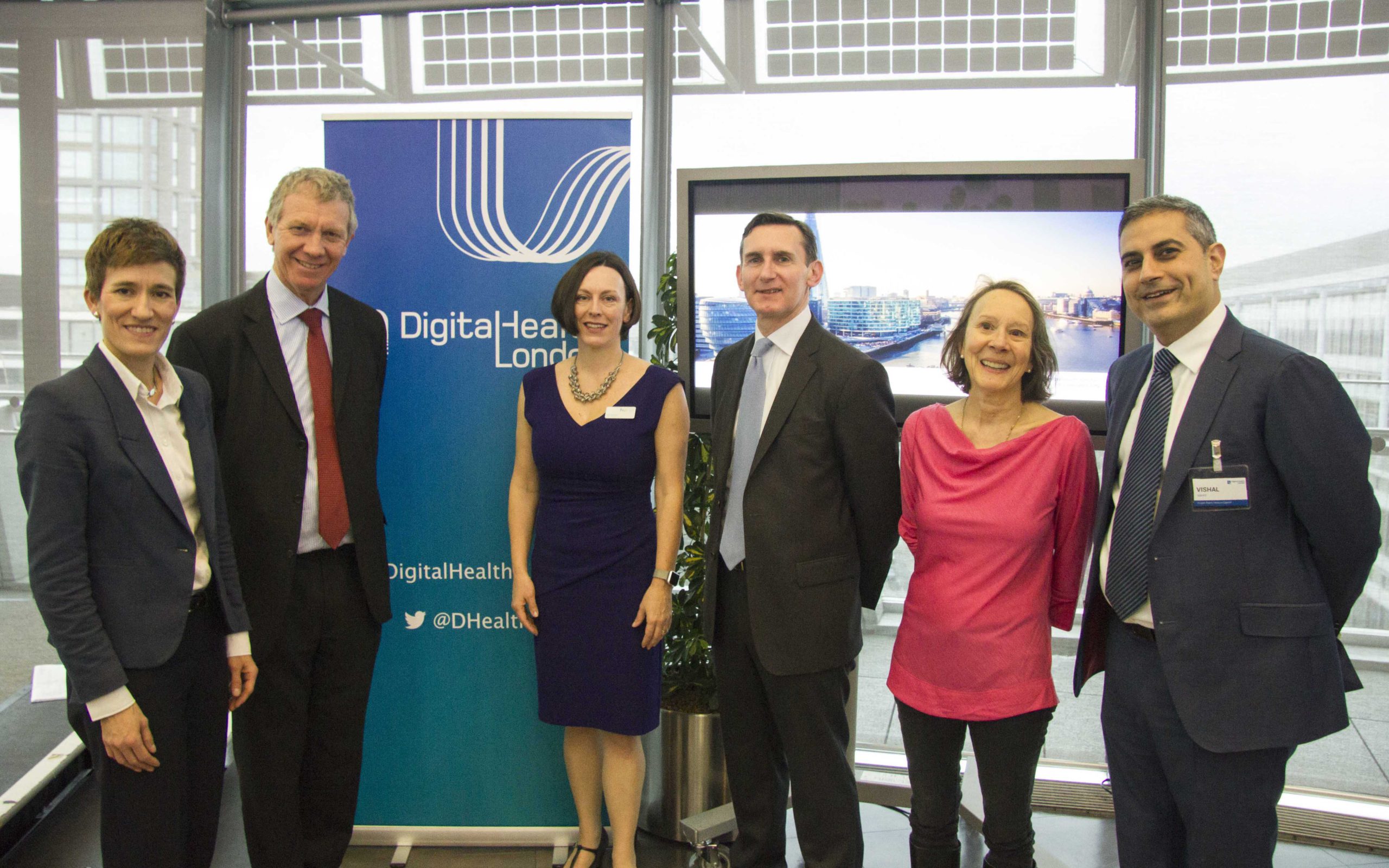
Jenny Thomas led the Accelerator’s setup. In her 2022 departure reflection, she credited Anna King and the institutional partners with shaping the organisation’s vision. She also described an early market in which interest in digital health startups was difficult to win. By her departure, the task had moved towards making adoption spread.
“Our focus has shifted to how we can roll this out at scale.”
Jenny Thomas, Programme Director, June 2022
That shift matters. A service designed only to introduce founders to hospitals would eventually encounter a second problem: an introduction cannot do the work of implementation. DigitalHealth.London’s expanding offer reflects the different kinds of preparation that companies, researchers and health service staff need.
The person who knows which door to try
The flagship Accelerator runs for twelve months and generally serves companies with products that have already been piloted and are ready to spread. Participants work with an assigned NHS Navigator, drawing on clinical or service-management experience. Workshops and direct conversations with healthcare professionals help them refine products and develop relationships around specific needs.
That is an unusually literal job title. A Navigator helps a company understand the terrain it wants to enter. For a founder, the practical value lies in learning which problem deserves attention, which people understand it and what a credible next conversation should contain. DigitalHealth.London’s connections are useful because they come with knowledge of the work those people do.
The range of participating technologies makes the point. Its directory includes Healthtech 1’s administrative automation, Ufonia’s automated telephone conversations and Concentric’s digital consent. The shared problem is getting a service to adopt them. Their software, commercial contracts and patient-facing responsibilities belong to the companies themselves.
Launchpad works earlier in the process. Its published 2025 offer included workshops, individual guidance and peer networking over ten weeks. The Digital Health Guide’s task was to prepare companies for their market; that offer explicitly excluded a focus on introductions to buyers or pilot sites. The distinction is useful for anyone tempted to treat every accelerator programme as a sales channel.
Evidence can change the plan
Concentric’s economics work shows how untidy useful support can be. A 2020 proposal failed to attract a suitable MSc student. Further introductions through its Navigator opened a route to King’s College London, with research planned for autumn 2021. The first match failed; the relationship continued. Its CEO later described conversations moving from explaining digital consent towards working out local implementation.
The lesson is to identify the decision a study must inform before committing to the study. In this historical case, mapping evidence requirements changed the proposed work. It is a lesson about research planning, rather than a universal instruction to skip a trial.
Regimen offers another example. The company’s approach to erectile dysfunction combined lifestyle support and digital tools. An expert roundtable highlighted the potential role of primary care and pharmacies, while stressing the need for efficacy and cost-effectiveness evidence. Participants also suggested collecting additional information about the patient journey. The company subsequently worked on platform functionality to support that data collection.
Here, feedback reached into product development. A founder could copy the process: bring clinicians and researchers into the discussion, identify missing information and build a way to collect it. The resulting work still has to establish whether the intervention deserves adoption. A promising discussion is the beginning of that investigation.
The 2026 Evidence Generator Bootcamp formalises this kind of preparation. Its ten-week online schedule, starting in the week of 22 June, combines five expert workshops, peer sessions, resources and guidance from an NHS Digital Guide. It targets companies developing or launching products that need stronger evidence plans. The service helps organise research and evaluation; the company must carry the plan into practice.
Public money, and a founder’s working week
The financial model follows the programme’s institutional roots. The Accelerator draws on public and partner support, including the UK Shared Prosperity Fund and Office for Life Sciences. Historically, a 2018 announcement identified up to £1.7 million in European Regional Development Fund backing. These are programme resources, separate from investment raised by participating businesses.
The Accelerator takes no equity and provides no direct investment. Its FAQ values the support at approximately £35,000 for subsidy-accounting purposes. Founders should read that as a value assigned to assistance, rather than a cheque arriving in the company account.
Approximate value for subsidy accounting. Delivered as support, with no direct investment.
Participation also uses scarce working hours. The programme describes an engaged representative spending at least three to four hours a week and attending four mandatory London events. Travel costs are not reimbursed. A founder needs the capacity to attend, follow up and change course; useful advice creates work of its own.
The numbers include two misses
The 2023–25 Business Support for London evaluation reports £1,378,632.63 spent against a £1,379,257.04 contract. Across six programmes, it supported 160 companies. Its results also expose the limits of organised encouragement.
Business Support for London programme. Full bar = contractual target.
Jobs fell short. Enterprise creation fell much further short. The team responded to employment risk by extending support to more mature alumni, while a delayed contract prompted a larger Launchpad cohort. The evaluation points to funding constraints, NHS budgets and policy changes as obstacles to job creation. Supporting prospective founders did not reliably turn them into registered businesses.
These results are a reminder to judge support by several outcomes. Attendance and advice delivered are useful operational measures. A viable company and an adopted product require decisions beyond the programme’s control.
The adopter needs support, too
DigitalHealth.London’s Digital Pioneer Fellowship, launched in 2018, addresses the people inside services. It supports staff leading digital projects, including clinicians, managers and IT professionals. The South West London programme describes twelve months of learning, with six learning days, peer problem-solving and work on business cases, evaluation and change management.

That broadens the organisation’s audience beyond entrepreneurs. The staff member trying to introduce a new service has colleagues to persuade and practical arrangements to make. Preparing the supplier addresses only part of that workload. Training people within the service gives the other side of the relationship somewhere to turn.
There is a human clue in Thomas’s retrospective: Yinka Makinde championed the Fellowship after identifying the need to support NHS staff alongside companies. Thomas also described learning to seek feedback in settings where people felt comfortable being candid. Both observations favour close attention to participants over a programme that simply repeats its workshop calendar.
More launches, and a wider map
HIN’s 2025/26 impact report records nineteen product launches from Launchpad’s eighth cohort in November and December 2025. It also reports that the eighth Accelerator cohort, running from September 2024 to September 2025, selected seventeen companies from 117 applicants. Those companies created more than fifty jobs, and three entered new markets. These are separate cohort results, rather than additions to an undated lifetime total.
The organisation is also extending its geographical connections. Global Alliances launched in September 2025 after more than thirty international ecosystem partners had visited during the preceding two years. The initiative aims to formalise knowledge exchange and market-access support in both directions: bringing innovations towards London and helping British companies understand opportunities overseas.
For applicants, the choice remains practical. The NHS Innovation Accelerator offers a national route; SBRI Healthcare addresses development funding; the Clinical Entrepreneur Programme supports staff entrepreneurship. DigitalHealth.London occupies the space around digital companies and London’s adoption needs. Its value depends on having a relevant product, a question that support can answer and the resources to act. The founder who arrives knowing what needs to change has a better starting conversation.
Keep the conversation going
Explore the programmes, meet the community or watch an archive conversation about putting digital health into practice.
Visit DigitalHealth.London ↗Explore the Accelerator ↗Evidence Generator Bootcamp ↗LinkedIn ↗Twitter / X ↗Read Jenny Thomas’s reflections ↗Watch: patient demand and implementation ↗