At eighteen, Diego Fanara stepped off a plane at Heathrow carrying a decision he had already made and questions nobody had answered. He had left Geneva for London in 2011 to study at Cass Business School, now Bayes. The usual machinery of university choice had done its work: rankings ranked, brochures beamed, websites supplied tidy descriptions. Yet none could perform the modest miracle of introducing him to a student who might say what life there actually felt like. The paperwork was abundant. The human signal was faint.
Fanara has described that period plainly: “I felt alone in that decision.” It was an expensive, international leap shaped by institutional language when what he wanted was lived experience. His parents had pursued entrepreneurship rather than advanced education, so there was no inherited map for the choice. As a child he had pictured Wall Street or financial management in London. Before he could reach that future, he first had to work out where, and whether, to study.
London gave him an answer of a different sort. Once he had learned the rhythms of student life, friends and relatives back in Switzerland began asking him for advice. The prospective student who lacked a guide became the guide. Questions crossed borders because useful candor traveled better than another polished paragraph. Somewhere in that reversal was a company, although it did not yet have a widget, a dashboard or a cheerful name.
A message, a roundabout, a coffee
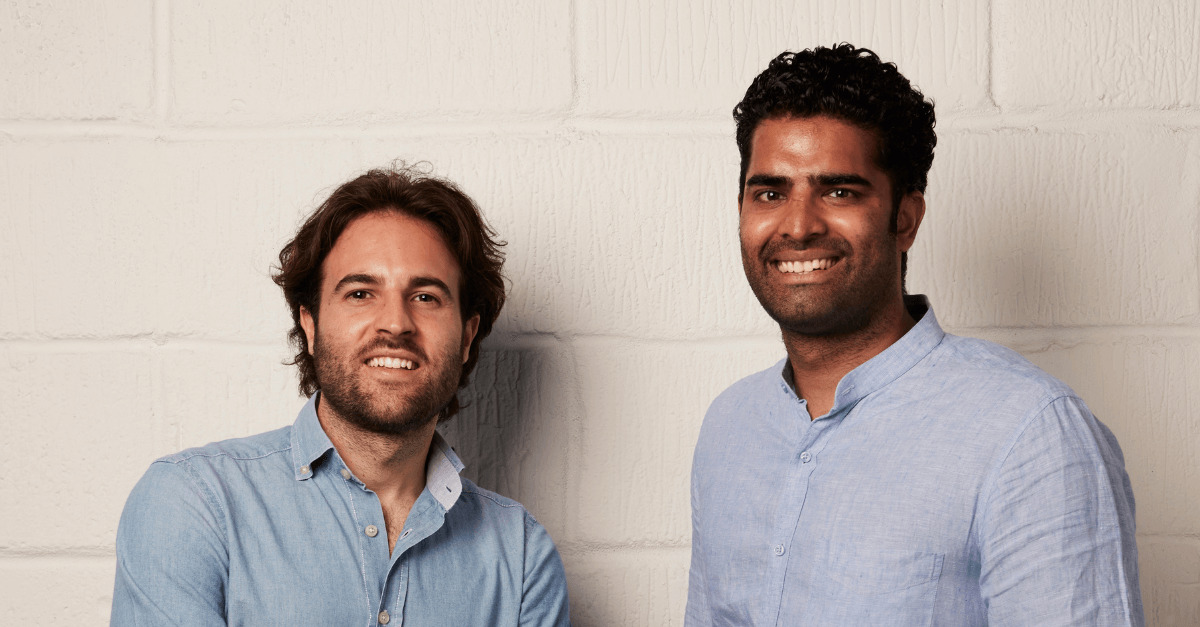
The co-founder arrived through the same medium the product would eventually celebrate: a direct conversation. Fanara sent Kimeshan Naidoo a message on LinkedIn. Naidoo had moved from South Africa to London for a master’s degree in computer science at University College London. He immediately recognized the problem. He, too, had crossed countries without knowing what awaited him.
Then came the geographical joke. The pair discovered they lived opposite the same roundabout near Old Street. They met at a local coffee shop. Fanara brought a problem sharpened by years of thinking about it; Naidoo brought the ability to build and a dissertation project that could become an early form of the software. Great distances had produced the insight. A very short walk produced the partnership.
“I could see the power that insights have on shaping a prospective student’s perception of a university.”Diego Fanara
The first attempts were useful mainly because they were wrong in different ways. The founders built a dashboard for high schools, thinking schools might be the customer. Then came a marketplace connecting prospective and current students on Unibuddy’s own platform. The eventual breakthrough was an embeddable web app that universities could place on their sites and make feel native. The conversation appeared at the exact point where formal information ran out.
The route to product-market fit
The first conversation
Five institutions agreed to pilot the platform: Queen Mary University, Royal Holloway, Imperial College Business School, New College of Humanities and Lancaster University. The engineering burden was unusually social. Unibuddy needed three working surfaces from day one: a widget for prospects, an app or dashboard for student ambassadors, and a dashboard for university staff. A conversation may look simple on screen. The machinery needed to make it safe, useful and institutionally manageable was not.
When the Queen Mary widget went live, Fanara watched the first messages from his living room in Shoreditch. He later remembered reading the conversation and having to pinch himself. Founders are often photographed beside giant funding numbers; the more revealing portrait is a person staring at two strangers typing. The first exchange proved that the private frustration from Geneva could become a public utility.
Those are Unibuddy’s current published figures. A 2026 UCL profile put the partner count above 600 and said students used the platform in 191 countries. The exact totals will keep moving. The more durable measurement is confidence: UCL reported that nine in ten surveyed users felt more confident about their university choice, while one analysis at NYU Tandon found users were 85 percent more likely to enroll than non-users.
Institutional trust, earned in stages
For Fanara, scale arrived as a sequence of credibility tests. The first was seeing the widget work. The second was international expansion, evidence that loneliness at the threshold of university was hardly a British peculiarity. The third was a partnership with UCAS, the UK’s admissions service. Unibuddy was still an underdog when UCAS trusted it to integrate peer conversation into its digital framework. Fanara viewed that trust as proof the company could be taken seriously across higher education.
The fourth test was abrupt. When campuses closed during the pandemic, institutions needed digital ways to preserve open days, student contact and a sense of campus. Unibuddy developed an events platform, and Fanara saw how much responsibility partners were willing to place on the company. The technology did not replace a university. It kept the social doors ajar while the physical ones were shut.
Community is the conversion
Fanara’s commercial argument is disarmingly personal. Students may consider an institution because of its courses, location or other rational parameters, he has said, “but they convert for the community.” In this view, an applicant is not merely buying instruction. They are rehearsing a future identity: the people they might meet, the place they might inhabit, the version of themselves that could belong there.
That insight nudged Unibuddy beyond recruitment chat. Community, introduced for incoming and admitted students, offered group spaces where classmates could find one another before arrival while university staff retained the ability to moderate. Events brought the open day online. Ambassador profiles and content made student life browseable. Each extension followed the same thesis: institutional facts start consideration, but human recognition helps a decision become real.
“It’s actually to scale one-to-one intimacy. That’s what students want.”Diego Fanara
“Scale intimacy” sounds like a contradiction, which is why it is useful. Scale usually standardizes. Intimacy depends on specificity. Unibuddy’s product challenge is to expand access to individual guidance without turning every student into a script. The student ambassador matters because they are not an admissions brochure wearing trainers. They have recently navigated the accommodation, the lecture hall and the awkward first week.
When customers repeatedly ask you for advice based on an experience you have just lived, do not dismiss the request as a favor. Write down the questions. A product may be hiding in the pattern.
From funnel to journey
By 2026, Fanara’s language had moved from a recruitment funnel to a student journey. A funnel is satisfyingly geometric. People are not. They circle, compare, ask a parent, message a stranger, lose confidence, regain it and occasionally change their minds for reasons no campaign planned. Fanara argues that institutions should read this movement through conversations as well as clicks.
Unibuddy’s newer Assistant adds artificial intelligence to that map. Launched in 2025, it is designed to learn what a student needs and match them with suitable information or a person who can help. Fanara’s 2026 agenda also includes turning conversations into dashboard insights, comparing patterns across regions, building onboarding hubs and expanding peer networks from one-to-one toward peer-to-many guidance.
The ambition is operational and oddly tender: help institutions see uncertainty sooner, then offer clarity before silence becomes departure. AI may sort, summarize and route. The company’s founding object remains a useful exchange between people. Its future therefore depends on a careful handoff between machine efficiency and human trust.
The financier’s other risk
Fanara studied investment and financial risk management at Cass, then completed an MSc in Finance at Imperial College London. He also attended a corporate valuation summer program at Columbia Business School. The education fits the childhood plan. The company that followed applies a financier’s attention to uncertainty in a domain where the stakes are personal rather than purely monetary.
In 2021, Highland Europe led a $20 million Series B, taking Unibuddy’s reported funding to $32 million. Fanara said the money would support product development, hiring and expansion in the United States and Asia-Pacific. He later relocated to the US to help grow North American partnerships. Capital accelerated the machine, but it did not alter the original question: where can a student find information that feels honest enough to act upon?
The answer has grown from a chat box into a broader student-experience platform, yet its emotional unit is unchanged. A teenager stands before a consequential choice. An institution has plenty to say. Somewhere on campus, a peer has precisely the ordinary knowledge that makes the future imaginable. Fanara’s work has been to shorten the distance between them.
There is a pleasing loop in the story. The young man who lacked a guide became a guide to people back home; the guide became a founder; the founder built infrastructure so guidance would no longer depend on knowing the right person by accident. Unibuddy’s software may be complicated. Its promise fits comfortably inside a message bubble: you do not have to make this decision alone.