A conversation is an inexpensive way to start a company. Keeping the conversation worth having for thirteen years is rather more demanding. Dhiraj Chhabra traces BuzzClan back to an exchange with Sachin Jain: two people who thought they could fill a gap in the technology market. In March 2013, they co-founded the business. By 2025, it had appeared on the Inc. 5000 for five consecutive years.
There is a temptation, with a record like that, to begin with the trophy cabinet. Chhabra supplies a more interesting entrance. When he talks about the company’s beginnings, he returns to a shared belief, then to the people who helped sustain it. The business has acquired more services, more markets and more recognition. His telling still starts with another person across the conversation.
Today, Chhabra is BuzzClan’s co-founder and chief executive, based in McKinney, Texas. He is also known as DJ. It is a pleasantly compact name for someone whose working vocabulary includes enterprise architecture, cloud infrastructure and digital transformation. The initials travel more lightly than the job description.
A technical career before the corner office
Before BuzzClan, Chhabra held roles at Tata Consultancy Services, Tech Mahindra, Navisite, Verizon and Keste. His work crossed technical architecture, account management, business development and delivery. That combination matters: the person designing a system and the person explaining its cost to a customer are often expected to speak different dialects of the same language.
His professional experience has taken in the United States, Canada, the United Kingdom, India, Kenya and Singapore. Working across those settings gave his career an international dimension before his own company expanded abroad. His technical specialties have included Oracle systems, infrastructure and cloud services, alongside the practical business questions of budgets, change management and taking products from concept to launch.
There is a business-school chapter, too. Chhabra holds an MBA from the University of Texas at Austin’s McCombs School of Business and a bachelor’s degree from Maharshi Dayanand University. His listed McCombs years, 2012 to 2014, overlap BuzzClan’s founding. Business education and the early business itself occupy the same stretch of his timeline.
His education did not end with the MBA. In July 2024, he added a Wharton Online and Wall Street Prep private equity certificate to his professional profile. It is a further point of contact between the technical and commercial sides of his career. The architect who works through a system’s dependencies is also interested in the financial language surrounding a business.
Two founders, and a widening map
Chhabra and Jain built BuzzClan together; Jain now serves as chief technology officer. The partnership is the recurring relationship in Chhabra’s account of the company. Looking back on its origin, he called it “a simple conversation.” It is an appealingly modest beginning for an enterprise now concerned with the complicated conversations between software, data, security and people.
The early offering focused on private cloud, with Oracle Gold Partner recognition part of the company’s beginnings. India and Canada followed in 2015 and 2016. In 2019, BuzzClan expanded into public-sector work in the United States and Canada and extended its operations to Kenya. A company founded in Texas was developing a wider working map.
That history also explains the breadth of Chhabra’s present remit. BuzzClan combines consulting and implementation with staffing. A technology project needs a plan, a functioning system and people able to operate it. The company sells services across those needs. For its chief executive, the territory stretches from technical decisions to hiring and customer relationships.
- 2013Founded by Chhabra and Jain
- 2015–16Presence in India and Canada
- 2019Public-sector expansion and Kenya
Five years, without a straight line
The five Inc. 5000 appearances give the story a useful piece of arithmetic. From 2021 through 2025, BuzzClan appeared each year on the ranking of growing private American companies. Its positions moved in both directions. The sequence offers a more honest picture than a decorative arrow forever pointing upward.
The 2023 position was No. 1,604; the 2025 position was No. 2,133. In between came No. 3,020 in 2024. Those are places on a comparative list, rather than a direct measure of annual revenue. They tell readers where BuzzClan ranked in each edition. Treating every change as a complete verdict on the business would ask the numbers to do a job they were never hired for.
Recognition continued in 2026 with No. 109 on the Inc. Regionals Southwest list, which recorded 37 percent growth over two years. Chhabra’s company had also been a Dallas 100 honoree in 2017, 2023 and 2024. The repetition is the meaningful detail: recognition became a recurring feature of a business that had begun more than a decade earlier.
A reception, and a reason to keep listening
At an SMU Cox Dallas 100 CEO reception, Chhabra and Jain met former Red Bull executive Stefan Kozak. Chhabra later described being struck by Kozak’s humility and the story of his career. The photograph preserves the agreeable social fact: three businesspeople at a reception, taking time for a picture between conversations.
Chhabra drew a lesson from the encounter: “dream big and work even harder to achieve it.” Coming from a founder at an event celebrating company growth, the sentiment fits the occasion. The more revealing detail is his interest in somebody else’s path. He attended as a business leader and came away talking about what he had learned.
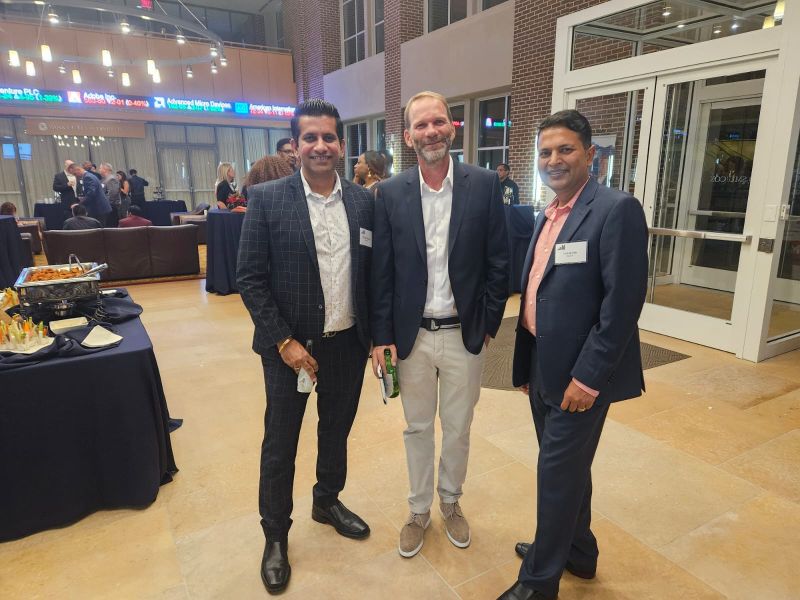
Company milestones can make entrepreneurship look solitary, with a founder permanently positioned at the centre of the frame. This scene has a different charm. Jain is there beside him, just as he is in the founding story. Even at an awards reception, the partnership remains visible.
The teacher in his account of success
When Chhabra wrote about the women who had shaped his life, he began with his mother. She was a teacher, balancing her career with caring for the family. He credited her with lessons that helped him reach his present position. Before the professional mentors and the executive gatherings, there was somebody doing the daily work of teaching.
He also described his wife as a partner in pursuing their shared ambitions and his daughter as a reminder of everyday pleasures. These are personal acknowledgments, offered in his own public account. They make the familiar phrase about family support more specific: a mother with a profession of her own, a marriage described through partnership, a child who draws attention beyond work.
The same reflection connected his family experiences with BuzzClan’s support for Women of Work. He thanked Jeannine Parise for the introduction and Anamika Jain for taking an ambassador role. He pointed to initiatives for mothers returning to technology work and for military spouses. The personal story led directly into a question about who gets an opportunity to work.
Making room for a return
In 2024, Chhabra announced that he was a top-ten finalist for the HeForShe Advocacy Award at the Women of Work conference. He linked the recognition to support for gender equality and to BuzzClan’s involvement with the Military Spouse Employment Partnership. The distinction was a finalist placement, a specific acknowledgment of the advocacy he had been discussing publicly.
There is a practical thread here for a founder whose business includes staffing. Returning after a career break, or finding work as a military spouse, brings questions about access to employment into the hiring process. Chhabra has chosen to put those questions into his public account of leadership, alongside growth awards and technology announcements.
The connection gives his story some texture. An executive can discuss inclusion as an abstract corporate virtue; Chhabra has also explained it through people in his own life. His account leaves the teacher in view. She belongs in the story as much as the executive at the reception.
“Plan for the unknown ‘why.’”
Dhiraj Chhabra, on preparing a business for change
Leaving space for the unknown
Chhabra’s advice on adaptability begins before the disruption arrives. In a 2021 contribution on business resilience, he argued for planning early, leaving room for uncertainty and building a workforce inclined to solve problems. His emphasis was on preparing people to respond when circumstances change. A plan, in this view, needs enough room to accommodate a surprise guest.
By 2026, the subjects in his public activity included AI governance and secure public-sector delivery. He shared a February webinar involving BuzzClan, Atlassian and Carahsoft about bringing security into everyday workflows. Later activity highlighted the governance challenges of employees using AI tools outside the full visibility of technology teams.
These are recognisable extensions of the work that came before: enterprise systems, organisational change and the people expected to make both function. AI gives the conversation new urgency. Chhabra’s earlier career supplies the surrounding questions about implementation, accountability and whether the organisation is equipped to use what it has bought.
He has put some of those professional concerns into writing as well. His published work includes a 2023 article on choosing a managed security services solution, alongside contributions to discussions of budgeting, partnerships and business presentations. The range is consistent with a working life spent moving between technical delivery and the commercial decisions that determine which projects receive attention and resources.
His stated ambition is to help boards and executive teams rethink business models through technology. It is a large assignment, but his own account keeps returning to human scale: a co-founder, a teacher, a returning worker, a conversation at a reception. The company began when two people thought there was useful work to do. Thirteen years later, that remains a serviceable reason to keep talking.
Keep the conversation going
Explore Chhabra’s LinkedIn, BuzzClan, his published contributions, the Dallas reception reflection, and BuzzClan’s Inc. profile.