By 2026, Dharmesh B. Shingala had a different question for the legal technology conversation. AI could help find information in a mass of documents. But whose AI was doing the finding? Where did it run? And who would answer for what came back? After more than two decades as Knovos’s chief executive, he was making customer control a central part of his pitch. A faster answer, in his line of work, still needs an owner.
It is a suitably practical preoccupation for someone whose career includes government software, document review and the patient business of helping organizations use their own information. The vocabulary has acquired new initials. The customer still has a job to finish and a process to explain. Shingala’s story becomes interesting when the product announcements are set beside that continuity.
The engineer before the acronym
His undergraduate studies were in a discipline concerned with how things get made: production engineering and management at the National Institute of Technology in Kozhikode, India. He later studied computer science and applications at Virginia Tech. His public education history places the undergraduate years in 1986–1990 and Virginia Tech in 1992–1993. Two technical educations, with management already present in the first degree’s name.
In 1994, he founded GDS Systems, a software business that worked primarily with the US government. Knovos’s lineage therefore begins before its own founding date. There was an earlier company and experience developing solutions for organizational clients. Eight years later, he would help establish a business with legal work in its name.
That background offers a useful way to read his later career. His customers would include federal agencies, law firms and corporate information managers. Their work brings requirements that survive changes in software fashion: access, reliability, cost and the ability to account for what happened. Taken together, those jobs give his current emphasis on accountability a longer history.
GDS Systems founded
Knovos’s business begins
TAR Guidelines contributor
Cloud and AI model choice
Two founders, three company names
In 2002, Shingala co-founded the business with Gita Shingala. It started as Capital Legal Solutions, became Capital Novus in 2013 and adopted Knovos in 2017. The sequence of names charts a widening identity, from a name explicitly tied to legal work toward one the company associates with knowledge and knowing its customers.
Gita’s role belongs at the center of that beginning. Knovos identifies her as founder and chairman and Dharmesh as co-founder and CEO. She studied electrical engineering at the New Jersey Institute of Technology and worked at the New York Port Authority and the United States Patent & Trademark Office before founding the company. Her leadership responsibilities include global management and participation in its steering committee.
The business grew through an international network. Its timeline records an office in Gandhinagar in 2006, branches in New York and Tokyo in 2007, European operations in Paris in 2008 and a London office in 2012. Singapore followed in 2024. For a company dealing with information, geography is more than a row of pins on a presentation slide. Different offices put the work closer to different customers and working environments.
The twentieth anniversary arrived in October 2022. By then, the company described a move from data processing into several areas of enterprise information management, including collaboration, arbitration and performance management. Those are different tasks, but each begins with people trying to organize information well enough to act on it. Shingala had stayed with the problem while its applications multiplied.
The work between the product launches
One revealing milestone appears in the acknowledgements of the January 2019 Technology Assisted Review Guidelines. Shingala is named among the contributors. The project brought together more than 50 practitioners and experts in an iterative drafting process associated with EDRM and Duke Law. Software-assisted review was already generating detailed questions about process years before the current generative AI conversation.
That credit places him in a professional discussion wider than his own products. Guidelines require explanations that other people can examine and use. Their foreword also acknowledges compromises and differences of opinion among contributors. It is a useful reminder that professional confidence in a technology involves a considerable amount of people discussing exactly what they mean.
In November 2020, both Dharmesh and Gita Shingala were listed for Knovos among the technology-provider participants in the Protocol for Online Case Management in International Arbitration. The protocol addressed a consistent approach to using online case-management platforms. Here again, the work concerned how people organize a process together, alongside the software that supports it.
His audience also extended beyond lawyers. At the June 2019 P.O.D Summit in Rajkot, held with technology partner The Intellects, he delivered opening remarks by video conference to people from the local automotive industry. The subject was preparing for a more data-driven industry. A manufacturer and a litigation team have different daily work; both have to make information usable.
Partnerships supplied another route into that work. In January 2021, Knovos announced a multi-year alliance with Forensic Risk Alliance, pairing Knovos’s eZReview technology with FRA’s work in data governance, eDiscovery and forensics. The arrangement put a software product inside another organization’s professional services. For Shingala, the company’s reach could also grow through people who already understood a client’s investigation.
Old friends at booth 3111
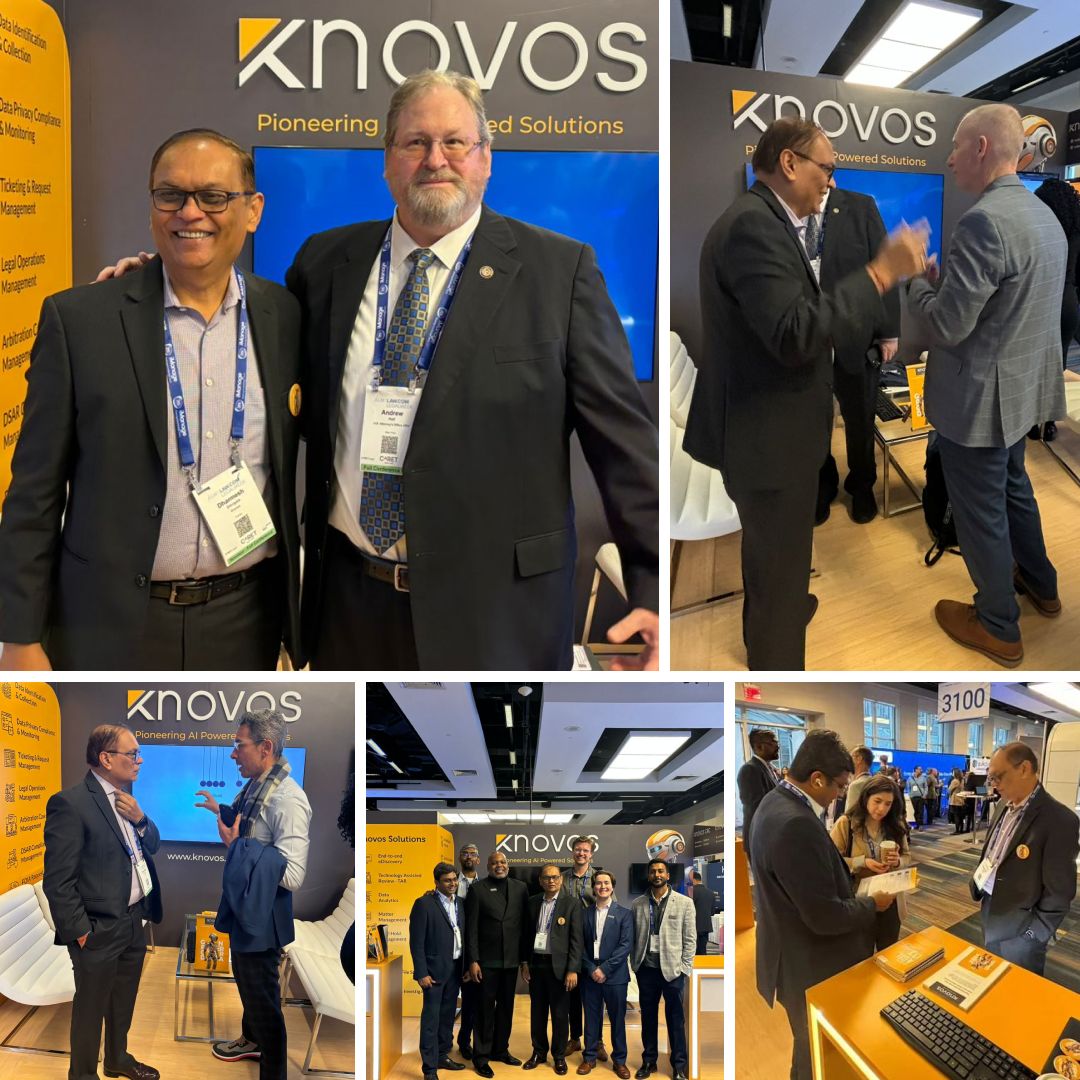
At Legalweek 2024, Shingala shared a less formal piece of his working life. He thanked friends he had known for more than two decades for the insights they had offered and invited visitors to booth 3111. His photo collage shows handshakes, small groups and conversations beside the Knovos display. The trade-show badge is doing its usual heroic work of trying to stay the right way round.
The event’s product agenda was current: generative AI assistance for searching documents, text assistance in Knovos Manage and AI-supported content searching in Knovos Rooms. Training was part of the offering too, through Knovos Academy’s video guidance, simulations and certification courses. The new features needed people who could put them to work.
Later that year, Knovos’s ILTACON announcements included transcription of deposition data, additional analysis of personally identifiable information and improvements to task tracking. Such details rarely provide a cinematic founder moment. They do show what occupies an enterprise software company between larger announcements: another piece of the customer’s day that needs to become easier to manage.
The collage and the release notes belong together. One records professional relationships; the other records changing tools. Shingala’s own description of learning from old friends gives the conference scene its point. After twenty years, there are still questions worth bringing back to the booth.
Who chooses the intelligence?
By Legalweek 2026, the product argument had become more explicitly about who makes the choices. Knovos promoted Bring Your Cloud, which lets customers deploy in their preferred cloud environment, and Bring Your AI Model, which lets them use approved models within Knovos workflows. Both proposals put an organization’s existing requirements into the architecture of the product.
“Legal teams need speed, but not at the expense of defensibility and control.”
Dharmesh Shingala · February 2026
The distinction between the two choices is useful. A cloud decision concerns where the software operates. A model decision concerns which intelligence is applied inside its workflows. A customer may care about both, for different reasons. Knovos was placing those decisions in the foreground of its offer, alongside search and document-summary enhancements.
Where it runs
Bring Your Cloud
Preferred cloud environment
Which model it uses
Bring Your AI Model
Approved AI within the workflow
In a May 2026 essay, Shingala argued that model choice belongs in leadership discussions. He described legal teams asking more specific questions about infrastructure, data and responsibility. His stated ambition was to allow AI adoption within an organization’s own requirements for oversight. It is a product position, and also a way of deciding which customer concerns deserve engineering attention.
This is the clearest expression of his present professional aspirations. He wants organizations to retain a say in the systems examining their information. The appeal is readily understandable without treating it as a guarantee of any particular result. A buyer can ask about model choice and still need to examine how the whole process works.
A laptop is a place, too
In August 2026, Knovos announced Discovery Lite, a standalone application for local eDiscovery and digital investigations. It was designed for situations where evidence must remain local or connectivity cannot be relied upon. Processing, search, review, redaction and production could take place in a controlled local environment, including offline and air-gapped settings.
After the discussion of cloud choice and AI models, a laptop might seem an unexpectedly modest place to end. Yet the launch fits the same practical concern: the customer’s working conditions should shape the tool. The investigator still needs to begin, even when a continuous connection is unavailable.
Shingala’s career has moved through engineering degrees, government software, company name changes and several generations of legal technology. His recent work keeps returning to the organization using it: the people who must choose the environment, understand the process and take responsibility afterward. The software can acquire another acronym. Someone still has to know where the documents went.