BREAKINGDeptrum ships the world's first non-VCSEL structured-light depth camera•
$68M raised across six rounds•
1,000+ patents filed•
Ex-Apple depth lead now runs the show in Pudong•
HandPass turns your palm into a wallet•
Stellar · Aurora · Nebula: depth cameras named after the sky•
Forbes 30 Under 30 founder, Optics-of-the-Year alum•
Dispatch — The present tense
A small black sensor, doing a big invisible job
Somewhere right now, a warehouse robot turns a corner it cannot afford to misjudge. A car decides whether the person in the driver's seat is awake. A hand hovers over a payment pad and the machine asks a quiet question: is this a real palm, or a photograph of one?
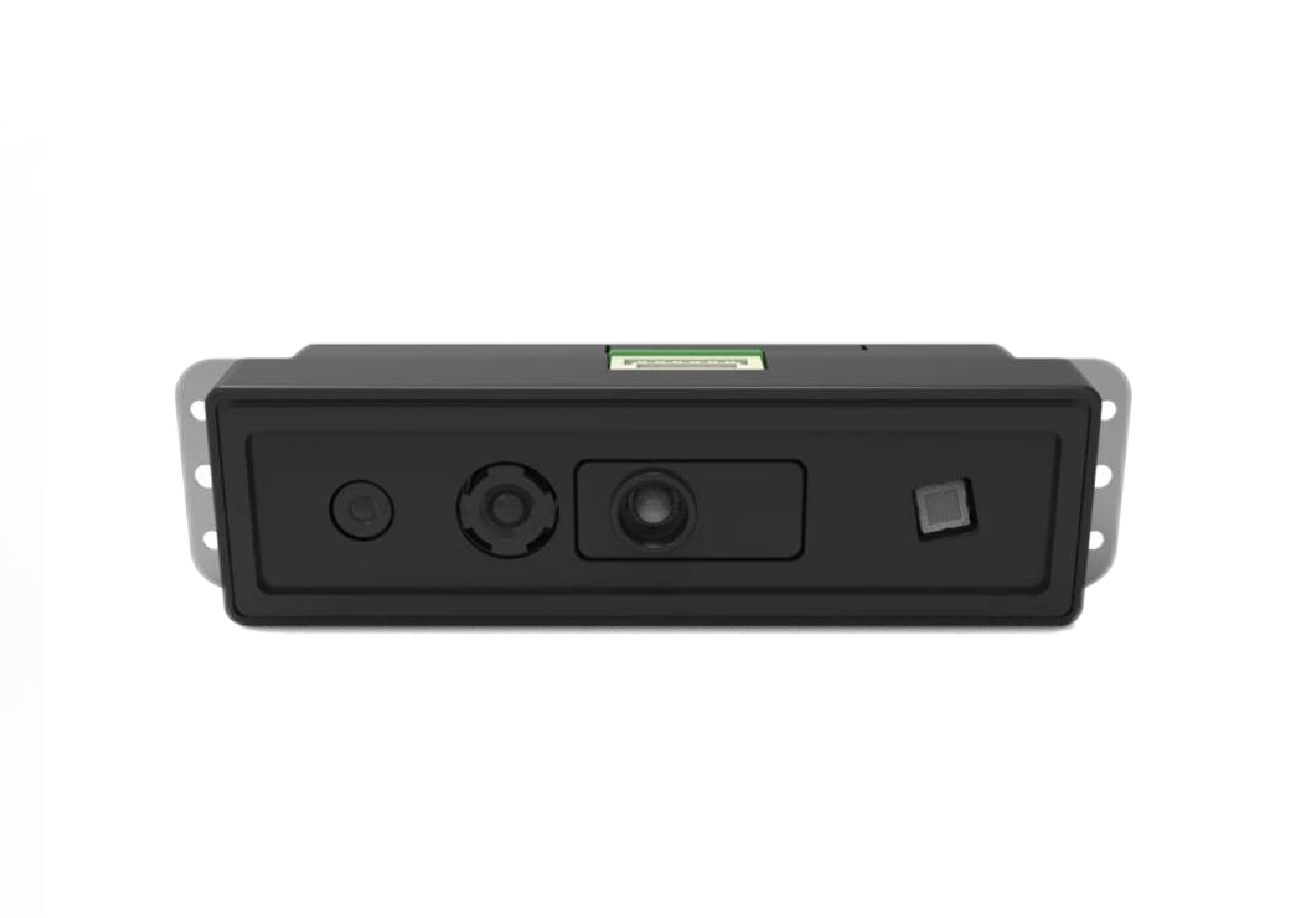
Behind each of those moments there is a decent chance a Deptrum sensor is doing the looking. The company makes depth cameras - hardware that does not just photograph the world but measures it, point by point, in three dimensions. Color cameras see a flat picture. Deptrum's cameras see distance. That difference is the entire business.
Deptrum, known in China as 光鉴科技, is headquartered in Shanghai with a second base in Shenzhen. It is not a household name, which is rather the point. Its work hides inside other companies' products: a robot's eyes, a cockpit's attention monitor, a turnstile's biometric lock. You are meant to never notice it. You are only meant to notice when it fails, and the bet is that it does not.
Color cameras tell you what something looks like. Depth cameras tell you where it is. Only one of those keeps a robot from walking into a wall.
— The case for 3D, in one sentence
The founders' bet
Three scientists, one wager on light
Deptrum was founded in 2018 by three people who had spent their careers bending photons for a living. Their bet was specific: that nanophotonics - engineering light at a scale smaller than its own wavelength - could replace bulkier depth optics and produce the world's first structured-light system that did not need a VCSEL array. It was a contrarian wager, and it has held up enough to draw both investors and lawsuits.
FOUNDER & CEO
Ph.D. in Electrical Engineering from UC Berkeley, B.S. from Tsinghua. Before Deptrum, he led depth-sensing hardware design at Apple. Forbes China 30 Under 30, 2018. His Berkeley work on artificial chameleon skin was named Optics of the Year in 2015.
Bo Wang
CO-FOUNDER & CTO
Ph.D. in Electrical Engineering from Stanford University. Runs the technology stack that turns nanophotonic optics into shippable depth modules.
Fanglu Lu
CO-FOUNDER & CHIEF SCIENTIST
Ph.D. in Electrical Engineering from UC Berkeley. The research conscience of the company, anchoring its optics-first approach.
A founder who led depth hardware at Apple and a chameleon-skin paper named Optics of the Year. The pedigree is the pitch deck.
— On why investors took the call
The product
Three camera families, one underlying chip
Deptrum's catalog reads like an astronomy syllabus, which is either a branding decision or a tell about how the founders think. Underneath the sky-themed names sits one common idea: a nanophotonic Wavefront Processor that shapes light, paired with AI algorithms that turn raw signal into usable depth. The company sells the whole stack - optics, sensor, chip and software - rather than a single piece.
Structured Light
Aurora
High-precision structured-light cameras (900/910/930) for robot obstacle avoidance and volume measurement, working from dim rooms to 80,000 lux.
Time-of-Flight
Stellar
ToF depth cameras (400/420/800) with on-board ARM processing for robots, smart homes and security systems.
sToF Fusion
Nebula
Structured-ToF hybrids (400/240) that pair near-distance ultra-high precision with far-distance depth in one module.
Biometrics
HandPass
Dual-mode palm-recognition camera reading palm-print and vein, with depth-based anti-spoofing for contactless payment.
Mobile
Under-Screen 3D
A structured-light face-unlock module that hides beneath a smartphone display - secure recognition you cannot see.
Core Tech
Wavefront Processor
The nanophotonic chip underneath it all, enabling structured light without a VCSEL laser array.
Every product above answers the same question - "how far away is that?" - in a slightly different accent.
They named the cameras after stars and nebulae, then pointed them at the most earthbound jobs imaginable: a robot's next step, a palm at a checkout.
— On naming things Stellar and Nebula
The proof
Patents, capital, and a lawsuit that flattered them
Talk is cheap in deep tech; the receipts are the patents, the rounds, and who bothers to sue you. Deptrum has filed more than 1,000 patent applications and collected 50-plus industry honors. It has raised roughly $68 million across six rounds, capped by a $28 million Series B in 2023 backed by investors including CICC Capital. And in a backhanded compliment, rival Orbbec sued Deptrum for about $7 million in a patent dispute - the kind of attention reserved for companies a competitor has started to take seriously.
Deptrum, by the numbers
// Selected public figures. Bars scaled within each row's own unit - read the labels, not the lengths against each other.
A chart is just a sentence wearing a suit. Translation: well-funded, heavily patented, and worth suing.
Where do the cameras end up? In financial payment terminals, intelligent robots, automotive smart cockpits, smartphones and new-retail systems. Deptrum sells to the makers of those devices, not to you - a classic B2B arrangement where success means being invisible to the end user and indispensable to the integrator.
You can measure a deep-tech company by who sues it. Orbbec's $7M patent claim was, in its way, a five-star review.
— On the Orbbec dispute
The mission
Building the eyes for the IoT era
Deptrum's stated mission - "Creating New Dimensions," building visual infrastructure for the IoT era - is the kind of line that sounds like a poster until you notice it is also a roadmap. The argument runs like this: the number of machines that need to perceive physical space is growing fast. Robots, vehicles, payment systems, appliances. Each one needs depth. Today most of them do not have it, or pay too much for it.
If depth sensing follows the path of the regular camera - from rare and expensive to cheap and ubiquitous - then whoever makes the small, affordable, home-grown 3D module is selling picks during a gold rush. That is the position Deptrum is trying to hold: not the flashy robot, not the famous car, but the sensor every one of them quietly depends on.
Creating New Dimensions. Building visual infrastructure for the IoT era.
— Deptrum, in its own words
Why it matters tomorrow
Back to that corner, that cockpit, that palm
Return to where we started. The warehouse robot rounds the corner and does not clip the shelf. The car notices the driver's eyes drifting shut and chimes. The payment pad reads a living palm and waves a photograph away.
None of those moments look like technology. They look like nothing happening, which is the highest compliment a sensor can earn. The robot just works. The car just watches. The checkout just clears. The third dimension, once the missing input that left smart machines half-blind, has quietly become assumed.
That is the change Deptrum is wagering its existence on: a world where every machine that moves through space can measure it, cheaply, without anyone thinking twice. The company that wins that bet does not become famous. It becomes furniture - the thing everyone uses and no one mentions. Deptrum seems entirely content with that. The black bar does the seeing. You get to forget it is there.