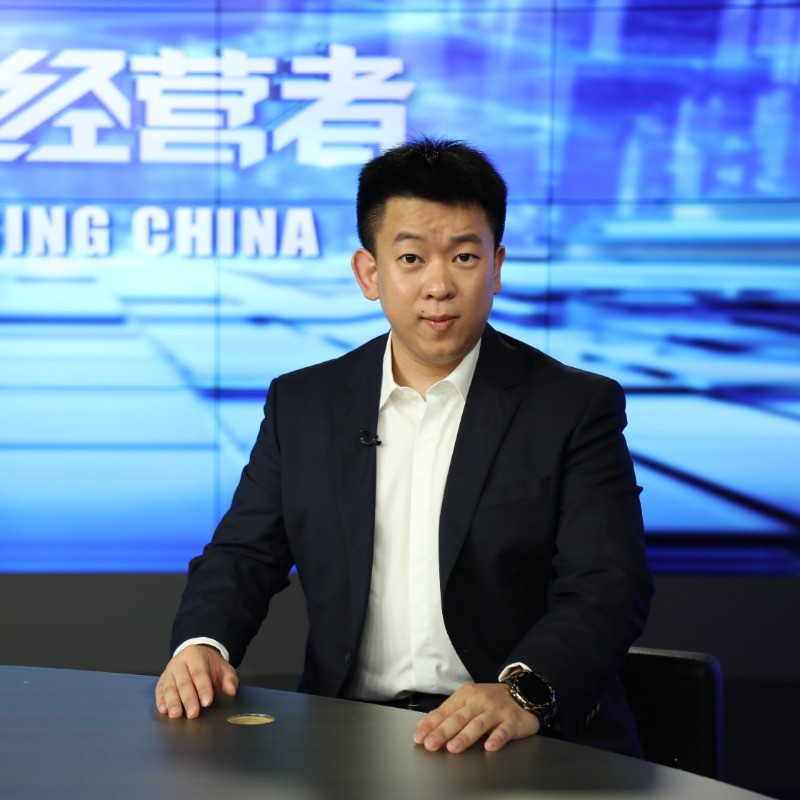
Haojie Hu runs LE Robotics, a company that builds welding robots smart enough to look at a piece of metal, work out where the seam is, and start welding on their own. No pre-programming. No track laid across the floor. Ten seconds of looking, then sparks.
The pitch sounds simple until you have stood in a fabrication shop. Welding is slow, hot, precise work, and skilled welders are getting harder to find in a lot of places. Hu's answer is a machine he describes in almost human terms - it has eyes, a brain, and feet. The eyes are 3D vision systems that detect a weld seam within about ten seconds. The brain is a set of AI algorithms wired to a database of welding knowledge. The feet are an autonomous, trackless navigation system that lets the robot move to the job instead of waiting for the job to be fixtured around it.
That combination is the product. LE Robotics, founded in Chengdu in 2022, sells it as what Hu calls a comprehensive ecosystem service provider for industrial embodied AI in metalworking. Its flagship machines carry names built for the factory floor: the WindRunner Welder and the IntelliMover Welder. Behind them sits a portfolio of close to 100 proprietary patents and a team Hu assembled from Tsinghua University and from experienced engineers abroad.
Robots should complement skilled workers rather than replace them.
The four-part robot
Hu talks about his machines as though they were built from parts of a body, and the framing is useful because it separates the hard problems. A welding robot that cannot see is just a fast arm. One that can see but cannot reason about the weld will make a clean line in the wrong place. And one that can see and reason but cannot move still needs a human to set it up for every new part.
Eyes, brain, feet
A trade he grew up inside
Hu did not arrive at welding as an outsider with a deck. He is a second-generation industrialist. His father, Hu Yachun, started building welding motors in the 1990s and grew that into Loyalty Enterprises Group, a diversified industrial conglomerate that today operates in nearly 40 countries. Before he ever launched his own venture, Hu picked up the specialized knowledge of welding technology on the floor of that family factory.
The academic path went in a different direction first. He studied finance and management at New York University's Stern School of Business, then earned an MBA at Columbia Business School after being accepted to both Columbia and Wharton. His coursework included Warren Buffett's investment philosophy. He worked in investment banking on Wall Street. Then he went back toward the sparks - founding companies tied to the family's group, including Shanghai Loyalty Network Technology, and eventually LE Robotics.
The technological revolution at Loyalty Robotics Welding Systems represents the hope for the great rejuvenation of the Chinese nation.
Recognition, and a number
In 2023, Forbes China named Hu to its list of 100 Outstanding Overseas Returnees, in the Growth Power category, alongside names like Tesla's Zhu Xiaotong and Microsoft's Hou Yang. Chinese authorities have designated the company a specialized, refined, differentiated and innovative enterprise - the label often translated as a little giant. State broadcaster CCTV has featured the company twice. Two rounds of funding in the double-digit millions of yuan came in quick succession.
Hu sizes the opportunity plainly. He puts the global market for this kind of metalworking robotics at roughly 300 billion euros, and notes that capturing even one percent of it would mean three billion euros a year. His stated targets are regions with welder shortages - North America, the Middle East, Southeast Asia. The larger ambition he frames in national terms: moving China from Made in China toward, as he puts it, Designed in China, Intelligently Manufactured in China.
The through-line
There is a neat symmetry to the story, and Hu seems aware of it. His father built a business on welding motors. He is building one on the intelligence that tells a welding robot what to do. The trade is the same. The layer he is adding is the part that used to live only in a skilled worker's head - reading the seam, choosing the pass, adjusting on the fly. He is careful to say the goal is to complement those workers, not erase them, and he points to the places short on welders as the reason the machines are needed at all.
Whether the 300-billion-euro math holds is the open question every hardware founder faces. What is already on the record is a company growing fast, a stack of patents, a Forbes listing, and a founder who can talk welding metallurgy and Buffett in the same breath.