Dennis Hu had two places to be. As a freshman at Northwestern, he was trying to fit rowing around research, two pursuits with an inconvenient insistence on daily attendance. His chemistry adviser, Regan Thomson, eventually asked him to choose: “Do you want to be a rower or do you want to be a chemist?” Hu chose chemistry. Years later, he would make another choice about where to spend his working day, with rather more people waiting for the answer.
He is now the founder and CEO of Drug Hunter, a scientific information business. Its starting point was a frustration familiar to anyone whose job requires keeping up with other clever people: finding out what they have done can take an unreasonable amount of time. Hu knew the frustration from inside the laboratory. Reading was part of the work, and the reading kept spreading across journals, patents and conferences.
There is a particular irony here. An industry can employ highly trained people to solve difficult problems, then leave those same people to wander through a thicket of documents looking for a useful precedent. Hu began gathering and explaining what he found. That activity eventually required him to learn about subscriptions, pricing, recruitment and cash. A paper never asks whether you can make payroll. A company is less tactful.
The student who made room for other students
Hu grew up in Skokie, Illinois. His Northwestern years produced a dual BA/MS, a Goldwater Scholarship and, in 2011, a Churchill Scholarship for graduate study at Cambridge. The achievements suggest someone comfortable with a demanding academic schedule. The extracurricular details complicate the picture in a useful way.
He was an active gymnast. He also founded and directed a program pairing local high school students with Northwestern student researchers. Alongside his own work, he helped fellow undergraduates become involved in research through campus programs. Even before he had a business to run, he was spending time arranging access for people who wanted to learn.
That is a more revealing detail than another award on a biography. Research depends on opportunities that can be hard to see from outside: who will supervise you, which laboratory will welcome you, whether you are allowed to contribute yet. A pairing program gives a student a person to ask. It makes an institution slightly less mysterious.
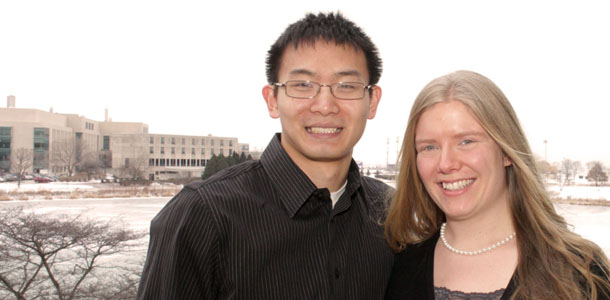
His chemistry education continued at Cambridge, where he earned an MPhil by Research, and at Stanford, where he earned his chemistry PhD in 2015. His published work includes a Cambridge collaboration with Matthew O’Brien and Steven Ley on flow chemistry. At Stanford he worked with Noah Burns, whose laboratory lists him among its alumni. These were years spent learning how to make complicated things work, and how to describe the result precisely enough for someone else to use it.
A career with the reading attached
Hu began his industry career at FLX Bio, later RAPT Therapeutics, working as a chemist and project team leader. He subsequently joined Genentech. Across those settings, he worked on small-molecule research and contributed to publications and patents. His later information business therefore grew out of professional experience with the material it would explain.
That background matters because a summary can be perfectly readable and still fail its intended reader. A researcher needs to know which detail changes the interpretation, which comparison deserves attention and what remains uncertain. The craft is in deciding what belongs in the explanation. Removing words is the easy part; removing the wrong words is easier still.
Hu started Drug Hunter in 2018 while continuing his scientific career. The project gave him a place to assemble useful lessons from work across the industry. It also let him test a practical proposition: would people return for explanations written with their working questions in mind? Before a subscription plan or an investor announcement, there was that smaller test of whether the reading helped.
There is no need to romanticize a side project to appreciate its advantages. It can remain close to the problem because the person making it still encounters the problem at work. Hu had that proximity. He understood the time consumed by staying current, learning unfamiliar areas and finding suitable industry partners because he was doing those things himself.
April 2022: the hobby gets the whole calendar
In April 2022, Hu announced that he was working on Drug Hunter full-time. His first month would be devoted to talking with readers about priorities. The decision tells us something about the founder he was becoming. He had plenty he could build; he wanted help deciding what would be useful.
He also thanked his Genentech colleagues and acknowledged that leaving work he loved was difficult. That makes the move more interesting than a standard tale of escape from a corporate job. He was choosing between two kinds of work he valued, and accepting the uncertainty that came with putting one of them first.
“I’m focusing my first month on talking to readers to see what we should prioritize to be most helpful.”Dennis Hu, announcing his full-time move, April 2022
The company’s commercial subscription plan and homegrown platform launched in 2023. By his May 2024 business interview with Alexej Pikovsky, Drug Hunter was serving more than 150 institutions and reporting annual recurring revenue above $2 million. Those are figures from that period, rather than a claim about today. They mark the point at which useful writing had become a business with repeat customers.
The interview covered a less photogenic part of that transition: choosing features, getting pricing right and moving away from consultancy toward subscriptions. Consultancy puts a person’s time at the center of the transaction. A subscription asks a different question: can the service be useful repeatedly, to enough people, without beginning again for every customer?
The awkward question at dinner
Hu has described a recurring question at events he hosts: how does Drug Hunter make money? Some people ask shyly, some suspiciously, some because they like the work and want to support it. Giving away educational material has a charming side effect. Eventually someone begins looking for the hidden invoice.
His explanation was straightforward. The company offered free resources and community activities, while institutional subscriptions supplied the vast majority of its revenue. He also said it did not accept payment from companies to feature their molecules. The distinction matters for a business whose usefulness depends on readers trusting its judgment.
He made a joke about mugs, too. Merchandise was not keeping the company alive. It is an unusually helpful joke because it names the confusion directly: an audience sees generosity, but a founder needs an economic arrangement behind it. A good newsletter can earn affection. Affection alone is an unreliable accounts receivable department.
The pricing and subscription decisions are part of Hu’s personal story because they changed what his job demanded. Knowing the subject was necessary. So was understanding which readers needed a paid service, what they expected from it and how a team could deliver it consistently. The founder had to become a student again, this time with customers setting the problems.
Hu starts Drug Hunter alongside his research career.
Reader conversations guide his first month.
A new commercial plan and homegrown platform launch.
Teamworthy Ventures leads the September round.
The numbers have colleagues behind them
In January 2025, Hu reported that Drug Hunter had reached roughly 200 institutional customers. Its publishing schedule had grown from monthly to daily, and the platform had expanded into patent, target and structure searches. More than ten PhDs were working full-time on the scientific material. A personal habit had become a coordinated editorial operation.
He described a fully remote company crossing twenty full-time US team members, with an Oregon gathering planned for later that year. The detail is worth keeping in the future tense: an announced gathering is a plan. It also gives a glimpse of a management problem distinct from the original reading problem. Colleagues can collaborate online for years; making time to meet requires a decision of its own.
In September, he marked the arrival of the thirtieth full-time team member. His gratitude came with an account of periods when the young company had only weeks of cash and used personally guaranteed loans. He described getting through the Silicon Valley Bank collapse and difficult industry conditions. Those experiences, he said, had shaped the team’s operating discipline.
“People are everything,” he wrote. Three words, with a fairly demanding job description behind them. For a founder, valuing colleagues includes finding a way to keep employing them when the cash position is unpleasant. His account connects the warmer language of team culture to the colder arithmetic that makes it possible.
Capital arrives; the job continues
Drug Hunter announced seed investment led by Teamworthy Ventures on September 15, 2025. The company said researchers at more than 200 organizations relied on it. Hu pointed to the investor’s experience in research and information services when explaining the partnership. The stated purpose was to expand the team and its capabilities.
Earlier that year he had described a cash-flow-positive business funded entirely by subscription revenue. Both statements belong in the chronology. Subscription income explains how customers support the service; investment explains another way to finance expansion. Keeping the dates attached prevents a moment of independence from becoming a permanent label that obscures a later decision.
Meanwhile, the teacher’s work continued. Hu returned to Stanford for a seminar in April 2025. The 2026 Discovery on Target program listed him as a plenary panel moderator. These appearances place him back in rooms of researchers, asking questions and explaining work, while carrying responsibility for the company that grew from doing so.
The dial-up sound comes back
In May 2026, Hu described experimenting with AI tools as a return to the creative excitement of discovering the internet through a 56k modem. He supplied the modem noises himself. An executive remembering dial-up is hardly unusual; an executive preserving the sound effects deserves a small amount of credit.
His argument extended beyond excitement about faster software. He expected improved efficiency to increase the demands on scientists’ judgment, including people early in their careers. More output would make understanding and choosing more consequential. That was his forecast, and it helps explain why he remained interested in a business built around interpretation.
At Northwestern, Hu once hoped to become a research professor. His career took him elsewhere, but the desire to make learning possible has a visible history: students paired with researchers, readers asked what they need, colleagues hired to explain difficult work. The title changed. The practical question kept returning: how do you help someone understand enough to take the next step?
For the freshman choosing between rowing and chemistry, the answer involved deciding where to spend his own time. For the founder, it involves helping other people spend theirs. That is a modest-sounding ambition with plenty of work inside it. Hu has built a company around taking it seriously.