Dennis Chua has a question for a generation of people preparing to run businesses: why must entrepreneurship begin with an empty room? There are already companies with customers, employees and years of accumulated know-how. Some need a successor. The aspiring entrepreneur and the retiring owner might have quite a lot to say to each other, provided somebody arranges the introduction and stays around afterward.
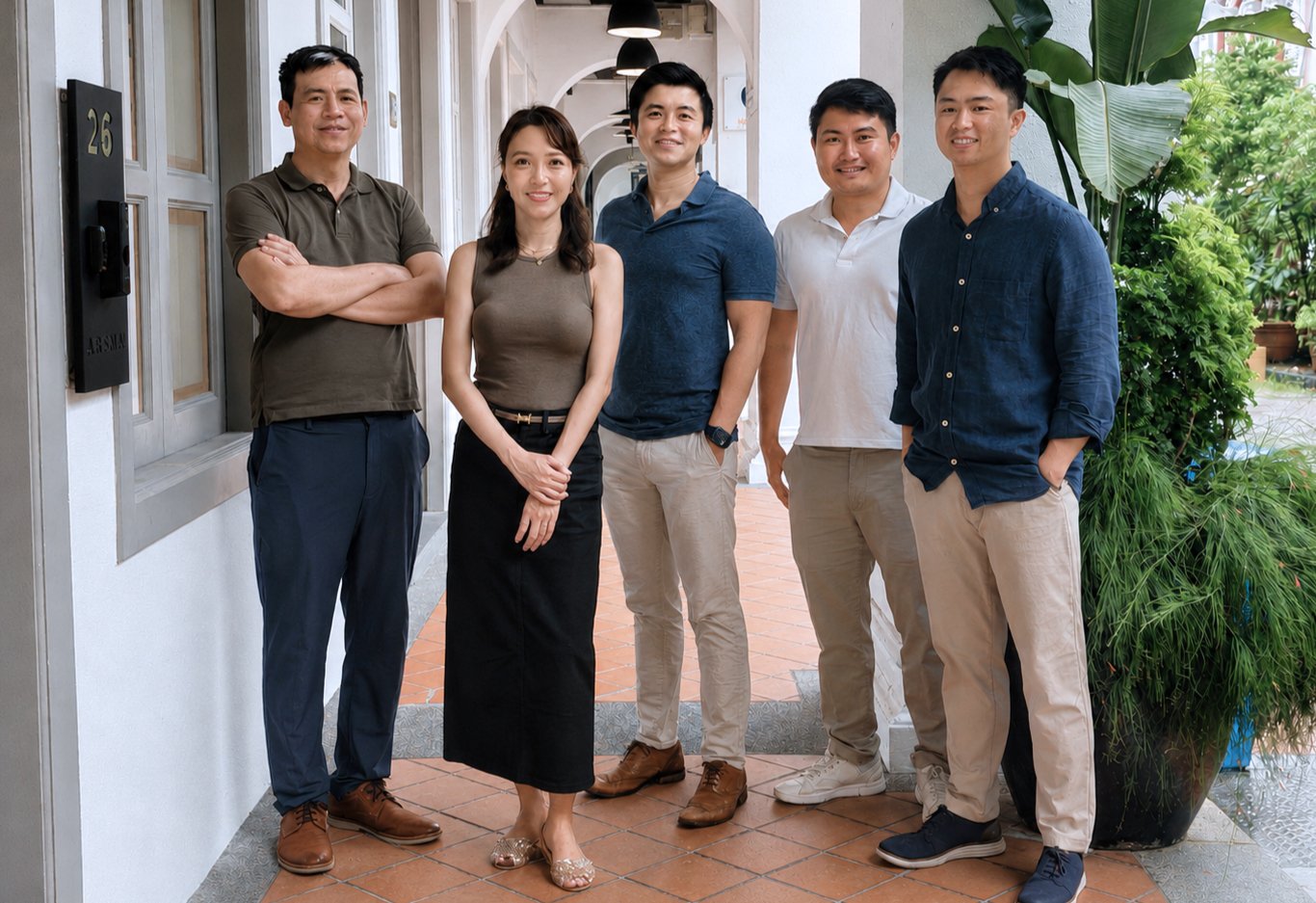
In 2025, Chua returned to Singapore with his family after 15 years in the United States and launched Timah Partners, a holding company designed to acquire and operate small and medium-sized enterprises over the long term. The move gave an international investing career a very local subject. A founder who has spent decades building a business has questions that a purchase price alone cannot answer.
Timah’s proposition puts ownership and leadership together: buy an established business, prepare someone to run it, and give that person time to learn. Chua is making a career out of the handover. The keys are the easy part.
A family education in small business
Chua grew up in Singapore with small businesses close at hand. His father left a corporate job to work in a relative’s family business. His mother spent more than 40 years as an in-house accountant for small businesses. Childhood friends later took over family firms, sometimes reluctantly and with little guidance. Succession was part of the world around him long before it became his investment thesis.
That background gives the return home its particular shape. He brought experience from Goldman Sachs, D.E. Shaw, Tiger Management and 3G Capital, and helped build an investment firm focused on smaller companies. But the subject waiting in Singapore was familiar: businesses whose future depended on the people prepared to lead them.
The phrase “family business” can make succession sound beautifully automatic. Families, however, do not come with an annex listing the next chief executive. Chua’s work begins in that gap between a company that deserves to continue and a person who actually wants, and is equipped, to continue it.
Before the handover, a hotline
At Cornell in October 2012, Chua joined Xiaoxi “Brook” Du and Joy Chua in a 48-hour competition to propose a business application for IBM’s Watson. Their idea, Hello Watson, addressed a familiar irritation: consumer electronics customers trying to get useful answers from technical support. The proposal would use Watson to process information and help answer those calls.
The team won first place. Chua was studying chemical and biomolecular engineering, Du computer science and Joy Chua chemical engineering. The challenge required them to make a business case as well as explain the technology. In Chua’s account, the engineers had to keep pulling themselves away from technical detail to concentrate on the business model and marketing.
That student project is a useful early glimpse of a recurring question in his work: how does a promising idea become useful to the people who need it? A clever system still has to fit a real problem. For Hello Watson, the problem was the person waiting for a helpful answer. Years later, the person waiting would be a business owner looking for a successor.
In 2014, Cornell named Chua a Merrill Presidential Scholar. The programme honours graduating seniors who then recognise teachers and faculty members important to their education. Chua selected Chee Keong Lee of Raffles Institution and Cornell chemical engineering professor Lynden Archer. Lee travelled from Singapore for the occasion. The award recorded both academic achievement and the people behind it.
His next academic chapter was Harvard Business School. He earned an MBA and the Ford Scholar, Baker Scholar and Loeb Fellow distinctions. At Harvard, he also co-led the Investment Club and Tech Club. His 2018 student biography listed two off-duty interests: thrillers and road trips. Even a future advocate of permanent ownership was allowed to enjoy a change of scenery.
The officer and the warrant officer
When Chua talks about choosing future leaders, he reaches for National Service. Picture the newly commissioned young officer alongside an experienced warrant officer. Rank establishes who has authority. It leaves open the rather more interesting question of who earns respect. Chua calls the quality he is looking for followership.
The example makes sense in a founder-led company. A new chief executive can arrive with a title while employees hold years of knowledge about customers, suppliers and the work itself. An organisational chart cannot make them trust the newcomer. Chua’s emphasis on humility, clarity and grit asks candidates to consider how they will be received by people whose experience predates their appointment.
His account of succession also gives the outgoing owner a continuing role in the story. The founder is lending a reputation to the person taking over. Staff and customers have built relationships around that reputation; the successor has to become worthy of it. That is a more demanding standard than looking suitably executive in the announcement photograph.
Timah’s acquisition approach follows a sequence of respecting the existing business, learning how it works and then improving it. There is room for change. The order matters. An inherited practice may be awkward, or it may contain knowledge that never made it into a slide deck. Listening first gives the new owner a chance to tell the difference.
“It’s followership.”
Dennis Chua, on the respect a leader earns
A chief executive, with an apprenticeship
Chua has put a training structure behind that leadership argument. Timah’s CEO Succession Program begins with a headquarters rotation, described as six to 12 months, covering business evaluation, acquisitions and capital allocation. It then moves into an operating company, where an apprenticeship can last 12 to 36 months. Candidates take on projects and work under an experienced chief executive before progressing toward a senior leadership role.
The programme is a paid, full-time job, with performance-based rewards and potential equity. Its intended destination is responsibility for a business, including its team and profit-and-loss account. The progression makes the work concrete: first understand how a company is acquired, then understand how it is run. Neither stage is a souvenir tour of the other.
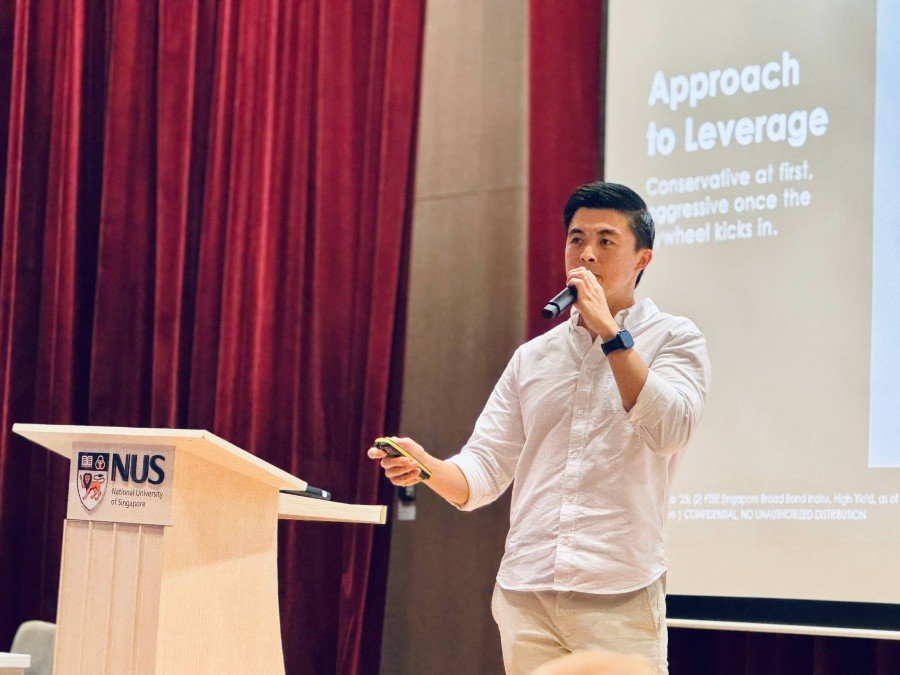
In July 2025, Chua took that proposition to the NUS Enterprise Summer Programme in Entrepreneurship. More than 300 students and aspiring entrepreneurs from over 30 countries attended. He discussed acquisitions, permanent ownership and a route into entrepreneurship through an existing company. The audience asked about what that route looks like in practice.
His invitation was brief: “Entrepreneurship doesn’t always have to mean being a founder.” It expands the choice facing someone who wants to build a business. Starting from scratch remains one possibility. Taking responsibility for an established company is another, with customers to serve and a history to understand from the first day.
- 01 · 6–12 monthsLearn the acquisition
Headquarters rotation: evaluate companies and learn capital allocation.
- 02 · 12–36 monthsLearn the operation
Work inside a business and apprentice under its chief executive.
- 03 · C-level roleTake responsibility
Lead a team, own the P&L and participate in equity.
The promise has terms
Timah announced a US$50 million Series A on 26 June 2025. Its backers included Mitch Rales of Danaher, Nick Howley of TransDigm and Alex Behring of 3G Capital, alongside Compounding Labs and Sator Grove. The investor roster connected Chua’s Singapore venture to people experienced in building and owning companies over long periods.
For an owner considering a sale, Timah describes a decades-long holding intention, support for the existing team and careful operational improvements. The distinction between an intention and an absolute guarantee deserves attention: its own acquisition FAQ allows rare exits when a business proves less enduring or lower quality than expected. The commitment is to long-term ownership with business judgment still attached.
That qualification makes the proposition easier to understand. Permanence requires decisions about which companies belong in the group and how they should operate. It also requires new leaders who will stay engaged after the documents are signed. Chua’s pitch joins these obligations rather than allowing the acquisition itself to stand in for a successful succession.
The first test comes with a grease trap
In June 2026, the model reached a specific industry. Timah launched a specialised waste management platform and announced a signed agreement to acquire an established Singapore operator with more than two decades of experience. Kelvin Ho, a CEO Succession Programme candidate, was named incoming co-CEO. The announcement described an agreement; it did not establish that the transaction had already closed.
The sector includes drainage, grease-trap maintenance and specialised waste collection. These are services whose usefulness rarely requires an elaborate explanation. A city has to keep working. Timah’s plan applies its ownership and leadership approach to companies providing recurring services, with an advisory board bringing experience in regulation, facilities management and operations.
It is a revealing choice for Chua’s venture. The work gives the succession idea something tangible to attach to: a business, a founder, customers and an incoming operator. A leadership programme now has a proposed destination. The story moves from finding people willing to learn to placing a learner where that knowledge will matter.
On 19 August 2026, Timah announced a separate S$60 million debt facility with UOB, RHB Bank and Genesis Alternative Ventures, with Kroll as facility and security agent. The arrangement provides a pre-agreed framework for financing multiple acquisitions over time. It is financing capacity, rather than a tally of completed purchases, and its currency differs from the earlier US-dollar equity round.
For Chua, a more predictable acquisition process is part of the founder’s experience. As he put it: “Succession is a big life decision for a founder.” Certainty about financing and partners can help an owner consider the decision itself. The spreadsheets remain necessary. They share the table with questions about employees, continuity and who will show up to run the company.
Series A announced
Umbrella facility announced
Home is also a place to contribute
Chua’s return includes work outside Timah. He serves on the Singapore Business Federation’s SME Committee, whose members address concerns facing smaller businesses. He is also a council member of the Old Rafflesians’ Association. These roles place him among business owners and alumni communities with their own interests in the next generation.
A recent NUS Executive MBA visit offered a lighter glimpse of the same life. Chua described a largely Chinese-speaking class that gave him considerably more language practice than usual. He joked that his wife, Jessica Li, would be proud of the effort. The students supplied questions and pushback, and some stayed to continue the discussion.
He lives in Singapore with his wife, two children and their dog. His ambition for Timah is to build a generational answer to succession across the region. The measure of that ambition will take time: whether the people taking over can earn confidence, whether businesses continue to serve their customers, and whether an owner can step away knowing who will arrive the next morning.
Follow the next chapter
Explore the work, the programme and the conversations around it.