A mushroom farm is not a bank. A digital health clinic is not a climate project. A company developing psychedelic medicines would rarely share a slide in an ordinary venture-capital pitch deck with an online grocer built around ugly carrots. Yet at Delphi, the small New York investment firm founded in 2018, those businesses occupy the same mental map. The founders believe human health, planetary health and social equity are not adjacent markets. They are one system viewed from different doors.
That premise has produced a portfolio that can look scattered from a distance. Delphi has been publicly associated with Imperfect Foods, the grocery service designed to keep surplus food in circulation; Smallhold, a grower of specialty mushrooms near the people who eat them; Parsley Health, a technology-enabled functional-medicine practice; Good Money, an activist-minded digital bank; and the psychedelic-therapy companies Journey Colab and Beckley Psytech. The common noun is not software, biotech or consumer. It is repair.
The sector is the system
Delphi calls itself a “world-positive” VC focused on regenerative global sustainability. The language is expansive, but its practice is easier to understand through one reported detail. After backing Smallhold, cofounder Kalika Lawrence encouraged its founders to make the mushroom packaging biodegradable and lower-carbon. Packaging is not the grand theory of climate justice. It is where the grand theory has to survive contact with plastic, freight and a grocery shelf.
That is the useful distinction between Delphi and a conventional screen-driven impact fund. A screen asks whether a startup belongs to an approved category. Delphi's approach, at least in its public telling, asks how the entire company behaves. Does a healthcare business widen access? Does a food company change waste and distribution? Can infrastructure improve without exporting its damage somewhere less visible? The answers influence what gets funded, then reappear in product and operating decisions.
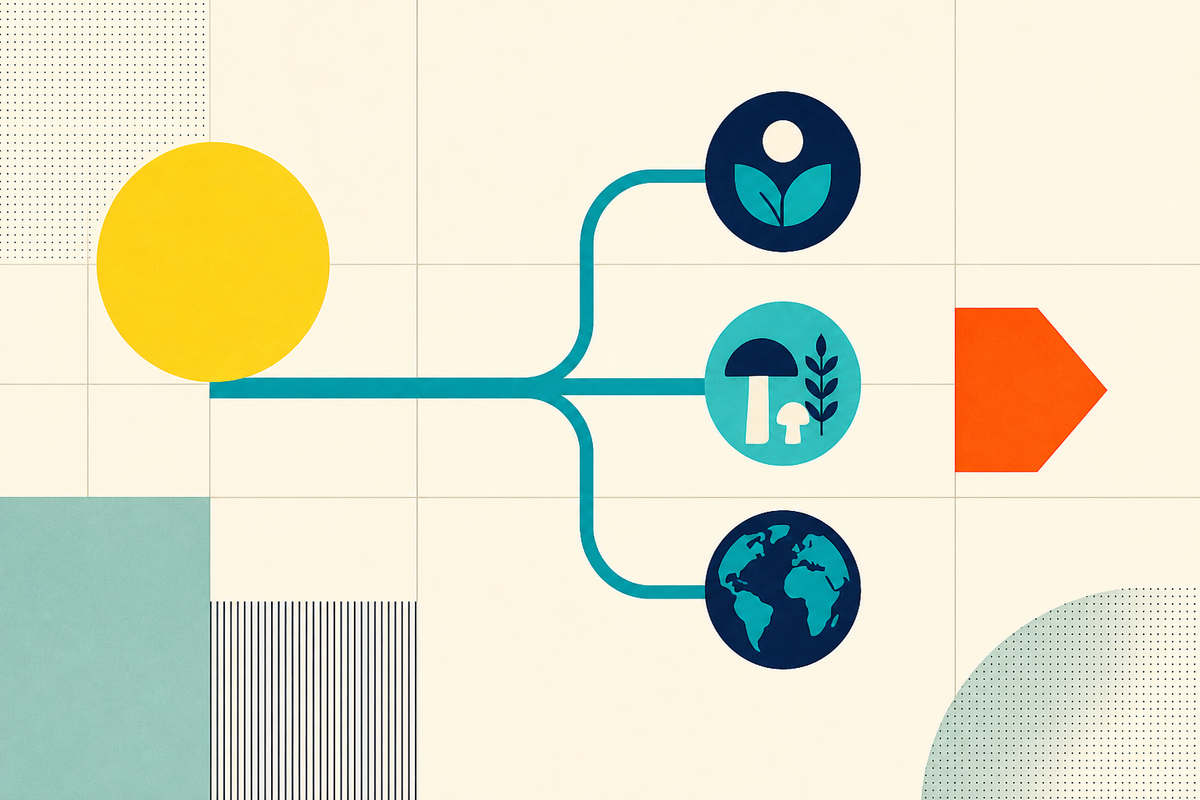
Delphi's thesis, reduced to four boxes. The real work happens in all the seams the boxes cannot contain.
The firm's customers are founders, especially those raising at pre-seed or seed, and the limited partners whose capital it deploys. Its product is familiar venture capital: money in exchange for ownership, followed by help intended to make that ownership more valuable. Delphi says it works closely with founders and teams. Parsley Health founder Robin Berzin has described support that extended to access to Delphi's LP network. That network is part of the service, even if it never appears as a button on a website.
For a founder, that breadth can change the conversation in the room. A food startup may arrive asking about distribution and leave discussing material science, labor, soil or preventative health. A clinic may need an investor who understands that patient behavior is shaped by price, trust and culture as much as software. Delphi is useful when a company's hardest constraint sits outside the category printed on its pitch deck. The tradeoff is equally plain: founders requiring a large in-house recruiting bench or a specialist regulatory team may find more infrastructure at a bigger fund. Delphi's offer is partner attention, a values filter and connective thinking. It resembles a small design studio more than a venture supermarket - fewer aisles, more opinion about how the pieces should fit.
“We often invest early, and always work closely with our founders and teams.”Delphi's description of its approach
An unusual route into medicine
Delphi's health thesis is where the interdisciplinary approach becomes most distinctive. Lawrence trained as an herbalist and once planned to become a midwife; she also worked in arts and publishing before venture investing. Cofounder Pip Lawrence studied cognitive neuroscience and anthropology, worked in hedge funds and later mentored startups. Their résumés cross disciplines in the same way the portfolio does.
Psychedelic medicine became a visible part of that portfolio by 2020. The commercial proposition is demanding: develop regulated therapies for addiction, depression and other hard-to-treat conditions, then pair them with care models capable of delivering treatment safely. Journey Colab raised a $12 million Series A in 2021 from a group that included Delphi, MBX Capital, Uprising, Lionheart Ventures, Sam Altman, Apollo Projects and Drew Houston. That same year, Delphi joined Beckley Psytech's oversubscribed $80 million Series B to advance clinical psychedelic research.
These are not ordinary wellness products. Drug development is capital-intensive, regulated and slow. It also sits beside Parsley Health, which tries to change primary care by looking for root causes and maintaining longer-running relationships with patients. Delphi's health portfolio therefore spans two ends of a care problem: developing new interventions and redesigning how people encounter medicine. Its expertise is less a single clinical specialty than the ability to connect science, care delivery, culture and financing.
Follow the waste
Food gives the same thesis a more visible body. Imperfect Foods built a subscription grocery business around products likely to be rejected by supermarkets because of cosmetic flaws or short shelf lives. Smallhold built compact farms near urban customers, selling specialty mushrooms into grocery and restaurant channels. One tackles what the supply chain discards; the other shortens the chain.
Both companies demonstrate Delphi's place in the market. It is not a pure climate-tech investor searching only for carbon-accounting software or batteries. It is not a healthcare specialist, a food fund or a fintech shop, although it touches all four. The firm competes for deals with each of those specialists and with broad seed funds. Its claimed advantage is pattern recognition across boundaries: a health investor may understand a clinical endpoint, while a systems investor also asks about access, packaging, waste and incentives.
The graphic above is a map of emphasis in Delphi's public story, not a measure of dollars. The fund does not publish assets under management, check sizes, fee structure, revenue or returns. That absence matters. Impact investing is easiest to assess when intentions, financial performance and measured outcomes can be compared. Delphi's public materials offer the intention and a set of portfolio examples, but not a full scorecard.
Small by design, broad by conviction
LinkedIn describes Delphi as a partnership with two to ten employees, while displaying a larger number of associated profiles. Either way, this is not a platform VC with dozens of recruiters, operators and communications staff. A small team can be a weakness when it ranges across clinical trials, agriculture, finance and climate infrastructure. Each field has its own technical traps. Specialists are specialists for a reason.
The counterargument is that a compact partnership can maintain a coherent point of view and move across categories before they become obvious. Delphi was discussing regenerative sustainability and psychedelic therapy before either became a routine venture-capital theme. It backed companies at the moment when an unconventional market still required explanation. If those companies mature, the early check buys both financial upside and the chance to shape mundane choices that scale with them.
Its business model is still venture math. Limited partners supply capital; Delphi selects private companies; ownership becomes valuable only if those companies grow, raise, sell or eventually trade publicly. “World-positive” does not exempt an investment from returns. The hard problem is making environmental and social benefits part of the engine that produces the return, rather than a cost tolerated until growth gets difficult.
The portfolio's common noun is not software, biotech or consumer. It is repair.YesPress
That explains why Delphi's strongest differentiation is also its greatest test. Connecting everything can reveal relationships that a sector lens misses. It can also turn a thesis into a fog where nearly any well-meaning company seems to fit. Discipline comes from saying no, measuring what changed and showing which interventions mattered. The public record gives glimpses: less wasted food, more local production, different models of primary care, experimental treatments for stubborn illness. The next layer would be evidence that connects those outcomes back to fund strategy.
A platform still becoming visible
Delphi's website remains strikingly spare. It promises a fuller site and points visitors toward Prophet, described as an interdisciplinary platform for sharing resources, starting solution-focused conversations and exploring mindful investment. The idea fits the firm: knowledge and community become infrastructure around the portfolio. But Prophet is presented as a direction, not a detailed product with pricing, user numbers or a public operating history.
That unfinished quality is oddly appropriate. Delphi is itself a wager on systems still being built: alternative care pathways, shorter food chains, financial products with a social mechanism, infrastructure that accounts for ecological cost. Founders can use the firm for early capital, introductions and a partner willing to discuss consequences beyond the next financing. Limited partners get exposure to a portfolio organized around regeneration rather than a standard industry index.
The lesson worth stealing is not to copy Delphi's list of sectors. It is to choose a problem large enough that several industries become relevant, then develop enough conviction to find the connections without abandoning rigor. A digital clinic and a mushroom farm do not need to resemble each other. They need to make different parts of the same system work better - and to become durable businesses while doing it.