Imagine answering a question about your fitness by mentioning a marathon you ran sixteen years ago. David Blake has used that comparison to explain his problem with education. A degree captures something real. It also captures a moment. The engineer who graduated before today’s tools existed has presumably learned a few things since. Where does that learning live?
- Degreed connects workplace learning with employee skill data.
- Its customers buy software to organize development across existing systems.
- The useful test: can people apply what they learned?
Blake and Eric Sharp founded Degreed in 2012 with the ambition to “jailbreak the degree.” The early proposition recognized formal and informal education together. A book, a course, a useful video: learning did not become worthless because a registrar failed to notice it. The commercial opening emerged inside organizations already spending money on education.
The ambition initially ran ahead of the household budget. In a 2022 retrospective, Blake recalled starting with $13,000 saved while paying $3,000 a month in rent. He described the first customer contract as $10,000, the second as about $15,000 and the third as a multimillion-dollar deal with a large bank. The leap helps explain the enterprise focus: institutions had both the tangled learning systems and the budgets to untangle them.
The trouble was finding the learning
In a 2017 interview, Blake described an early customer, a Fortune 20 bank, with an assortment of internal tools and outside content. Other large employers had similar arrangements. Each purchase answered a need. Collectively, the purchases produced a maze. Employees were expected to keep learning while navigating the architecture of the procurement department.
Degreed’s learning experience platform, or LXP, offered a common entrance. It could connect resources from different places, recommend material and organize it into learning pathways. Think of the distinction between owning a library and having a librarian who understands the task you are trying to finish. The underlying books still matter.
That explains Degreed’s place in the market. It sells to enterprise learning, talent and HR teams, with employees using the resulting experience. Its expertise sits in connecting learning systems, organizing development and interpreting skills. It can sit above an existing learning management system. At Ericsson, that position became quite literal.
The telecom company wanted to simplify a fragmented learning environment while preparing people for technologies including 5G. Its team put Degreed at the top of the learning stack. The rollout included communications and onboarding, with pathways tied to skills needed in different parts of the business. Installing software was one part of a wider change.
The published case study reports a 50% reduction in overall learning spending, alongside increases of 62% in completions and 24% in learning hours year over year. Those are encouraging operating numbers. They describe participation and spending, however, rather than establish what every employee could subsequently do. That distinction follows Degreed through its next chapter.
The founder comes back with a missing piece
In June 2022, Degreed announced it was acquiring Learn In, a talent-academy business Blake had co-founded. He returned as CEO. The announcement was unusually candid: his plans had diverged from the company’s direction. The combined business would connect everyday learning with longer programs for developing deeper capabilities.

The logic is easy to follow. Discovering a resource solves the search problem. Developing a capability requires more. Today, Degreed Academies supports cohorts, projects, feedback, deadlines and discussions. Skills+ helps organizations reconcile skill information, identify gaps and customize proficiency scales. Professional services bring implementation and learning-design help. These products address different obstacles between intention and useful work.
Maestro adds AI coaching, roleplays and skill reviews. Following a 2024 beta, Degreed announced broader availability for its July 2025 release. An employee can practice a conversation and receive feedback; a learning team can curate development with more individual context. The appeal is repetition without needing a human coach available for every attempt.
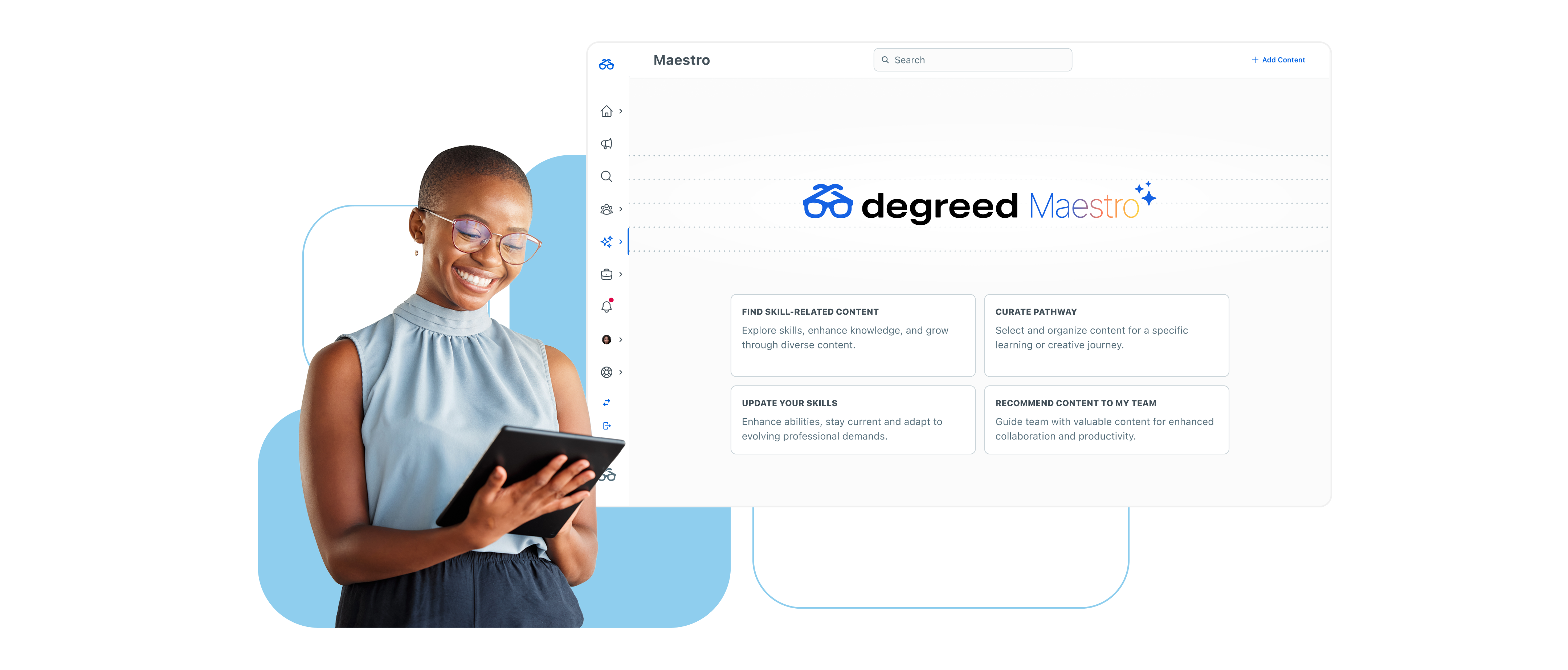
On October 6, 2026, Degreed announced agents that draft personalized pathways and audit catalogs for broken links and stale material. The launch description retains an explicit human checkpoint: “L&D reviews, edits, and approves.” For anyone who has encountered a dead training link, the catalog audit may sound refreshingly practical.
- 01 Identify a skill gap
- 02 Draft the pathway
- 03 Human review
- 04 Deliver learning
The bill, the alternatives, the human judgment
Degreed’s business is enterprise software sold through sales conversations, with additional products and services. Its public pricing page describes capabilities rather than posting a standard dollar price. Content is another consideration: the edX integration, for example, requires an edX for Business subscription. Connecting a catalog does not automatically buy access to everything inside it.
The company’s own expansion required substantial capital. Its April 2021 Series D raised $153 million in equity at a $1.4 billion valuation, alongside a separate $30 million credit facility. Those figures describe historical financing. They are not a price tag for a customer deployment, or evidence that a learning program will repay its cost.
Buyers have alternatives. Cornerstone’s EdCast combines learning, skills and career mobility; Docebo offers enterprise learning with personalization and analytics. Degreed’s case is particularly legible when an employer has several learning sources to connect. The relevant comparison is how well each option fits the systems, content and development work already in place.
Finding the course is the beginning of the work.The practical lesson
There is a useful idea to copy without buying anything: start with a business task, identify the skill it requires, connect the resources, then provide practice and feedback. Measure something beyond attendance. This is an inference from the customer approach, not a promise that another organization will reproduce Ericsson’s numbers.
It also reveals the conditions. Poor skill data gives personalization a shaky starting point. Irrelevant content remains irrelevant when recommended faster. People need time to practice, and someone must judge the result. Degreed can help organize that process. For a small team with a single training source, the coordination problem may be modest. For a large organization with competing catalogs and inconsistent skill labels, it becomes harder to ignore. The question Blake began with still belongs to the employer and the learner: what can you do now?