Dee Hock had an awkward qualification for the credit card business: he and his wife had decided to avoid debt apart from their mortgage. When he took on BankAmericard at a Seattle bank, enthusiasm for borrowing was hardly his motivating force. Yet this reluctant recruit would help create Visa. His contribution began with a problem that a prettier piece of plastic could never solve. Banks wanted customers to use their cards everywhere, while behaving as though every shop counter were private territory.
In one early card system Hock encountered, a hole in the card matched a metal peg on the merchant's imprinter. A rival card would not fit. It was an admirably literal expression of a bad idea. The bank had designed competition into the machinery, then expected a network to emerge. Meanwhile, paper sales records travelled between banks by mail. Transactions piled up, billing lagged and fraud exploited the confusion. The everyday promise of a convenient card rested on a back office that could barely keep up.
Hock's answer required an uncomfortable conversation about ownership. Bank of America had licensed BankAmericard to other institutions. What if those institutions jointly owned the organization that coordinated their transactions? Each could compete for customers while helping govern the common system. A bank would have to give up unilateral control to gain something useful: a network that other banks had a reason to join. This was a difficult sales pitch in an industry accustomed to putting its own name on the door.
A working life before the breakthrough
Born in North Ogden, Utah, on March 21, 1929, Dee Ward Hock came to banking by a long route. He attended Weber College from 1947 to 1949 and married Ferol Delors Cragun in Salt Lake City that September. The geography of his next seventeen years reads like a western road map: Ogden, Klamath Falls, Los Angeles, Seattle. There were branch-management jobs at Pacific Finance, work in advertising and public relations, a general-management position at Columbia Investment Company, and regional supervision at CIT Financial.
These were jobs with customers, colleagues and bosses, rather than an uninterrupted ascent through a single institution. By the time he joined National Bank of Commerce in 1966, Hock had considerable experience of financial organizations from inside their offices. He would later make their habits a subject of sustained criticism. The familiar diagram of a boss above a row of subordinates seemed to him a poor guide to what people actually did together.
His biography places him in charge of the bank's BankAmericard department and at the head of the national executive committee of issuing banks. That second position mattered. A committee of institutions with separate interests needed persuasion across boundaries. Orders from his own office could accomplish only so much. The work forced him to confront the question that would accompany him for decades: how could people retain their differences and still make a common undertaking function?
Rivals at the same table
In 1970, National BankAmericard Inc. took shape, with Hock as president and chief executive. It was owned by its member banks. The arrangement made cooperation part of the business's structure. Participants could pursue their own commercial interests, but the shared network needed rules and a way to make decisions. Membership carried a stake in the whole. The customers did not need to understand that constitution; they needed a purchase to go through.
That is the useful tension in Hock's achievement. Decentralization sounds pleasantly airy until a payment has to be authorized. Then ambiguity becomes expensive. A shared system needs agreement about responsibilities and reliable mechanisms for carrying them out. Hock's organizational thinking had a practical test waiting at every checkout. Independence for participating institutions had to coexist with dependable coordination between them.
The technological milestones arrived in sequence. The electronic authorization system known as BASE I launched in 1973; electronic clearing and settlement through BASE II followed in 1974. International expansion also came in 1974, and support for a debit card in 1975. In 1976, BankAmericard became Visa. A name tied to one American bank gave way to a shorter name for a growing international undertaking. Visa remembers an internal naming contest, another instance of Hock inviting ideas from within the organization.
It is tempting to read the familiar brand backward and assume everything was inevitable. The dates suggest a more interesting story: organizational agreement, computing systems and a common identity were built through separate decisions. A credit card could be carried in a pocket. Its usefulness depended on relationships extending far beyond the person carrying it. Hock spent his career trying to make those relationships easier to sustain.
- 1970Member-owned National BankAmericard Inc.
- 1973BASE I: electronic authorization
- 1974BASE II: electronic clearing and settlement
- 1976The Visa name arrives
The chief executive leaves the picture
In May 1984, Hock resigned his management role at Visa. He was fifty-five. He moved into a markedly different routine on a 200-acre ranch in Pescadero, California, spending years on physical work, reading and reflection. His own career chronology gives the period from 1984 to 1992 an unusually candid description: ranch owner, recluse, student and philosopher. Few executive biographies make room for recluse as an occupation.
His departure also gave force to a belief he expressed about Visa: “Such organizations should be management-proof.” A founder can become the explanation for everything an organization does. Hock wanted the organizational ideas to carry more weight than the individual who symbolized them. Leaving made the distinction tangible. The network would continue, and the person associated with its creation would have to find another way to spend his days.
The ranch years fit his later writing's persistent concern with control. He examined the desire to eliminate uncertainty as though it were a proposition that could be taken to its logical conclusion. Perfect control would require complete knowledge, including every future event and every person's thoughts. Surprise would disappear. So would much of what made life interesting. It was a characteristic Hock exercise: take a respectable managerial ambition and follow it until its absurdity became visible.
“Such organizations should be management-proof.”
Dee Hock
A word for the space between
Hock eventually gave his organizational approach a name: chaordic, combining chaos and order. The word described arrangements capable of holding both characteristics without being dominated by either. In 1993, he spoke at the Santa Fe Institute about adaptation and learning in institutions. His later work sought ways to spread the approach beyond payments, including the Chaordic Alliance and the Chaordic Commons.
Nature supplied an alternative to the machine image he disliked. In his essay on that metaphor, Hock argued that organizations had been designed to produce uniformity and predictable responses to commands. Human affairs, meanwhile, were becoming more varied and interconnected. A structure built to suppress variation could become an obstacle to understanding it. This was his argument about institutions, rather than a claim that every rule should vanish.
He returned to agreement as the basis of organization. Agreement presupposed different views; otherwise there would be little to agree about. Shared intent and principles could provide direction while allowing people to respond to circumstances. Contracts and regulations had a place, but he doubted that they could anticipate every particular of a relationship. Anyone who has tried to settle an argument by producing a longer document may recognize the difficulty.
The boss has homework
Hock's leadership advice began close to home. Before directing anyone else, a manager should attend to personal conduct: character, judgment, ethics, temperament and the gap between words and actions. He then moved attention upward, toward people with authority, and sideways, toward peers. Subordinates came last. His sequence challenged the instinct to equate management with spending the day supervising other people.
In one essay, he proposed an illustrative allocation: 35 percent of time and ability for managing oneself, 25 percent for superiors and 25 percent for peers. That left 15 percent for those under one's authority. The arithmetic made his point difficult to miss. A calendar dominated by correcting employees might say something about the manager's priorities. Hock placed a substantial share of the work in places where rank conferred no automatic obedience.
His point depended on influence. A colleague or boss could be understood, persuaded, challenged or shown an example. Authority was only one way of affecting another person's behavior. Leadership, in his account, also required freedom on the other side of the relationship. An instruction backed by compulsion could produce compliance; he reserved the language of following for a person able to exercise independent judgment.
The final 15% is the remainder after his three stated allocations. This is advice, not measured behavior.
From bank charters to an interfaith charter
The later work reached an unexpected setting. In 1997, people trying to establish the United Religions Initiative gathered at Stanford University to develop a charter. Bishop William Swing remembered a group rich in aspirations but needing help turning them into an organization. Hock and his team worked with URI for two years. The resulting approach emphasized shared purpose, principles, interdependent parts and room for different local expressions.
Swing remembered Hock as playful, probing and challenging. He also recalled a story Hock told about a bank president who flatly refused to adopt Visa. Hock replied, in effect, that somebody would have to be the last banker to join, and perhaps this president would enjoy the distinction. Then he left. The anecdote suggests a negotiator with a taste for mischief. He could invite cooperation without pretending that resistance was always dignified.
There was a connection between the two projects, despite their different purposes. Banks did not have to become identical to share a payment network. Religious communities did not have to become identical to take part in a common organization. In both cases, an agreement had to respect what participants wished to preserve. Hock's contribution to URI was organizational advice, applied alongside other contributors, including David Cooperrider, rather than a new doctrine for its members.
A restless mind, still in print
Hock turned his experience into Birth of the Chaordic Age in 1999. An updated edition appeared as One from Many in 2005. In 2013 came the two-volume Autobiography of a Restless Mind, a different kind of project built around short observations. The titles trace his continuing interests: the emergence of a system, the relationship between individuals and a whole, and a mind reluctant to stop asking questions.
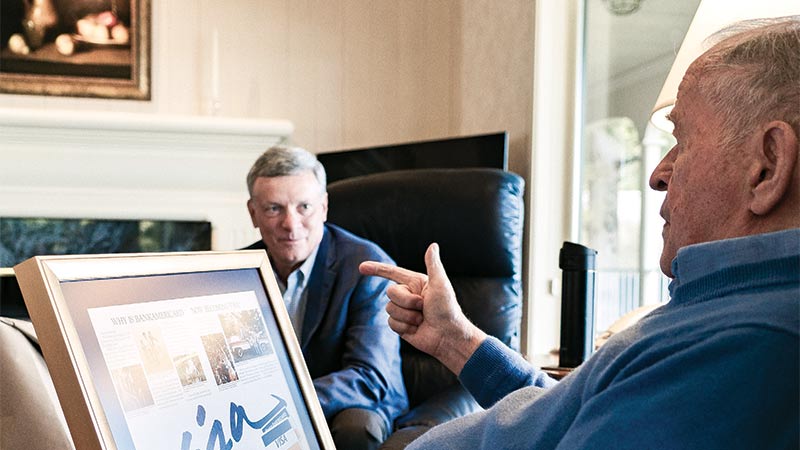
When Al Kelly became Visa's chief executive in 2016, he called Hock. A later visit to Hock's home in Olympia brought conversation about family, payments, leadership and life. The photograph of their meeting catches Hock mid-gesture, with a framed Visa display between them. The subject that had occupied his working life was still close at hand, but the setting was a home rather than a boardroom.
Hock died on July 16, 2022, aged ninety-three. His website now preserves his writing as an archive. Visa itself had changed over the intervening decades: regional businesses combined into Visa Inc. in 2007, and it went public in 2008. The member-owned arrangement he built belongs to a particular chapter of that history. His enduring question travels more freely. When people need to accomplish something together, how much control must they give up to make room for one another?