The first useful thing to know about Debbie Umbach is that somebody once told her she would fail. She was an engineering student, spending an internship in a laboratory with chemical samples and not nearly enough people. Her boss, Hank, looked at this unhappy arrangement and predicted she would never finish the degree. Umbach's response was wonderfully inconvenient: now that it was a challenge, of course she would finish.
She did. She also changed the design. Mechanical engineering became systems engineering, a course with more computer science and a clearer route into software. It is tempting to treat this as an origin-story flourish, the youthful rebuke that future executives keep polished for podcasts. But the more revealing fact is the switch. Umbach did not confuse persistence with standing still. She finished the larger task by changing the system around it.
That instinct has followed her through more than two decades in B2B technology: from IT consulting to product management, from product marketing to the top marketing job, and through companies concerned with internet infrastructure, cybersecurity, cloud operations, data protection, and now document management. The nouns keep changing. Her verbs are stubbornly consistent: inspect, connect, test, explain.
A hand raised before the answer was ready
After working in IT consulting, Umbach went to Harvard Business School to round out a technical education with a business one. The case method presented a fresh engineering problem: half the grade depended on speaking in class, and Umbach was quiet. Professors sent notes warning that she was not participating enough. The obstacle was not a lack of ideas. It was the belief that an idea ought to be perfect before it entered the room.
She made herself raise her hand anyway. It was uncomfortable, then less uncomfortable, and eventually fun. She found friends and a voice. Her account has no theatrical conversion. Confidence arrived by repetition, the same dull mechanism by which most useful capacities arrive.
“Curious.”Debbie Umbach, on the one word she uses for herself
The lesson matured with her career. Junior people are often told to speak more; senior people eventually have to learn to speak less. Umbach describes executive confidence as the ability to absorb a conversation, hold a point of view, and offer it when useful without treating every intervention as a final examination. The hand still goes up. It no longer needs to wave.
Product management gave that instinct practical work. Engineers were building the product, but a product manager could not merely order them toward a preferred result. She had to understand how they thought and influence without pretending that a cross-functional company was a tidy chain of command. When Umbach moved into product marketing and then broader marketing leadership, she retained the systems view. Demand generation, brand, sales, product, customers, and analytics were not rival departments in a budget drama. They were parts of one machine, prone to producing nonsense if optimized separately.
Employee 39 learns the category business
At BitSight, Umbach arrived in 2014 as employee number 39. The founders were building the security-ratings market, which meant marketing had to do more than advertise a product. It had to explain why a category should exist, establish a vocabulary, and help buyers recognize a problem in a new shape. By 2019, she said the customer base had grown more than tenfold to 1,000, with 30 percent outside the United States. Her remit covered communications, demand, product and customer marketing, events, channels, operations, and analytics.
In an interview from that period, she named three hiring signals: curiosity, operational follow-through, and integrity. Curiosity without execution is a pleasant lunch. Execution without trust is an expensive hazard. Her framework joined the traits, much as the systems engineer kept joining functions that organizations prefer to draw in separate boxes.
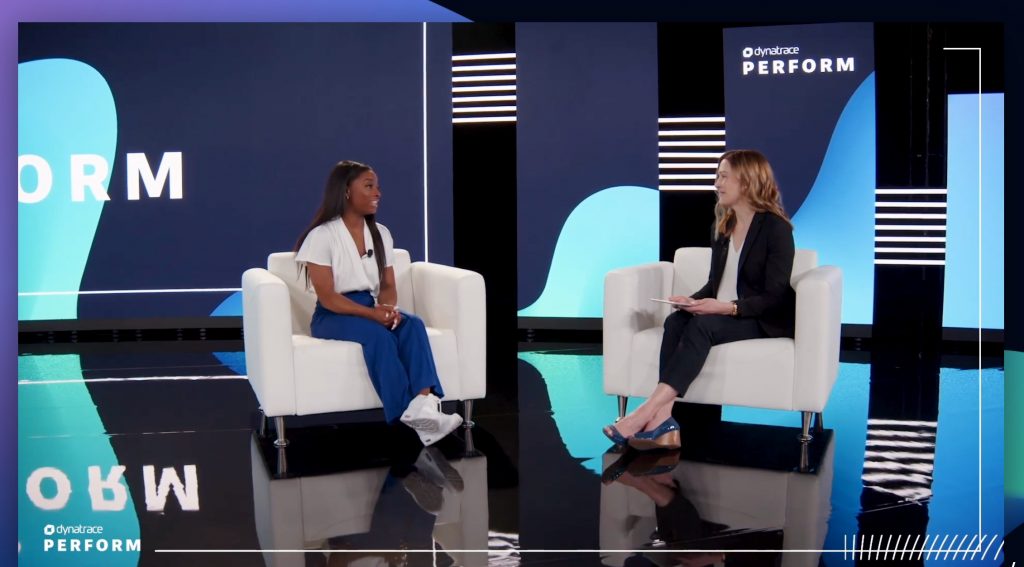
There was also a patent, issued in 2018, for a capacity-management method in computing. There were later stages and different rooms. At Dynatrace she moderated customer conversations on digital transformation and, in 2022, interviewed Simone Biles. Umbach had been a youth gymnast herself. The executive career had looped back toward the balance beam, though this time she held the questions.
Umbach's route then passed through Fairwinds, where she spent a week doing the work of a business development representative because proximity can reveal what an org chart conceals; Dynatrace, where she led corporate marketing; and Own, the data-protection company acquired by Salesforce. By 2025, she was considering the next chapter and asking where she could make the most meaningful difference.
She used AI to interview for the AI job
For the M-Files interview process, Umbach used AI as a research amplifier. She collected market reports, competitive material, customer reviews, the company website, the job description, and her own record. With NotebookLM, she created audio summaries to listen to in the car. The tools let her absorb more of the market than an earlier executive search would have permitted.
Then came the important human clause: she applied her own lens. A model could gather and combine. It could not decide what she genuinely believed, what the company needed, or why her particular experience fit the moment. Research without taste would have produced a competent pile. She needed a point of view.
M-Files appointed her chief marketing officer in 2025 as the document-management company expanded its partnership with Microsoft. The assignment was larger than promotion. Enterprise AI is ravenous for reliable context, while business content is commonly scattered, duplicated, weakly governed, or trapped in departmental habitats. M-Files sells a metadata-driven approach meant to connect documents with the people, projects, and transactions that give them meaning. Umbach's task is to make that infrastructure legible as an AI concern, not merely a filing concern.
“Context is everything right now.”Umbach on the condition for useful AI
The line could summarize both the product positioning and her management method. AI supplied with broken context can deliver a confident wrong answer. Employees asked to change without context can deliver an equally rational wrong response: resistance. In each case, the repair begins upstream.
Inside a global marketing organization of more than 50 people, Umbach has treated AI as an operating-model question. The team introduced an AI sales-development teammate named Mia, short for M-Files Intelligent Assistant. Umbach tested Mia in conversation and tossed curveballs before the system became a serious participant in pipeline work. The point, as she explains it, is to take on repetitive tasks so human representatives have more live conversations, not fewer reasons to exist.
She also created an AI go-to-market transformation role, working across functions rather than living in one marketing specialty. The job arrived while its professional category was still being invented. That uncertainty made definition more important: agree on expectations, set North Star measures, attach time frames, and be candid about what is working and what is not.
The wobble in the trust triangle
New technology makes an org chart nervous. A new leader does, too. Umbach uses a trust triangle with three sides: analytical rigor, authenticity, and empathy. Everybody, she says, has a wobble. Her strongest side is authenticity, followed by a data-driven habit. She has spoken candidly about making empathy more visible, including the basic managerial discipline of paraphrasing what someone has said so the person knows the message landed.
It is a revealing admission. Executive profiles generally present weaknesses that have been house-trained into strengths. Umbach's version remains useful because it concerns perception. Feeling empathetic in private does little for a colleague who cannot see it. Leadership happens at the receiving end.
Her practice includes one-to-one conversations, skip-level meetings, transparent agendas, and more than one route for feedback. Every other week, the marketing team meets to trade AI experiments. They celebrate what worked and examine what did not. Mistakes are treated as material for the next iteration. This is systems engineering with chairs pulled into a circle.
“We all want to be heard.”Umbach on leading through change
The ambition is not automation as an abstract virtue. Umbach asks how a change will make work better, more interesting, even more fun. She is suspicious of activity detached from outcome, a common marketing ailment because marketing is always visibly doing something. Her corrective is the smallest word in the executive lexicon and the hardest to answer honestly: why?
Why this tool? Why this role? Why this campaign? Why should the team care? Why will the customer? The question slows the meeting for a minute and can save a quarter. It also returns agency to people who might otherwise experience AI as weather rolling in from headquarters.
At an M-Files kickoff, the theme was “Making Our Own Weather,” a call to own outcomes despite market conditions. The phrase suits Umbach, though perhaps not in the intended way. She has spent a career declining the forecast. A lab boss said she would not finish. A quiet student thought an answer needed to be perfect. A technical graduate was not the obvious future CMO. Each time, she adjusted the system and kept moving.
Now the forecast concerns intelligent machines. Umbach's answer is neither panic nor worship. Learn how they work. Test them. Check the context. Define the outcome. Tell the people why. Then raise a hand before certainty becomes another excuse for standing still.