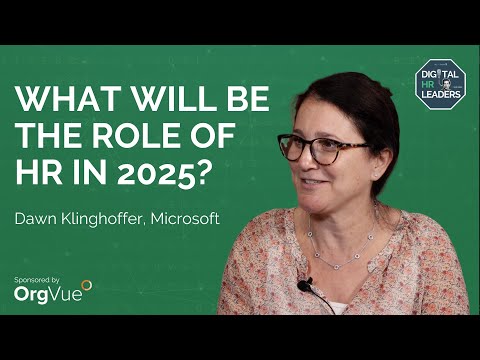
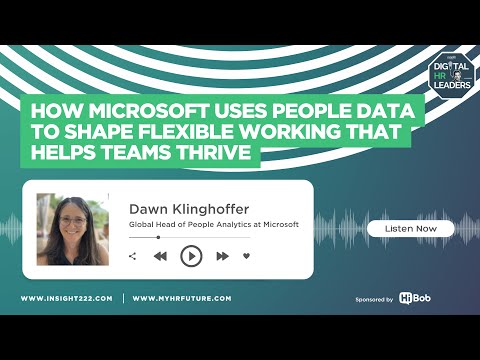
BREAKING
Dawn Klinghoffer - VP HR Business Insights at Microsoft HR's Rising Star 2023 - HR Executive Magazine Co-author of landmark HBR article on Employee Thriving 25+ years building people analytics at Microsoft From Hartford actuary to Microsoft's data-driven HR chief Employee Thriving - the metric that's reshaping HR worldwide Pulsing 2,500 Microsoft employees every single day Dawn Klinghoffer - VP HR Business Insights at Microsoft HR's Rising Star 2023 - HR Executive Magazine Co-author of landmark HBR article on Employee Thriving 25+ years building people analytics at Microsoft From Hartford actuary to Microsoft's data-driven HR chief Employee Thriving - the metric that's reshaping HR worldwide Pulsing 2,500 Microsoft employees every single day
Profile  •  Microsoft

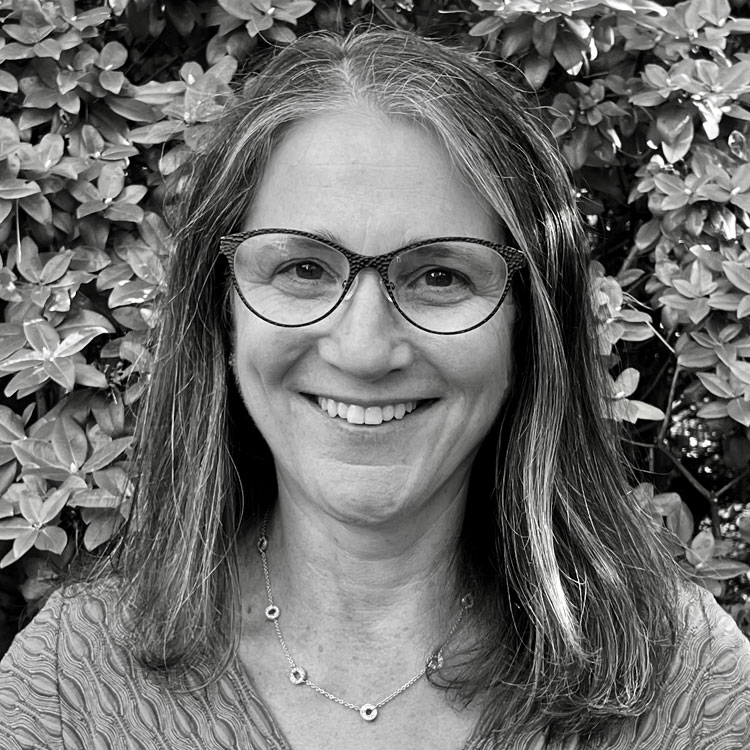
Dawn
Klinghoffer

The mathematician who decided feelings could be measured - and then built the infrastructure to prove it.

VP, HR Business Insights People Analytics HR's Rising Star 2023
25+
Years at Microsoft
228K
Employees Measured
2,500
Daily Pulse Responses
Dawn Klinghoffer, VP HR Business Insights at Microsoft
Microsoft, Seattle, WA
2003
Joined People Analytics
HBR
Harvard Business Review Author
2022
Thriving Framework Launch
2x
Annual Employee Listening Cycles

Measuring what actually matters - when everyone else was measuring the wrong thing

In June 2022, Dawn Klinghoffer and her colleague Elizabeth McCune published a piece in Harvard Business Review that quietly upended a multi-billion-dollar HR industry assumption. The question at the center of it was deceptively simple: what if "employee engagement" - the metric every company obsessed over for decades - was actually measuring the wrong thing?

Microsoft's answer: it was. Klinghoffer's team had spent months combing through academic literature, running internal focus groups with employees across the company, and asking a more uncomfortable question. Instead of "are you engaged at work?" they asked what made people bring their best to work every day. The answer wasn't engagement. It was thriving.

"Thriving means being energized and empowered to do meaningful work," Klinghoffer explained. Not just showing up. Not just completing tasks. Actually thriving. The difference sounds philosophical until you realize she built a measurement system around it - a biannual survey of 228,000 employees, a daily pulse of 2,500 people, and a data infrastructure feeding directly into Microsoft's executive decision-making.

That's the characteristic move: take a vague concept, make it quantifiable, and then make the data unavoidable for the people who run the company. For over two decades, Klinghoffer has been translating what humans feel at work into numbers that C-suites actually read.

She grew up in Hartford, Connecticut - insurance capital of the United States - and studied mathematics at Bucknell University in Pennsylvania. The actuarial path was right there, obvious and waiting. She took it briefly, working as an actuarial analyst at Connecticut Mutual Life Insurance. Then she moved to Seattle, joined Microsoft in corporate accounting, and in 2003 stumbled into a nascent HR analytics role that didn't yet have a name in the industry.

She joined part-time. "All I knew is that I wanted to be able to work part-time," she said. The field had no playbook. Klinghoffer brought actuarial thinking - hypothesis-driven, probabilistic, privacy-obsessed - to questions that HR had always answered with gut instinct and annual surveys. It turned out to be an unusual combination of skills exactly when the world needed it.

Over the next two decades she built what became one of the most sophisticated people analytics functions in corporate history. Her team's work restructured Microsoft's approach to hybrid work, informed post-pandemic return-to-office policy, and produced research landing in the New York Times, Forbes, MIT Sloan Management Review, and Harvard Business Review. She has presented data-driven people insights directly to Microsoft's senior leadership - including during the Steve Ballmer era, when such an idea was barely legible as an organizational function.

None of it, notably, was built by someone who thought they were destined for it. She's self-described as introverted. She didn't dream of running HR. She joined part-time and just kept finding interesting problems to solve with data. Twenty-five years later, she leads people analytics across a 228,000-person global organization, helps set hybrid work strategy, and shapes the way one of the world's most influential companies thinks about its own employees.

"Don't throw a bunch of data at the wall and hope that people will know what you're talking about."
- Dawn Klinghoffer, VP HR Business Insights, Microsoft

In 2019, she restructured the HR Business Insights team into four specialized units: Advanced Analytics & Research, Reporting Solutions, COE Analytics, and a new Analytics at Scale team. The architecture reflected her underlying philosophy - data should be close to the people making decisions, not warehoused in a central function that sends reports no one reads.

She maintains a dedicated privacy expert on her analytics team. It's not a compliance checkbox. It's a conviction. "It's super easy to do creepy things. It's really hard to be creative," she's noted when discussing the ethical edge of people analytics. The trust framework she built at Microsoft - transparency about data use, joint value for employees and company, clear purpose for every analytical project - became a model for the field.

The 2022 pivot to employee thriving wasn't sudden. It came from the pandemic forcing a reckoning: if engagement could hold steady while burnout surged, the metric wasn't measuring what mattered. Klinghoffer's team looked at what thriving employees said versus those who weren't: the thriving talked about collaboration, inclusion, autonomy, and support for wellbeing. Those not thriving described silos, bureaucracy, and a lack of accountability. The gap was measurable - and once measured, addressable.

Microsoft's employee listening system now pulses 2,500 employees every day. The twice-yearly Employee Signals survey covers the full company. The data flows into initiatives around hybrid work optimization, manager effectiveness, onboarding in a distributed world, and increasingly - as the AI era reshapes work at speed - into how Microsoft thinks about workforce readiness for what comes next.

At Microsoft Ignite 2025, Klinghoffer was back at the center of the AI conversation, exploring how Copilot and agents are already changing the nature of work at Microsoft's scale. The data, as always, is her medium. The question driving it hasn't changed since 2003: what actually makes people do their best work?
Engagement was the ceiling. Thriving became the standard.

Microsoft's shift in 2022 was not a rebrand. It was a structural rethink of how a company listens to its people - and what it does with what it hears.

Old Metric: Engagement

  • Annual surveys
  • Measures satisfaction with job
  • Reactive - identifies problems after the fact
  • Broad, hard-to-act-on findings
  • Lower bar - can be "engaged" but burned out
  • Limited connection to business outcomes
vs

New Metric: Thriving

  • Biannual + daily pulse surveys
  • Measures energy, empowerment, meaning
  • Proactive - drives early interventions
  • Actionable signals for managers and leaders
  • Higher bar - energized AND empowered
  • Direct link to retention, performance, culture

Source: "Why Microsoft Measures Employee Thriving, Not Engagement" - Harvard Business Review, June 2022. Dawn Klinghoffer & Elizabeth McCune.

Straight from the data chief

"Thriving means being energized and empowered to do meaningful work."
HBR, June 2022
"Don't throw a bunch of data at the wall and hope that people will know what you're talking about."
On communication of analytics
"It's super easy to do creepy things. It's really hard to be creative."
On data privacy in people analytics
"None of us are the same people today as we were prior to 2020. So, as our employees change, the ways we can best empower them need to evolve, too."
On post-pandemic HR evolution
"Is there a higher bar that we could aspire to?"
On moving beyond engagement metrics
"Productivity is a multi-faceted concept that is highly dependent on the work the person does and the outcome they are trying to drive."
On measuring workforce performance

The record, in brief

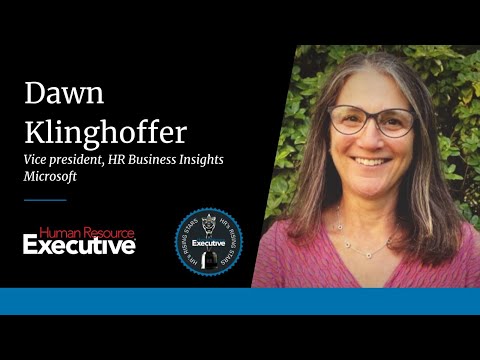
HR's Rising Stars 2023 - HR Executive Magazine
📄 Harvard Business Review - Employee Thriving article
📊 Built Microsoft's people analytics function from founding
🌐 Research in NYT, Forbes, MIT Sloan, HBR
🏢 25+ years driving HR strategy at Microsoft
🔄 Guided Microsoft's hybrid work policy post-pandemic

The Hartford Actuary Who Went West

Klinghoffer grew up in Hartford, Connecticut - insurance capital of America. She became an actuarial analyst after Bucknell, then relocated to Seattle and joined Microsoft in accounting. The pivot to people analytics came in 2003, not from a grand plan but from a part-time opportunity that fit her life at the time. The field didn't have a name yet. She built it anyway.

The Privacy Expert On Staff

Most analytics teams hire data scientists. Klinghoffer's team also carries a dedicated privacy expert. This wasn't a legal mandate - it was her decision, rooted in the belief that employee trust is the prerequisite for any meaningful people data. You can surveil or you can listen. She chose listening - and built the governance to prove it means something.

2,500 Voices. Every Day.

Microsoft's employee listening system pulses 2,500 employees daily. Not monthly. Not quarterly. Every day. That's a methodology decision that looks like a logistical one but is actually philosophical: the state of a workforce is not a snapshot, it's a continuous signal. Klinghoffer built the system to reflect that.

Thriving, Not Languishing

The pandemic gave everyone the word "languishing" - the not-quite-depressed, not-quite-fine feeling that psychologist Adam Grant wrote about in the NYT. Klinghoffer and her team took the inverse: what does it look like when people are genuinely thriving? Then they built a survey instrument to measure the distance. The result replaced Microsoft's entire engagement framework in 2022.

From actuary to analytics chief in 30 years

The non-linear path that happens to look inevitable in retrospect.

1991
Graduated Bucknell University with a mathematics degree. Joined Connecticut Mutual Life Insurance as an actuarial analyst in Hartford, CT.
Early 1990s
Relocated to Seattle. Joined Microsoft in corporate accounting - a long way from the actuarial tables of Hartford.
2003
Joined Microsoft's founding people analytics team, initially part-time. People analytics as a field barely had a name. She helped give it one.
2003 - 2018
Built and expanded Microsoft's centralized people analytics function. Leveraged actuarial instincts and programming skills to advance the practice. Presented insights to executive leadership including former CEO Steve Ballmer.
2019
Restructured HR Business Insights into four specialized units: Advanced Analytics & Research, Reporting Solutions, COE Analytics, and Analytics at Scale.
June 2022
Co-authored "Why Microsoft Measures Employee Thriving, Not Engagement" in Harvard Business Review. Launched the Employee Thriving framework companywide.
2023
Named one of HR Executive's five HR's Rising Stars. Elevated to Vice President, HR Business Insights at Microsoft.
2025
Featured at Microsoft Ignite 2025 exploring AI and Copilot's impact on the future of work and workforce analytics. Speaker at People Analytics World 2025, London.

What thriving employees say vs. what struggling ones say

Data from Microsoft's internal research informing the thriving framework.

Employee Sentiment Analysis
Thriving vs. Not Thriving: What They Actually Say
Thriving employees talk about...
  • Collaborative environment
  • Teamwork with colleagues
  • Inclusive culture
  • Autonomy & flexibility
  • Wellbeing support
Not thriving employees cite...
  • Silos & bureaucracy
  • Lack of collaboration
  • Missing accountability
  • Limited flexibility
  • Feeling unsupported
Fun Fact

Klinghoffer's team posts bi-weekly insights on an internal Yammer channel under the hashtag #DataDrivenHR - sharing tips, tricks, and analytics learnings with Microsoft's broader HR organization. The channel runs whether or not anyone's watching. Most times, someone is.

Where you've read her research

Klinghoffer's team doesn't keep findings internal. The research goes public - in outlets that reach HR leaders, executives, and anyone paying attention to the future of work.

HBR
Harvard Business Review
Why Microsoft Measures Employee Thriving, Not Engagement
June 2022
NYT
The New York Times
People analytics research on hybrid work and employee wellbeing at Microsoft
2021 - 2023
MIT
MIT Sloan Management Review
Research on data-driven workforce strategy and organizational analytics
Multiple issues
FRB
Forbes
Perspectives on employee thriving, hybrid work, and the future of HR analytics
Multiple features

Dawn Klinghoffer on video