A refrigerator magnet is an unlikely starting point for a company that would trade on Nasdaq. It has no grand ambitions. It holds up a shopping list. For David Wright, that modest object offered something useful: a way to test whether better decisions about online selling could produce better results. In 2013, he and Melanie Alder began selling small products on Amazon from her living room in Lehi, Utah. The business was called iServe. The magnets were Alder’s idea.
Wright brought a background in data. Alder carried the day-to-day business while he worked evenings around another job. Their division of labor matters to the story. A formula can look rather tidy on a screen. Someone still has to answer the telephone, persuade a supplier and keep the orders moving.
Years later, Wright would describe business as a team sport. At the beginning, the team was small enough to fit among the furniture.
The database person goes shopping
Wright’s route into retail ran through information systems. He studied accounting and information systems management at Brigham Young University, then worked in database operations at Autoliv. From 2004 to 2015, his career included database management and enterprise information management at The Church of Jesus Christ of Latter-day Saints. His experience concerned the machinery behind an organization: collecting information, making it usable and keeping it dependable.
That background helps explain the kind of opportunity he saw. Where a shopper sees a product page, an information specialist can see a series of adjustable conditions. How did the shopper arrive? Was the product available? Did the description answer a question? Did the price make sense? Each condition offers a possible explanation for a sale that happened, or one that slipped away.
Wright has described revenue in terms of traffic, conversion and price, with availability also part of the problem. He also acknowledged the difficulty of solving everything with software. Marketplaces have different systems; brands need people with practical expertise alongside the technology. The apparent simplicity of the equation hides a considerable amount of work.
A sold-out product is an especially rude correction to an elegant advertising plan. Wright’s business grew around dealing with the whole sequence, including the parts that fail to appear in a glamorous presentation.
Consider the ordinary sequence behind one purchase. An advertisement earns attention, a page explains the item, a price feels acceptable and a delivery promise makes the order worth placing. Breaking any link can waste the effort spent on the others. The attraction of Wright’s formula is that it makes those dependencies visible. Its difficulty is that each part belongs to a different daily task, often handled by a different person. Improving the result means getting those tasks to cooperate. The customer has little reason to care which department got its own part right.
A paycheck with a return policy
The early company kept putting its money back into the business. When Alder finally received a paycheck, they photographed it. Within days, another opportunity required cash, and Wright asked whether she would reinvest it. She did. It is an unusually literal example of a founder taking money out of one pocket and putting it into another.
The name eventually received attention too. Wright liked Continuum, partly for its Star Wars associations. Creative chief Josh Mendenhall favored Pattern. In 2018, iServe became Pattern, a name suited to the repeatable processes Wright wanted to build.
The company also acquired the international consultancy Practicology that year. A business that began with products in a Utah living room was assembling the people and infrastructure to operate across borders. In 2020 came a $52 million Series A. In 2021, a $225 million round led by Knox Lane put its valuation at $2 billion. Those were company milestones, separate from any measure of Wright’s personal wealth.
- 2013iServe starts selling on Amazon
- 2018Pattern name; Practicology acquisition
- 2021$225 million funding round
- 2025Nasdaq debut as PTRN
The interview before the interview
Ask Wright about his advantage and the conversation often returns to hiring. His interest in measurement extends to the people doing the measuring. In a 2025 discussion, he described reviewing candidates personally, with extensive reference checks and packets running to 20 or 30 pages. Getting hired at Pattern could involve a fair amount of reading before anyone ordered a laptop.
There is a practical tension here. Entrepreneurs are encouraged to move quickly. A careful hiring process deliberately inserts friction. Wright’s approach treats that friction as an investment: spend time deciding who joins, then give capable colleagues room to act. Scrutiny at the door and freedom inside are compatible, provided the judgment at the door holds up.
His hiring process has roots in a book. Pattern adapted the hiring method in Geoff Smart and Randy Street’s book Who, using role outcomes, competencies and scorecards. Employees who exemplified a value helped evaluate it in applicants. References were a check on an interviewer’s confidence.
That last detail is revealing. A charming conversation can flatter both participants. A scorecard asks each to be more specific. Wright’s method tries to make the decision survive the end of the meeting, when everyone has stopped smiling and someone has to do the job.
He even described the skeptical interviewers who earned the nickname wet blanket. Most organizations have one. In this account, the person slowing down the celebration has a useful assignment.
Make room at the bell
By September 2025, there was a much larger celebration to arrange. Pattern’s initial public offering priced at $14 a share. The roughly $300 million offering was split between shares sold by the company and shares sold by existing stockholders. The distinction matters: the headline amount was never all new cash for Pattern.
For the opening-bell ceremony, Wright and Alder asked how many people could fit behind the Nasdaq podium. They flew out 100 of the company’s longest-serving employees, including a janitor. Tenure became a ticket to a moment usually photographed around a handful of executives.
“You have to be ridiculously fair.”
David Wright, on leadership
The gesture fits their partnership. Wright generates ideas rapidly; Alder works through operational angles. They have described their collaboration as a dance. They also became spouses, marrying in 2018 after years of building the company together. That makes the repeated credit Wright gives Alder more than a ceremonial acknowledgment. She was doing the work while he still had a day job.
The bell photograph offered a different kind of company record from a financial statement. It showed who had been invited into the frame.
When the shopper asks a machine
Wright’s more recent work concerns a change in how shoppers find things. At the 2025 K5 retail conference, he discussed discovery through AI assistants, the importance of clear product information and the way reviews can expose weaknesses that marketing would prefer to leave alone. The job of a brand now includes answering questions posed through an intermediary that may never display a conventional search-results page.
That brings him back to the original appeal of information systems. A product needs accurate descriptions, useful images and a reliable account of what it does. A new interface changes where those details are encountered. It does little to excuse their absence.
In May 2026, Pattern launched Pattern Intelligence, shortened to Pi. The company describes it as an execution engine: sensors monitor areas such as pricing, content, inventory and advertising, while automated actions address problems. Decisions requiring brand judgment are presented for approval. The ambition is to close the distance between noticing something and doing something about it.
Wright carried that argument to a September 2026 conference in China. His emphasis included a stubbornly physical constraint on all this digital machinery: the quality of the product. Better technology can improve presentation and distribution. A customer eventually opens the parcel. That remains a rather effective audit.
Numbers large enough to need a date
Pattern reported $774 million in revenue for the first quarter of 2026, an increase of 43 percent from a year earlier. In the second quarter, revenue reached $877 million, up 47 percent. These are quarterly company revenues, rather than sales attributed personally to Wright or a forecast of future performance.
For Wright, the same period brought the public rollout of Pi and continued discussion of AI’s consequences. In 2026, he argued that companies needed to think about its effect on human jobs. He did not present a finished answer. The acknowledgment belongs beside the product launch: adopting automation also means deciding what responsibility comes with it.
The next set of quarterly results was scheduled for November 4, 2026. A public-company calendar supplies its own rhythm. However persuasive the presentation, another reporting date is already approaching.
Five seconds in Los Angeles
There is one relocation proposal Wright appears to have considered very efficiently. His daughter, after arriving at UCLA, asked whether he had thought about Los Angeles. His answer gave it about five seconds. In his 2026 account of the exchange, his attachment to Utah was unequivocal. He wanted the company to stay.
For someone building an international business, that is a useful personal detail. Global reach can coexist with a settled idea of home. Wright’s work sends products and software across marketplaces; his account of where he belongs remains local.
Refrigerator magnets, hiring packets, an overcrowded bell ceremony: the objects in his story are wonderfully uneven in scale. Each makes an abstract claim tangible. Test the process on something small. Check the person before trusting the interview. Invite the people who stayed. Wright keeps talking about data, but his career supplies a second recurring subject: who does the work when the equation leaves the page.
Follow the conversation
Read, watch and hear more from Wright.
- Pattern’s website ↗
- David Wright on LinkedIn ↗
- David Wright on X ↗
- Watch: Wright’s K5 keynote on YouTube ↗
- Watch: a conversation with Nasdaq ↗
- Listen: hiring by values with Gene Hammett ↗
- Read: Wright’s account of the early years ↗
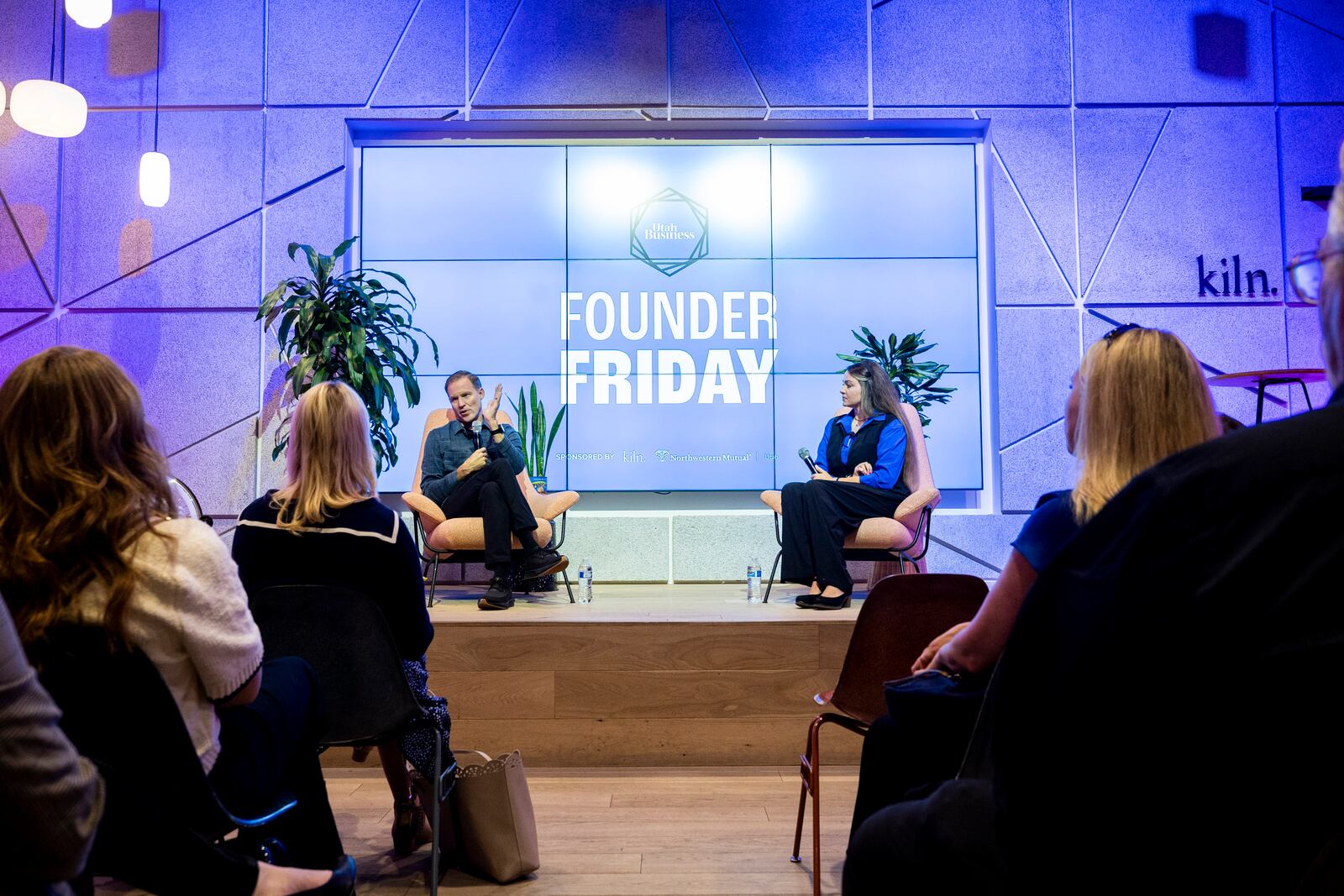
- Read: the Founder Friday conversation ↗
- Read: Wright on Utah, people and AI in 2026 ↗
- Pattern’s results and investor updates ↗