David Selinger had helped his neighbors buy better cameras. Then a home invasion made him reconsider what better meant. In his account, the footage showed people waiting outside a neighbor’s house, preparing to break in. The equipment had preserved the scene. Nobody watching it intervened. For an engineer who had recommended the technology, the recording was an awkwardly precise record of an unmet expectation.
By then, Selinger had spent years making software useful in commerce. He had worked at Amazon, co-founded Redfin, and founded RichRelevance. Here was a more personal question. What should technology do when the thing happening outside the front door matters more than the quality of the picture? A camera can deliver a remarkably clear image of a problem while leaving the problem quite intact.
He began investigating security services and talking to police. Deep Sentinel, incorporated in 2016, grew from that inquiry. The company combines cameras, artificial intelligence, and live guards who can speak through a camera and contact police. Selinger’s interest lies in the interval when somebody can still change what happens next. It is a small interval on a screen, and a rather large one in a person’s life.
One shelf in Grants Pass
Long before he was arguing about cameras, Selinger was a child in Grants Pass, in southern Oregon, looking for programming books. He says he started learning to program at six. His parents were doctors; their son’s enthusiasm pointed toward computers. He remembers taking them to the library, where one shelf held the programming material he wanted. He taught himself languages from what he could find.
The story is appealing partly because the setting is so ordinary. No incubator, no elaborate origin ceremony, just a library shelf and a child who wanted to understand a machine. Looking back, he describes himself with two words: intensity and technical. His metaphor is a gearbox with very little patience for the intermediate settings. First gear gets him moving; fifth follows soon afterward.
At Stanford, that technical appetite expanded into artificial intelligence, robotics, and machine learning. His public education record lists 1996 to 2003 and robotics research. He has described the university as a place where he encountered the business world as well as engineering. The two would keep meeting in his career: first in shopping, then in housing, and eventually in the business of watching a doorway.
Friends and colleagues call him Selly. It is a useful nickname for somebody whose public résumé can become a procession of company names. The interviews supply a less polished character: energetic, technically minded, quick with an analogy, and willing to describe himself in terms that sound more like an engine specification than an executive biography. Those are his descriptions, and they fit the library story rather well.
Customer behavior
Maps & homes
Retail personalization
Physical security
A bad idea, pending a test
Amazon hired Selinger in 2003, straight out of Stanford. In his own written account, he had declined six offers before accepting a role running its Customer Behavior Research group. The work concerned data mining and research and development. He worked with Jeff Bezos, an experience that became a recurring reference point when he explained how he wanted to run companies of his own.
One proposal was to sell advertising on Amazon’s homepage. Selinger remembers Bezos responding badly to the idea. Then Selinger brought evidence, and Bezos authorized a live test. The episode matters less as a trophy from proximity to a famous founder than as an account of a decision changing. An unfavorable first reaction did not end the discussion. Evidence gave the proposal somewhere to go.
His team also investigated the effect of website loading time on sales. He later described producing 65 pages of proof and seeing Amazon reorganize work around the performance measurements. Speed had become something that could be examined and assigned to people, rather than admired in a meeting. That distinction would travel with him. A number earns its keep when somebody’s behavior changes because of it.
The relationship continued beyond his employment. Selinger recalls meeting Bezos for coffee shortly before the pandemic, then going to another coffee shop to write down their conversation. He estimates spending longer on the notes than on the meeting itself. This is an excellent way to make one coffee last an entire afternoon. It also shows how deliberately he treats an opportunity to learn from somebody he respects.
Houses, shopping carts, and the same appetite
In 2004, Selinger co-founded Redfin. As its founding CTO, he helped build the mapping and real estate data analytics engine. The subject had changed from online shopping to property, but the attraction was familiar: use software to make information more useful to the person trying to do something with it. Redfin put him in a business where the user’s experience carried considerable weight.
He later credited that experience with teaching him how much the interface matters. A tool can contain plenty of information and still ask too much of the person using it. For a founder coming from data mining, that is a useful complication. The measurements have to meet someone’s actual task. A prospective buyer wants to explore homes, not contemplate the magnificence of a database.
RichRelevance followed in 2006, applying personalization to retail. Its customers included recognizable shops such as Macy’s and Office Depot. By 2013, reporting on its acquisition of Precog described close to 200 customers, including Walmart, Target, and Marks & Spencer. The career had moved from studying behavior inside Amazon to supplying other retailers with tools for understanding and responding to their shoppers.
There were experiments beyond recommendation lists. In 2009, RichRelevance and Zugara introduced Fashionista, a webcam-based virtual clothing experience. Shoppers could use motion to control the application. Selinger’s objection to cumbersome installation was succinct: “Downloading is the enemy.” The remark belongs to its time, but the concern is recognizable today. An exciting feature becomes less exciting when using it feels like unpaid technical support.
Taken together, these businesses explain the breadth of his résumé without requiring a theory of destiny. Each put a technical problem beside a human decision. Shopping asks what someone might want. Housing asks what someone needs to see. Security asks who should act, and when. Selinger had experience with the first two questions before a neighborhood incident gave the third an uncomfortable urgency.
The guard at the other end
An early Deep Sentinel incident supplied a modest, concrete demonstration. In January 2019, the company was still operating a beta service from an office overlooking Main Street in Pleasanton, in the Kolln Hardware building. An employee, a former police dispatcher, saw a person on a bicycle apparently surveying a customer’s home in New York. When he picked up a package, she spoke through the system’s loudspeaker.
The person put the package back and rode away. There was no need for an elaborate ending. The package remained, which was the point. Selinger was pleased because the event gave his team evidence that their intended sequence could work across the country: observe something relevant, put a person in a position to respond, and intervene while the outcome is still unsettled.
The human role is central to how he explains the business. AI screens video and brings potentially suspicious activity to a guard’s attention; a guard reviews it and can speak or escalate. The arrangement gives software the repetitive watching and gives people a decision to make. It also makes the service more complicated to build than a camera that merely stores footage. Someone must staff and operate the response.
By June 2025, Deep Sentinel had raised a $15 million Series B led by Egis Capital Partners. The announced purpose included expansion, continued AI development, and a Bring Your Own Camera program. That program accounted for nearly half of sales at the time, according to the company. It allowed customers to add the service to supported equipment they already owned, avoiding a wholesale hardware replacement.
That is an interesting development for a founder who began by reconsidering expensive cameras. Existing hardware can have another chapter if the surrounding service changes. It also moves the business beyond the original residential story into commercial properties and relationships with installers. The doorway in the founding anecdote remains recognizable, even as the practical work becomes camera compatibility, sales channels, and running a monitoring operation.
Still interested in the machinery
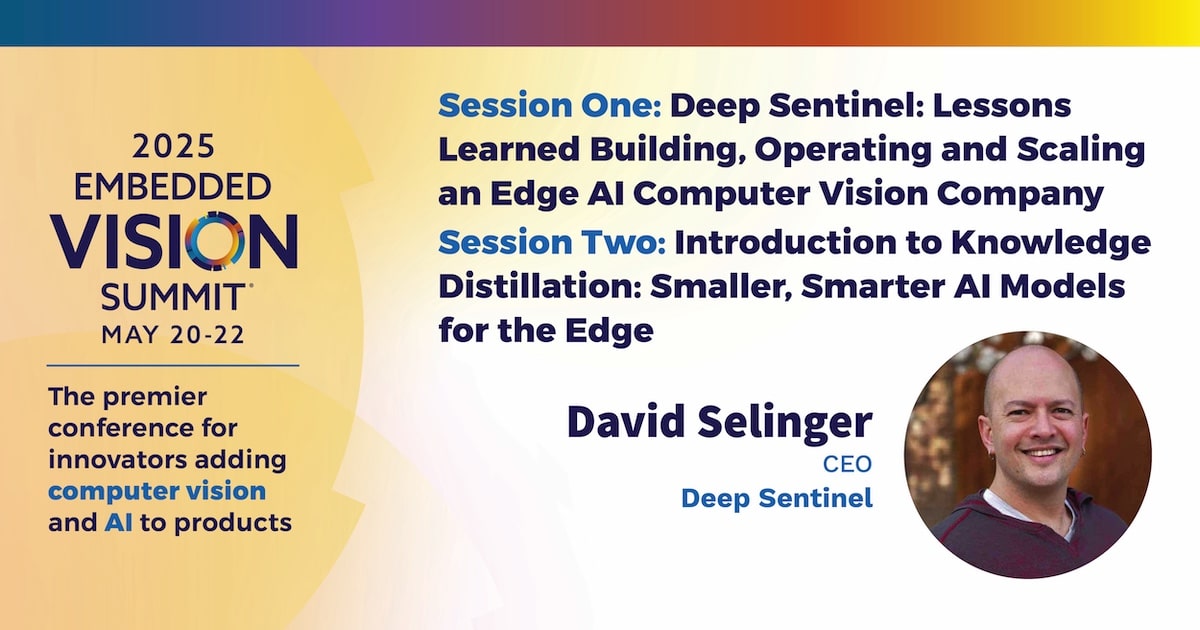
Selinger has remained publicly involved in the technical detail. At the May 2025 Embedded Vision Summit, he presented a tutorial on knowledge distillation: transferring capabilities into smaller AI models suited to edge computing. His presentation addressed when to use the method, its tradeoffs, and implementation requirements. The library shelf has acquired a conference screen, but the interest in how a system works is still visible.
His interests also extend into nonprofit work. A 2022 interview biography listed board or advisory involvement with MyTwoFrontTeeth, the Darfur Stoves Project, and Silicon Climate. These affiliations add another dimension to a career frequently introduced through venture-backed companies. They belong beside the business record, rather than being treated as decorative proof of virtue. The useful question in either setting is what the work helps somebody do.
When the conversation turns away from companies, the details become pleasantly less predictable. He has named Snow Crash and The Speed of Trust among his favorite books. Asked about music, he chose Gin Blossoms, remembering a concert for which he had gathered friends and persuaded everyone to buy tickets. The answer concerned the shared occasion as much as the songs. Even his leisure anecdote includes a little organizing.
The ordinary life behind the alarm
Selinger is a father of two daughters, and he repeatedly connects Deep Sentinel’s purpose to parenthood. His aspiration is broader than a collection of cameras. “When people feel safe, they thrive,” he says. He links that feeling to children taking risks, people listening to each other, and the freedom to go about ordinary life. That is his stated ambition for the work, rather than a measured result.
In a November 2025 radio conversation, he also discussed lighting, clear sightlines, and neighbors who can see one another’s front doors. It was practical advice from a technology founder who still makes room for the unglamorous parts of a neighborhood. A trimmed view and somebody walking past can matter. The argument for watching does not require every useful observer to be running a neural network.
By September 2026, he was still explaining the difference between a recording and an intervention in a Modern CTO conversation. The question that brought him into security had survived funding rounds, integrations, and years of company building. Who sees the important moment in time to respond? For Selinger, the answer continues to include a human being, somewhere at the other end of the camera, ready to speak.
“When people feel safe, they thrive.”David Selinger