For more than a decade, David Nyland went to Mobile World Congress with a badge and shoes that were poorly suited to the distances involved. In 2025, he looked up in Hall 2 and saw Lumine’s name illuminated above its pavilion. He later wrote about being moved by the sight. Software entrepreneurship has many measures of progress. Occasionally, one of them is a place to sit down.
The detail is a welcome interruption in a career usually described through acquisitions and executive appointments. A badge gets you into the room. Building something that earns a place in it takes longer. By then, Nyland had spent years assembling a group of communications and media software businesses, and considerably longer learning what it meant to run one.
His current project carries an unusually expansive promise: buy businesses and keep them. Lumine’s permanent ownership model places the consequences of a transaction on a long calendar. For the founder of the acquiring company, that means the story continues well beyond the satisfying moment when another deal closes.
A career on both sides of the table
Nyland began as a software developer at a systems integrator. His subsequent career took him into entrepreneurial telecommunications software businesses, then into chief executive roles. This was a progression through several kinds of responsibility: understanding the product, running operations, leading a company, and eventually choosing companies to bring into a larger organization.
At Architel Systems and Syndesis, he held chief operating officer roles. Both were venture-backed telecommunications software businesses. His next chapters included leading NBS Technologies, a publicly listed company, and Blueprint Software Systems, which was funded by venture capital. Public and private ownership gave him experience with different settings for the same essential work of running a software business.
He also had an engineering education behind him. Nyland studied at Brunel University in the United Kingdom, earning a Bachelor of Engineering. His public LinkedIn profile lists the years 1985 to 1989. The sequence matters more than the credential: the executive buying specialist software businesses had first worked inside the craft and the organizations that produced it.
In 2014, he joined the Volaris operating group of Constellation Software to build a communications and media business. A career that had moved between individual companies now had a different assignment. He would help construct the setting in which many companies could keep operating.
The first purchase had a longer job description
Incognito Software Systems was the first acquisition. Its established cable-market presence across the Americas, its provisioning and operations software, and its technical team made it a fit for the business Nyland was building. More than a decade later, he returned to that decision in an interview about the company’s development.
“The first acquisition has to go well for them and for us, because it’s the foundation upon which the portfolio is built.”David Nyland, on Incognito
The pronouns do useful work. Success had to make sense to the acquired business as well as the buyer. A first transaction would become the example that later founders and executives could inspect. It would also teach Lumine what its own promises required in practice.
Incognito’s subsequent development included new analytics capabilities and changes to how software was developed. People moved too: former leader Pete Koat went on to lead Axyom.Core within the group. A permanent owner still needs movement inside the businesses it keeps. The company remains; the assignment can change.
Give growth somewhere to stand
When asked how to grow a mature software business, Nyland’s answer began with the core. He advocated discipline across the company’s functions, followed by investment grounded in a business case. Sales, marketing, and new products were places to deploy capital once the underlying operation was profitable and dependable.
It is an operating answer to a growth question. Buying another business creates an announcement. Strengthening the existing one requires decisions that are harder to photograph. The sequence he describes puts those decisions ahead of expansion, so the company has something stable to build upon.
Lumine has given this accumulated experience a formal home in its Playbook. The collection covers practical work across functions, including sales and research and development. Its public description uses a Rubik’s Cube as the organizing image: complicated problems can be approached through a sequence of learned moves.
A diagram of Nyland’s growth approach and Lumine’s shared learning model, rather than a forecast.
The metaphor has limits, of course. Customers are entitled to be less predictable than coloured squares. But the appeal is clear: a leader should be able to borrow a useful method without having to discover every mistake personally.
The morning the ticker became LMN
In February 2023, the WideOrbit transaction was completed and Lumine spun out of Constellation Software as a separate public company. On March 24, its shares began trading on the TSX Venture Exchange under LMN. Nyland joined colleagues and directors for the market opening.
He remembered the morning in his mid-year letter. The event supplied a visible punctuation mark to work that had begun years earlier. A business assembled inside an existing software group now had its own stock-market identity.
There is an appealing tension in that moment. A public market displays a price that can change throughout the day. A permanent owner talks about keeping businesses indefinitely. Nyland’s job puts both time scales in the same frame. The opening ceremony lasts a morning. The operating commitments travel home with everybody.
Autonomy has a meeting schedule
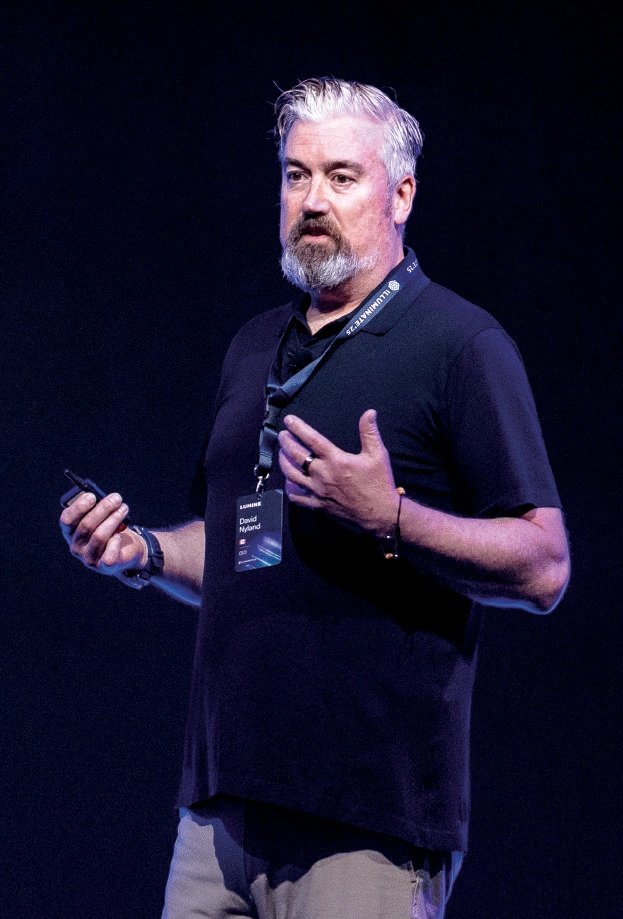
Lumine’s companies retain their own leadership. Making that arrangement useful requires ways for people to meet, compare experience, and ask for help. At Illuminate in 2025, more than 250 delegates from 22 countries gathered in Tulum, Mexico, for the group’s senior leadership learning event.
Nyland’s opening keynote traced the journey from the first Illuminate in Prague. He also stressed a culture of low ego, curiosity, and continued learning. The gathering included case studies, conversations with chairman Mark Miller, and an AI presentation challenge. These were executives expected to learn alongside one another.
A public recommendation from Incognito founder Stephane Bourque describes Nyland as analytical and practical, with clear expectations and constructive feedback. Another, from Mike Bell of Envisio, highlights his work as an adviser and mentor. These are colleagues’ assessments, and they point to a style rooted in helping other leaders operate.
The same work appears at the functional level. Lumine’s SparkX event brings finance, HR, legal, and IT leaders together. In a September 2026 account, Synchronoss CFO Craig Cutter described the value of discovering peers who faced similar problems and building a network he could contact afterward.
This is the unglamorous infrastructure of belonging to a group: knowing whom to call. The acquired business keeps its decisions. Its leaders gain more people with whom to think them through.
The sign above the separate booths
The pavilion at Mobile World Congress gives that arrangement a physical shape. Lumine businesses can exhibit in a shared space while maintaining their own booths and conversations. The 2026 booklet described more than 20 businesses present on site, each bringing its own experience of serving customers.
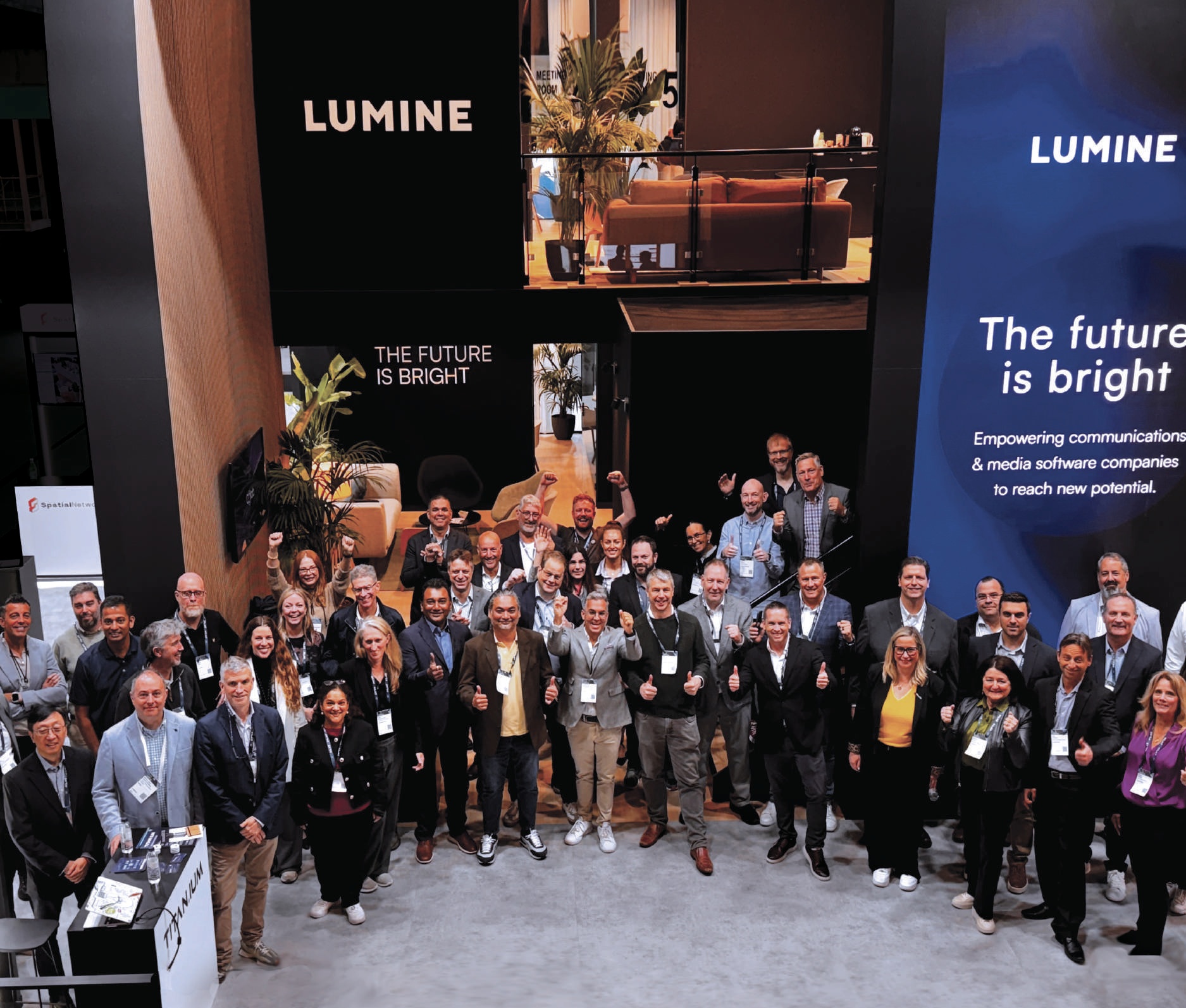
For Nyland, the earlier sight of the group’s illuminated name had personal meaning. For an operating company, the practical benefit is different: a place to meet customers and encounter colleagues from elsewhere in the portfolio. Both meanings can occupy the same stand without requiring a reorganization.
When the seller returns
In February 2026, Lumine completed its acquisition of Synchronoss, its first purchase of a public company. The relationship already had a history. Lumine had previously acquired Synchronoss businesses that became Openwave, RazorFlow, and SpatialNetworX. Nyland treated the return to the table as evidence that the earlier experience had mattered.
In the transaction’s employee presentation, he appeared alongside Lumine COO Tony Garcia. The discussion addressed the ownership model and the future of the business. Acquisition language becomes considerably more concrete when the audience includes the people who will turn up for work after it.
Imagine Communications offered another view from the acquired side. After the July 2026 announcement, CEO Steve Reynolds described years of contact with Lumine’s M&A team at industry events before a sale became the immediate subject. He valued an owner that understood media software and could offer continuity to customers with long relationships.
That history gives the permanent ownership promise a human scale. People meet. They keep in touch. Eventually, an ownership question becomes pressing, and a familiar conversation takes on a new purpose.
A future with ordinary work in it
Nyland’s recent letters put AI inside daily operations: product development, customer support, and internal work. His January 2026 message paired its adoption with training, security, and measurable results. He also highlighted leadership appointments, including Garcia’s promotion to COO and Mary Anne Lavallee’s arrival as CFO.
Alongside the business agenda sits Brighter Futures, Lumine’s community program. It supports access to technology and education, including scholarships and refurbished computers for Ontario communities. The scholarship program includes career coaching from senior HR leaders, extending the group’s emphasis on learning beyond its own employees.
Nyland’s career began with software and widened into the responsibility of ownership. The recurring question now is how to keep businesses useful, people developing, and relationships worth continuing. In that context, the illuminated name in Hall 2 feels like a well-earned pause in an unfinished task. There are still customers to meet, leaders to teach, and hallways to walk. Sensible shoes remain a sound investment.