David Mindell began an MIT class with a book that had a small publishing problem: it did not exist. The cover looked convincing. The subject, aerospace entrepreneurship, was useful. A student wanted to know where to get a copy. Mindell supplied the catch. “It doesn’t exist,” he said. “You’re going to write it this semester.” A reading assignment had quietly become a manufacturing problem.
By October 2026, the class had produced a 100-page report, informed by more than 50 interviews with people working across aerospace. The episode makes a fitting introduction to Mindell. He teaches the history of making things, builds technology, and invests in industrial companies. When an explanation is missing, his students may discover that they have been volunteered to assemble it.
There is a similar invitation running through his career: look around the machine. Who is operating it? Who decided what it should do? What must be built around it before it becomes useful? These questions have followed him from underwater archaeology into spaceflight history and onto the factory floor. They also complicate the familiar picture of automation as a device gradually shedding its human company.
The ocean had other plans
In the summer of 1988, Mindell went looking for work at the Deep Submergence Laboratory in Woods Hole. He met Skip Marquet, an original engineer on the Alvin submersible and a co-founder of the laboratory with Robert Ballard. Mindell had studied electrical engineering and literature at Yale. The combination offered two ways of approaching the same object: work out how it functions, then ask what kind of story people tell about it.
The deep ocean gave both habits something to do. Robots could enter places that people reached with difficulty. Cameras and navigation equipment could make those places visible from a ship. But sending machinery down did more than change the means of travel. It changed the company an explorer could keep.
Working with the tethered robot Jason, Mindell saw images from the seabed transmitted through a fiber-optic cable into a control room above. Twenty or thirty people could experience the exploration together. A submerged vehicle carried the instruments; the ship carried a conversation. Someone could notice a detail, another could interpret it, and the group could decide what to investigate.
He later recalled that the early expectation had been for robots to replace occupied submersibles and eventually work independently for long stretches. Experience complicated that expectation. The remotely operated vehicles changed the work itself, including who could participate. The cable, which looks like a limitation in a drawing of a robot, also made the exploration a shared event.
That distinction matters to the story Mindell would eventually tell about autonomy. A machine can create distance between a person and a task while bringing more people into the task’s interpretation. Counting the people physically inside the vehicle gives a rather incomplete account of who is doing the exploring.
↑ Images
The tether carries a conversation in both directions.
Eight wrecks and a blip worth following
In 1997, Mindell was a co-principal investigator on a Mediterranean expedition that found eight ancient shipwrecks. The cargo included amphorae used to carry wine and oil along the route between Rome and Carthage. The expedition combined a nuclear-powered research submarine, sonar, a remotely operated robot, and archaeological expertise. Ancient commerce was being inspected through a decidedly modern supply chain.
On one dive, Mindell served as chief scientist and search director aboard the Navy’s NR-1 submarine. A sonar return appeared outside the planned search route. Such returns often amounted to little. The team investigated anyway and found ancient objects lying exposed on the bottom. A plan had directed the search; attention to something outside it helped deliver the discovery.
Jason then supplied the means to map and examine the site. The robot produced a digital photomosaic in about four hours. Artifacts were photographed, and their positions and orientations recorded before retrieval. For archaeology, knowing where an object lay is part of knowing what it means. The engineering had to preserve that context.
The work helps explain why precision navigation became such a persistent interest for Mindell. Finding an object and placing it accurately in a map are different achievements. An underwater camera can show a pot. A navigation system helps make the pot part of a site, with relationships that other researchers can examine.
Apollo, with the people put back in
Mindell earned his doctorate in the history of technology at MIT. His academic appointments eventually joined aeronautics and astronautics with the history of engineering and manufacturing. His subjects span military technology, computing, and exploration. It is a career in which the engineering drawing and the historical archive have repeatedly found themselves on the same desk.
His book on the USS Monitor examined war, technology, and experience aboard the ironclad. It won the Society for the History of Technology’s Sally Hacker Prize in 2001. He examined the experience of being aboard the machine, along with the machine’s place in technical history.
With Digital Apollo, published in 2008, he studied how astronauts and computers worked together during the six lunar landings. He drew on flight transcripts, telemetry, astronaut interviews, and NASA archives. The Moon landing offered a particularly crowded version of his continuing question. A pilot, a guidance computer, a spacecraft, and a ground organization all had roles in the result.
Popular retellings can award the landing either to heroic flying or to extraordinary computing. Mindell’s subject is the relationship between them: how people designed it, how crews used it, and how it changed across missions. Once the relationship becomes visible, the argument over who deserves the starring role grows less interesting than the practical business of getting them to work together.
Our Robots, Ourselves, published in 2015, carried those concerns across air, sea, and space. It examined the assumptions behind promises of complete robotic independence. Mindell could approach the subject as an engineer with expedition experience and as a historian accustomed to seeing yesterday’s confident forecast meet tomorrow’s awkward details.
“We need new sensors, new software, new ways of architecting systems.”
David Mindell / 2017
A factory is a surprisingly wet idea
Humatics brought that thinking into a business. Mindell began working with co-founder Gary Cohen in 2014. Early in 2015, he and radar specialist Greg Charvat built a prototype navigation system. The company started two weeks later. Charvat became its chief technology officer and first employee. Years of questions about where robots were going had acquired an address and a payroll.
The industrial problem was concrete. A factory or warehouse needs to know where its moving equipment, objects, and people are. GPS cannot supply every answer indoors. A machine may need to navigate a changing space, while an operator needs dependable information about what is happening nearby. Location becomes part of coordination.
For Mindell, the resemblance to the ocean was useful. Both environments could lack GPS and require navigation amid noise with limited fixed reference points. His earlier work on sonar offered experience with locating robots under difficult conditions. Humatics pursued radio-frequency positioning for terrestrial industry, carrying the navigation problem into a different physical setting.
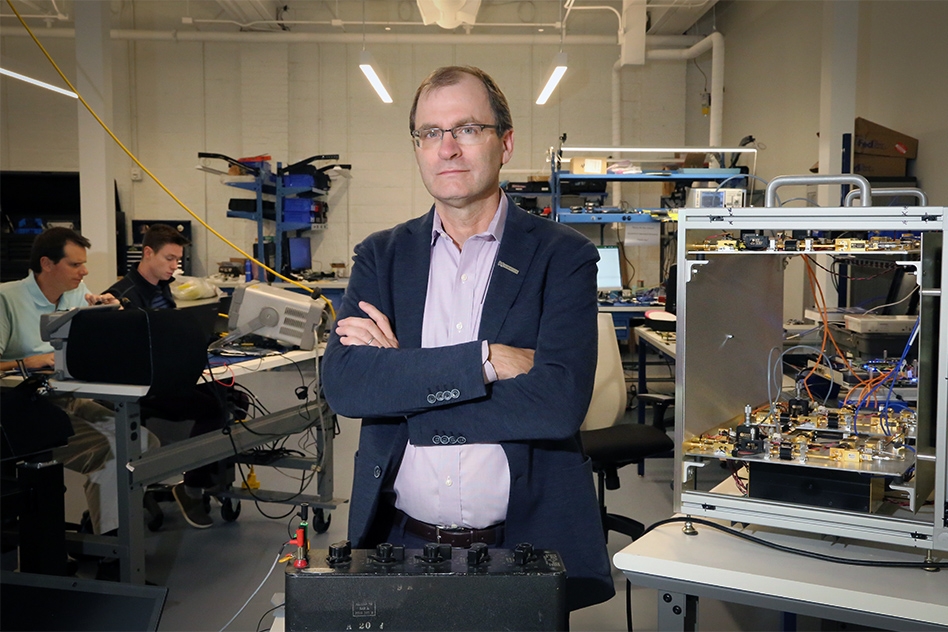
The company’s ambition concerned cooperation as much as movement. A position becomes valuable when someone or something can act on it. A robot, a person, and the surrounding equipment have to share a workable account of the space. A technically impressive measurement still needs to fit into the day’s operations.
Mindell is now Humatics’ executive chairman, following his tenure as CEO. The distinction belongs in his story because the company is one chapter of a broader working life. His research and writing continue at MIT, and his role at Unless places him alongside other industrial founders trying to turn technical possibilities into functioning businesses.
The steam engine takes its time
At Unless, Mindell is a co-founder and leads its Collective of Experts. His interests include robotics, artificial intelligence, and sustainable energy. His publicly listed pastimes are private piloting, skiing, and embedded electronics. Even the leisure list leaves room for a circuit board. There is something pleasingly consistent about an engineer who keeps electronics among his interests after work.
Industrial investment also puts money behind the questions his books raise. An idea must survive contact with production, customers, existing equipment, and the time needed to change working practices. In a June 2026 conversation with Brad Porter, a former MIT student, Mindell discussed the work of deploying robotics beyond demonstrations. The conversation returned to a distinction familiar from his historical research: showing something can work leaves considerable work still to do.
His 2025 book, The New Lunar Society, looks back to the British inventors and manufacturers associated with the Industrial Enlightenment. James Watt’s improved steam engine needed sustained development and partnership with Matthew Boulton. The historical interest lies partly in everything that happens after the moment usually given the convenient label of invention.
Mindell argues for more attention to improving industrial processes and to the knowledge held by people who maintain and repair equipment. He also connects industrial development with decarbonization and better work. The ambition involves making material systems function differently, with people participating in the improvement. History gives him examples to think with; he does not present it as a timetable.
“The book doesn’t predict the future.”
David Mindell / on The New Lunar Society
The employment question is explicit in The Work of the Future, which he co-authored with David Autor and Elisabeth B. Reynolds. Published in 2022, it draws on MIT’s task force examining technological change and work. Its argument puts institutions, skills, and employment practices alongside technical innovation. Better machinery alone cannot settle who benefits from it.
That broadens the unit of analysis again. The underwater robot came with a control room. A factory comes with workers, training, and organizational choices. In each case, treating the device as the whole story removes much of what determines whether it becomes useful. Mindell’s career keeps returning the surrounding people to the picture.
Back to the book that did not exist
In April 2026, he emceed MIT AeroAstro’s SpaceTech conference, devoted to the space innovation ecosystem. Later that year, his students’ aerospace report supplied another example of his interest in bringing research into contact with practitioners. Teaching, founding, writing, and investing all offer different ways to arrange that meeting.
The imaginary textbook was an unusually economical teaching device. It gave the students a destination before they had a route. To reach it, they had to ask questions, listen to working people, and turn separate accounts into something others could use. The exercise bears a family resemblance to mapping a wreck: observations become valuable through the relationships established between them.
Mindell’s robots have taken him far from a classroom. His work has repeatedly brought him back to people gathered around a difficult task, comparing what they know. A book may begin with a convincing cover. A machine may begin with a convincing demonstration. Eventually, someone has to do the work that makes either one worth opening.
Follow the conversation
Books, talks, and work in progress.
- Mindell at MIT ↗
- David Mindell on LinkedIn ↗
- Mindell at Unless ↗
- The origins of Humatics ↗
- Watch: Mindell and Brad Porter on deploying robotics ↗
- Watch: the SpaceTech 2026 introduction ↗
- Listen: Our Robots, Ourselves with Russ Roberts ↗
- Read about The New Lunar Society ↗
- The classroom story and aerospace report ↗
- Read Entrepreneurship in Aerospace ↗