A house can teach a child that the world is finished, or that the doors could do with replacing. David Galullo grew up with the second possibility. His father was a builder. In Hamilton Square, New Jersey, renovation was part of family life, and changing the house was a perfectly ordinary subject for dinner. A drawing implement, a pair of scissors, some paper: young David kept finding things to make.
There is a useful way to read the career that followed. Galullo has spent it making room for people to do something of their own. At Rapt Studio, the design practice he founded in its current form in 2011, that might mean giving employees distinct places to gather or concentrate. In Milan, it meant inviting strangers to supply the questions that would become part of an installation. The room gets people started. They carry it on.
The doors were always negotiable
He studied architecture at Syracuse University. Before the degree was finished, there was already a lesson in the distance between an elegant idea and an actual building. A summer assignment took him into a former mansion in downtown Trenton, where he had to measure the rooms and prepare drawings. The building had served as a funeral home; caskets remained downstairs. Architectural romance had acquired a basement.
Philadelphia came after school, followed by the Bay Area and work at firms including Pollack Architecture and Gordon Chong + Partners. Along the way, his interest settled on how people inhabit places. Restaurant and hospitality work appealed to his sense of theatre: a space could tell a story and invite someone into it. The usefulness of a room and the feeling it produced belonged in the same conversation.
Travel widened that conversation. At fifteen he visited Europe, landing in Rome and spending time in Madrid. Growing up between Philadelphia and New York had already made him attentive to the differences between cities and suburbs. Here were other ways to arrange daily life. He wanted to keep looking. It helps explain a practice whose curiosity runs across types of work rather than settling comfortably into one.
Before the floor plan, an awkward question
Rapt grew out of an existing design practice. Galullo had joined it, become president, and then reimagined its scope. Projects kept running into the divisions between consultants. A space, a website, a company’s rituals and its public identity might be handed to different people, although everyone was trying to describe the same organization. He wanted those conversations to happen together.
By 2012, he was describing the addition of an art director and an ambition to bring more of a client’s brand work into one place. Before discussing architecture, he asked what the client hoped to achieve and communicate. He also liked showing clients the solution they had requested alongside other possibilities. A brief could be the beginning of an inquiry, with enough room left for a better answer.
His later account of workplace branding makes the stakes concrete. Who gets daylight? What happens when people enter? Where can they encounter one another? Decisions like those establish a company’s character in daily use. A logo on a wall has rather less authority if the floor plan spends the working day contradicting it. The design has to hold up when the presentation is over.
That principle also limits the designer’s vanity. Galullo wants the work to express the particular client. A recognizable house style could become an obstacle if it made different organizations feel alike. His portfolio’s variety follows from that commitment: the company using a space should be legible in it. An architect’s signature is a pleasant thing, provided the occupants can still find somewhere to put their own.
A village for a company in the cloud
At Dropbox, Rapt used the idea of a village to organize a large headquarters. Conversations with employees had exposed a problem: noisy circulation routes and uniformly treated spaces made it difficult to feel settled. The plan gave different neighborhoods their own landmarks and atmosphere, with gathering places and quieter work areas doing different jobs.
The contrast with the product was deliberate. Dropbox’s software could be visually continuous and minimal; its physical workplace needed variety. Changes of scale, material and color helped people orient themselves and choose where to spend time. A large company could have smaller, recognizable communities inside it. The village metaphor earned its keep through the arrangement of the building.
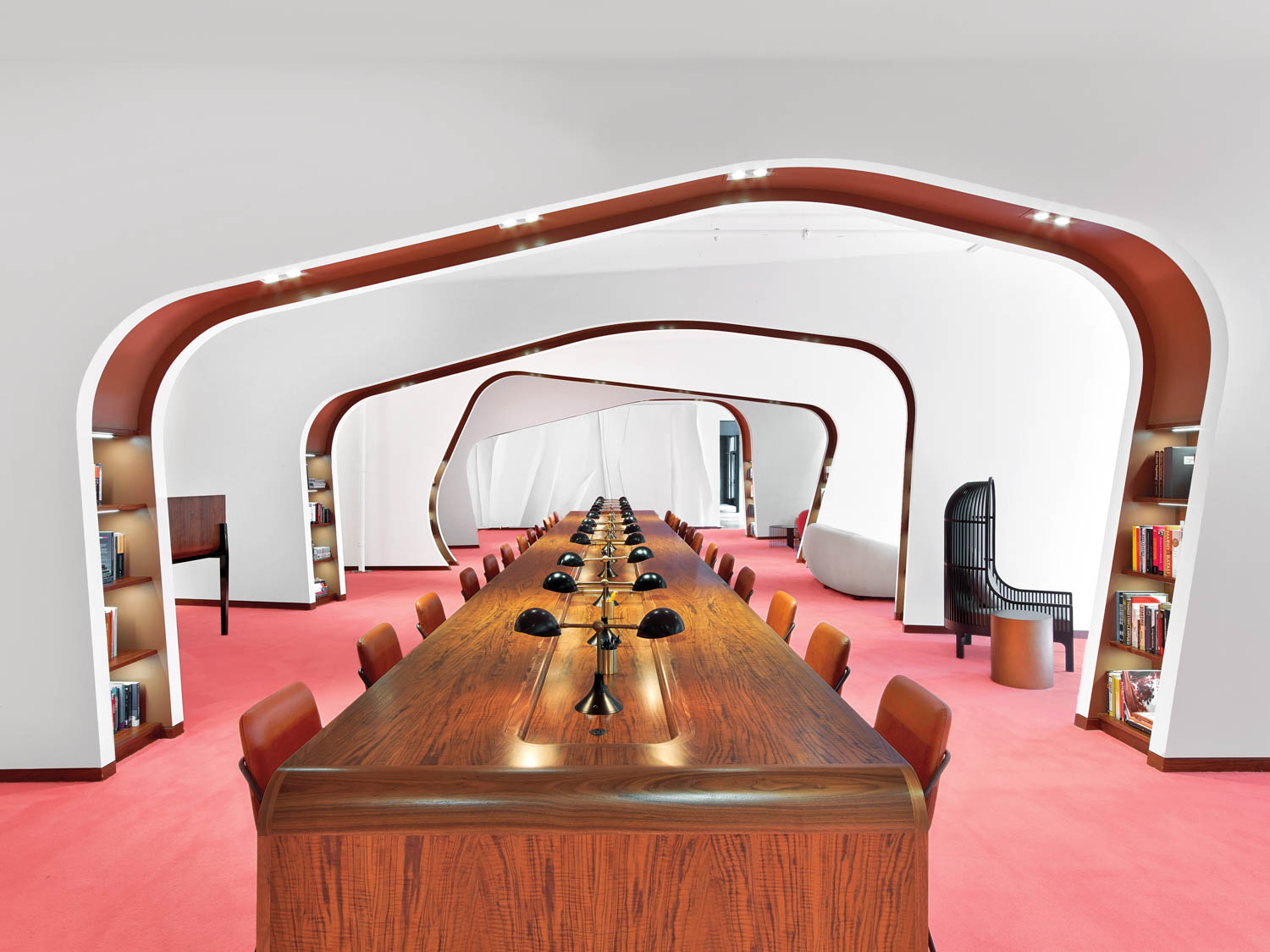
Other projects began with what was already there. At Unity’s San Francisco headquarters, finishes came away to reveal brick, columns and the building’s structure. Beams removed to create an atrium returned as a reception desk and café bar. A business making tools for virtual worlds acquired a workplace with a fairly insistent physical presence. The material had a previous life, and was allowed to show it.
At the MDR Truss campus in Marina del Rey, Rapt retained five of six existing structures, adapting a collection of midcentury industrial buildings. New openings, decks and outdoor spaces helped turn the site into a shared working environment. Bradmore Group, the developer that commissioned the project, moved into it too. There is a certain force to a client deciding to become an occupant.
What strangers left behind in Milan
In 2019, Galullo took the question of participation to Milan Design Week. Rapt’s Tell Me More, installed at Ventura Centrale, asked visitors to enter curtained spaces, encounter a question from a previous guest, and leave one for whoever came next. A lounge offered somewhere to linger. A design exhibition had quietly assigned its audience some of the writing.
Galullo’s account of the week describes his uncertainty about whether visitors would slow down. Some arrived in the familiar exhibition rhythm: photograph, move, repeat. Others stayed, considered their questions and talked. By the time the installation was packed away, approximately 30,000 question cards were going back to San Francisco. The visitors had left something rather more interesting than an attendance total.
A visitor’s question became the next visitor’s starting point.
The invitation had its awkwardness. A contemporary account of the exhibition thought the space could have used more help to get strangers interacting naturally. That is a useful complication. Chairs and curtains can create an opening; conversation still has to happen between people. Galullo was testing how far an environment could help, and watching what visitors actually did with it.
The same subject surfaced in his conversation with Hinge founder Justin McLeod at Fast Company’s Innovation Festival. A dating app and a design practice had common ground in the passage from a possible connection to a sustained relationship. They discussed vulnerability, deliberate communication and experiences that last beyond an immediate response. Galullo’s work keeps returning to the effort involved after the introduction.
A beautiful room with somebody missing
Rapt returned to Milan in 2024 with Design Is Language; Speak for Yourself. The installation moved visitors from AI-generated imagery toward objects with personal histories, then into a living space furnished with vintage pieces sourced with intOndo. The progression asked what a room can communicate about its inhabitants, and what disappears when taste is supplied wholesale.
For Galullo, automated suggestions risk averaging what already exists. Inherited objects and things collected along the way carry particular memories. He compared automated furnishing advice to letting someone who had never met you choose your wardrobe. The clothes might be attractive. You would still have to go about introducing yourself.
“Objects and places tell the stories of our lives.”
David Galullo, on the 2024 Milan installation
That exhibition gave a physical route to the argument. Visitors encountered images, ordinary objects treated as worthy of attention, and finally a room with vintage furniture. The selection included pieces with histories before their present owners. Purchasing something older could be part of personal expression too; the point was to choose with an awareness of the story being assembled.
The office gets more than one answer
His workplace projects make a related allowance for difference. Duolingo’s New York office includes quiet study areas, livelier communal space and a room concealed behind a hidden door. At Roblox, meeting and phone rooms help separate concentrated individual work from the social areas. A shared address need not require everyone to work in the same atmosphere.
It is a practical extension of Galullo’s interest in belonging. Someone can want colleagues nearby and still need a quiet place to finish a task. The design needs enough range to accommodate both. His ongoing attention to the subject included a January 2026 appearance on Monocle on Design, discussing the future of the office.
The pen has to be new
For someone comfortable with unfinished possibilities, Galullo can be particular about his equipment. His chosen sketching tool is a black Pentel Sign Pen with a fresh nib. Once the tip softens, its tenure ends. He has also described an olive-wood corkscrew as an essential detail of opening a good bottle. There is room in his philosophy for imperfection, with exceptions made for the implements.
Cooking and amateur winemaking belong to the same personal picture. So do the objects he collects and the pleasure of having people over. The evidence suggests a host’s sensibility running through the designer’s work: attend to the setting, make arrival matter, give people something to gather around. His 2024 induction into the Interior Design Hall of Fame recognized a career built around those questions.
The childhood house keeps offering a useful image. Someone proposes changing the doors, and an apparently settled room becomes a possibility again. Galullo’s work asks for that openness on a larger scale. The building may be handed over. What its occupants will make of it remains an invitation.
Continue the conversation
- Rapt Studio ↗The studio’s work and practice
- David Galullo on LinkedIn ↗Professional profile
- David Galullo on Instagram ↗Personal account
- A conversation with Cindy Allen ↗Watch the DesignTV interview on Vimeo
- The office’s future ↗Listen: Monocle on Design, January 2026
- The rooms we work in ↗Read the Duolingo and workplace interview
- The questions from Milan ↗Galullo’s own 2019 dispatches