A boat is an agreeable place to spend an afternoon until it is time to park it. Then the wind develops opinions. The water declines to hold still. An audience may assemble on the dock, apparently with nothing else to do. David Foulkes has spent a considerable part of his career thinking about the machinery that might make this moment less eventful.
That is a useful way into the story of Brunswick’s chairman and chief executive. His professional life includes powerful engines, acquisitions and a consumer electronics show in the desert. Yet the connecting concern is quite ordinary: how much work must a person do before the pleasure begins? For an engineer running a recreation business, that question can grow surprisingly large.
Foulkes is now approaching a handover of his own. Brunswick announced in September 2026 that he will retire at the end of the year. Áine Denari will become CEO on January 1, 2027. Before that date arrives, there is a career worth examining through its changing brief: first the engine, then the vessel, then the customer’s entire day.
A bigger engineering brief
His education supplied an appropriate starting point. At Imperial College London, Foulkes earned a bachelor’s degree in aeronautical engineering and a master’s in structural and fluid mechanics. His early career included the United Kingdom Ministry of Defence and Shell Exploration. He then spent 18 years at Ford, accumulating experience in engineering, product development and leadership before joining Brunswick in 2007.
At Mercury Marine, he worked on the business of turning engineering into engines people would buy and use. Product development was his responsibility for a decade. Mercury Racing added another brief in 2012, putting high-performance products alongside the broader propulsion work. The route to the executive office ran through the workshop’s concerns: performance, controls, manufacturing and whether the product actually did what its designers intended.
One episode gives that period some texture. Looking back in 2018, Foulkes described how Mercury used the downturn to reshape its engineering organization, adding more than 100 engineers and drawing people from other industries. Electronics, controls and design gained attention. A difficult market had provided time to reconsider the skills the next generation of products would require.
That account reveals what he valued in the achievement: a team capable of moving from project to project. A successful engine attracts attention when it appears. The organization capable of producing its successor is harder to photograph.
The company around the engine
By 2018, Foulkes’s responsibilities stretched across technology and Brunswick Marine Consumer Solutions. The latter included boats, services, financing and insurance. The company’s announcement naming him its next CEO also pointed to his work with the University of Illinois innovation lab and a TechNexus venture partnership. He was being asked to connect disciplines that a customer already encountered together.
He became chief executive on January 1, 2019. That year brought two decisions that help explain the company he would lead. Brunswick agreed to sell its Fitness business for approximately $490 million, completing the sale in June. The exit concentrated the portfolio on marine products and services. The company was narrowing its industrial focus while broadening what it could offer within boating.
In May, it acquired Freedom Boat Club. Boats could now sit at the center of a membership relationship as well as an ownership transaction. This required thinking beyond the moment a vessel left a showroom. There were reservations, fleets, maintenance and eventual resale to consider. A manufacturer had acquired a recurring invitation to spend a day on its products.
The electronics side expanded in October 2021, when Brunswick completed its $1.05 billion acquisition of Navico. Lowrance, Simrad, B&G and C-MAP brought displays, navigation, sonar and other capabilities into the group. Those are the instruments through which an operator understands the water and the vessel. The engine could supply the movement; the screen could help explain where that movement ought to go.
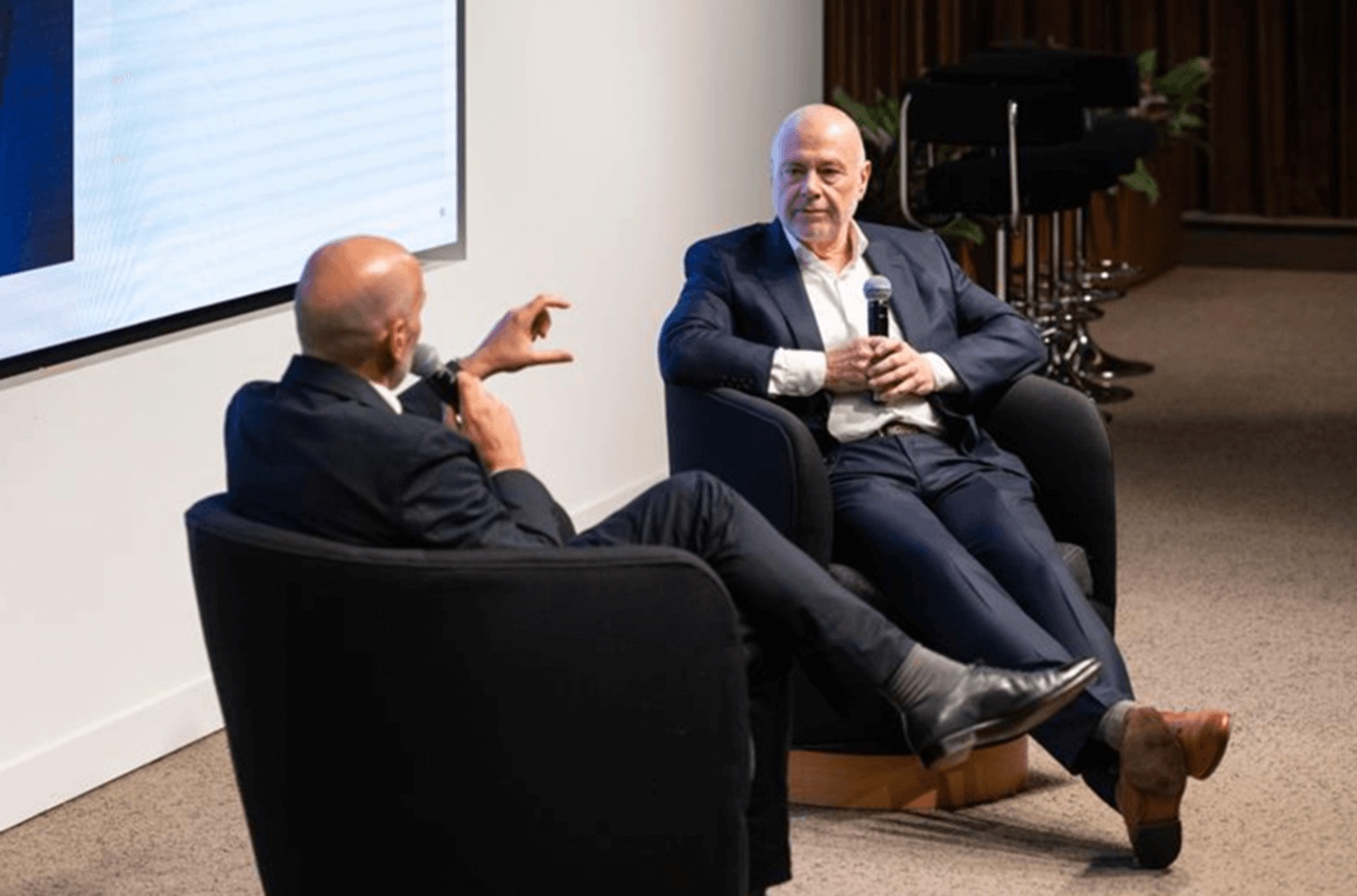
The dock is the examination
Foulkes’s shorthand for the wider effort was ACES: autonomy, connectivity, electrification and shared access. Corporate acronyms can require their own flotation device. This one becomes easier to understand when attached to an actual boating problem. Assistance at the dock belongs to autonomy. Checking the boat remotely belongs to connectivity. A small electric outboard and a club reservation supply the other two letters.
In conversation, he has repeatedly explained why borrowing ideas from cars requires care. A dock offers fewer certainties than a marked parking space. The vessel moves in several directions, the water reflects light and the surroundings can change. The customer may want a simple control. Delivering that simplicity asks quite a lot of the equipment behind it.
There is also the question of which parts of the experience should remain in the operator’s hands. During a 2023 discussion, Foulkes described recreational boating as something people enjoy doing themselves. Assistance could take on stressful tasks while leaving the pleasure of operating a boat intact. That is a more specific ambition than imagining every skipper replaced by software.
Brunswick’s January 2025 CES presentation gave the idea a physical setting. Its Boating Intelligence initiative added AI capabilities to ACES, with a 200-degree helm simulator, an AI co-captain demonstration and a development version of autonomous docking. A Boston Whaler 405 Conquest helped show the work. These were demonstrations and development systems, an important distinction when discussing the distance between an exhibition floor and a customer’s next departure.
A battery has to earn its berth
Electrification brings a different test of judgment. An engineer can be enthusiastic about a technology and precise about where it belongs. In a 2022 interview, Foulkes pointed toward small boats and lakes as natural early applications for electric propulsion, where expectations about range and performance differ from an offshore trip. The outing determines the requirement.
Mercury introduced the Avator 7.5e electric outboard in January 2023. The product gave the electric part of the strategy something a customer could recognize and handle: an outboard motor, rather than an abstract promise about the future. Familiar forms matter when the power source changes. The buyer still has to decide what boat to use and what sort of day to plan.
His discussion of conventional propulsion is similarly interested in what the user has to manage. In a 2026 interview, he described the 600-horsepower engine’s automatic transmission and other systems that operate without asking the customer to intervene. He also talked about fuel efficiency as an area where environmental goals and customers’ wishes can meet. Less work and less fuel are intelligible benefits, even without an engineering degree.
“Our goal is to make everything as simple as possible for the user.”
David Foulkes, 2026 interview
The quote is a useful test for all those systems. A feature can offer more capability and still demand less attention. The work migrates into the design, the controls and the software. The person who arranged a day off need not spend it administering the machinery.
The customer who never bought a boat
Foulkes has also taken the discussion beyond equipment. At the London IBI Summit in 2025, he argued that the industry needed to reach audiences outside its familiar boat-show circuit. Relevance was the concern. A business devoted to recreation has to earn a place among all the other ways people might spend their time and money.
Freedom Boat Club provided one route. Membership could suit people for whom storing and maintaining a boat made ownership impractical. It could also introduce people who had never seriously considered buying a new boat. That distinction matters: an industry can widen participation by serving a different customer, rather than waiting for every interested person to become an owner.
The club also required operational discipline. Foulkes discussed acquiring boats, using them in fleets and disposing of them efficiently. Revenue during membership service is only part of that story. Depreciation and resale still have their say. The invitation to enjoy effortless leisure rests on somebody else doing a great deal of scheduling, maintenance and arithmetic.
His own relationship with the product predates these arguments. A 2018 profile described family outings on Lake Michigan aboard a Boston Whaler 345 Conquest and a home in Lake Bluff, Illinois, with his wife, Gillian. There is something grounding about that detail. The executive describing the customer’s afternoon had afternoons on a boat of his own.
The last handover
Brunswick added the chairmanship to Foulkes’s responsibilities effective March 1, 2025. In July 2026, it reported second-quarter net sales of $1,557.8 million, up 8 percent from a year earlier. Those figures give a dated view of the business as his final year proceeds. The next announced change concerns who will run it.
Denari brings experience leading Brunswick’s Boat Group, Navico Group and its technology work. David Everitt will become non-executive chairman when she takes over as CEO. The transition separates the two posts Foulkes currently holds and places another executive with an engineering and technology background at the company’s head.
In announcing his departure, Foulkes thanked his colleagues and Gillian. He also described preparing a successor as a central duty of the job. The handover supplies a fitting final problem for a career spent thinking about how connected parts should work together. On January 1, someone else will take the controls. The organization has to keep moving.