David Flitman trained as a chemical engineer at Purdue. At DuPont, one of his early lessons involved sizing a pump. It is an unglamorous beginning for someone who would eventually oversee a food distributor with billions of dollars in quarterly sales. It is also a useful beginning. A pump has a job to do. So does a delivery truck. Neither is improved much by an inspirational slogan.
Flitman has spent his career moving among businesses that look different from the pavement: chemicals, electricity, building materials, food. Read the company names in sequence and the route seems restless. Look at the work underneath and a pattern appears. Products must move. Customers need them. Somewhere between those two facts, a manager has to make the machinery behave.
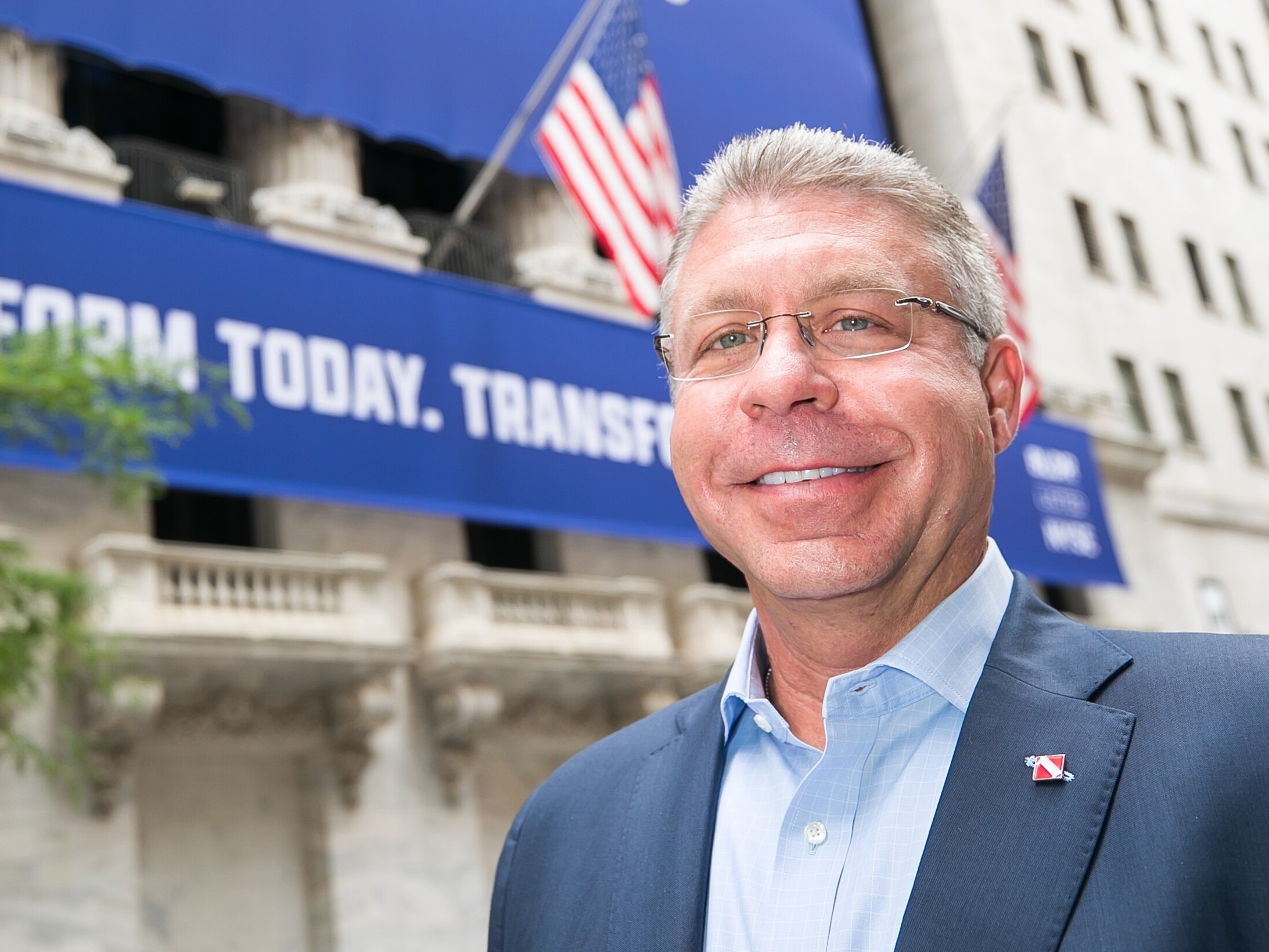
He put the connection plainly in a September 2023 conversation at the New York Stock Exchange: “You solve problems as an engineer.” By then he was eight months into running US Foods. The subject had changed from pumps to restaurants. His way of approaching it sounded familiar.
A career with several kinds of cargo
His first long apprenticeship was at DuPont, where he spent nearly two decades in operational, commercial, and global business leadership positions. That combination matters. Production teaches one set of constraints; selling what production makes introduces another. Flitman’s early career placed him on both sides of the handoff.
He later led Allegheny Power, held senior roles at Nalco and Ecolab, and joined chemical distributor Univar in December 2012. By 2014, he had chief operating officer and regional leadership responsibilities there. These were different organizations, with different products and customers. The recurring work was coordinating operations at a scale that made small errors expensive.
In January 2015 he moved into foodservice, becoming an executive vice president at Performance Food Group and president and CEO of its Performance Foodservice division. He stayed until 2018. His eventual arrival at US Foods was therefore a return to an industry he knew, with a substantial detour through the American building site.
The detour began at BMC Stock Holdings in 2018. BMC and Builders FirstSource combined in January 2021. Flitman became president of the combined business, then succeeded Chad Crow as CEO on April 1. The merger brought together roughly 550 locations in 40 states. A new organization chart had to work across a very large map.
There is a particular challenge in leading after a merger: everyone can agree on the arithmetic while disagreeing about how Tuesday should work. Which processes survive? Who makes decisions? How much local knowledge gets lost in the pursuit of consistency? Combining distribution businesses brings those questions out of the meeting room and onto the loading dock.
Flitman left Builders FirstSource in November 2022. Later that month, US Foods announced his appointment. The company highlighted his team’s delivery of merger savings ahead of the original schedule. For its next CEO, it was buying experience in making complicated organizations work together, along with someone who already understood foodservice.
Back to the restaurant business, via Rosemont
He started at US Foods on January 5, 2023, taking over from interim CEO Andrew Iacobucci. The company’s headquarters were in Rosemont, Illinois. Its customers were spread across the country. That geography creates a useful tension: leadership can be centralized, but the customer’s experience arrives through a particular warehouse, sales team, and truck.
One early management change made responsibility more direct. When Iacobucci departed in May 2023, US Foods flattened its executive leadership structure. Jim Sturgell took the chief commercial officer role, while Randy Taylor became executive vice president of field operations. Both reported to Flitman. The company was putting commercial decisions and operating results closer to the chief executive.
That is a revealing choice for a leader with an engineering education. An organization chart can be a diagram of where information slows down. Redrawing it does not automatically improve service, but it identifies who must answer when service goes wrong. The elegance of the diagram matters less than the speed and quality of the answer.
- DuPontOperations + commerce
- 2015Performance Foodservice
- 2018BMC Stock Holdings
- 2021Builders FirstSource CEO
- 2023US Foods CEO
The attraction of a warehouse in Watertown
Consider the first acquisition announced under his US Foods leadership. Renzi Foodservice was a family business in Watertown, New York, with more than $180 million in annual revenue and more than 2,300 customers. It had a 110,000-square-foot facility. The purchase was announced in May 2023 and completed on July 7.
For a national business, that single local address had a practical appeal. US Foods did not have a distribution center in central upstate New York. Renzi supplied an established operation in the region, together with customer relationships built over two generations. Expansion could begin with a business that already knew the territory.
This is an acquisition story measured in road miles as much as revenue. A national network can still contain awkward gaps. Filling one can change how efficiently existing customers are served as well as how readily new ones can be reached. The map, in other words, deserves a place beside the spreadsheet.
There is something refreshingly literal about that kind of growth. A business buys a building in a useful place, people who know their customers, and an operation with its own working habits. The interesting management question comes afterward: how to add the benefits of scale without making those local advantages disappear.
A better shift is an operating decision
Flitman’s early tenure also included a less photogenic subject: the work schedule. Flexible scheduling gave warehouse and delivery employees options beyond a single standard pattern. By the end of fiscal 2023, the program was operating in half of US Foods’ markets. This was an attempt to change the terms of physically demanding work through the design of the week.
The company subsequently described flexible scheduling as benefiting associates and reducing turnover by more than 30% in its 2024 investor presentation. That figure belongs to the initiative as reported at that time. It is a useful clue to the operating logic: keeping experienced people can be part of improving performance, alongside equipment and software.
A delivery network depends on many ordinary acts performed correctly. A worker who knows the job carries knowledge that is hard to put in a procedure manual. Replacing that worker means recruiting, training, and rebuilding familiarity. Scheduling therefore belongs in the same conversation as productivity. The calendar has consequences for the warehouse.
Flitman has also described visiting distribution centers to compare management accounts with what employees experience. A company update from an Austin visit described a warehouse roundtable and his participation in the start of night selection. There is a useful limit to the view from headquarters; walking the floor changes the viewing angle.
“I get out and about.”
Dave Flitman, September 2023
The order on the screen still needs a truck
Software occupies a visible place in this physical business. US Foods’ MOXē platform lets customers order products, track deliveries, pay bills, and manage inventory. Its appeal is practical: several chores that once needed separate attention can sit in one place. The restaurant operator has a kitchen to run.
In May 2023, Flitman said roughly 84% of company sales went through e-commerce transactions. He also emphasized a selling approach that included people with restaurant operating experience. The two ideas belong together. A good ordering system handles routine work; people who understand restaurants can help with the situations that resist a dropdown menu.
At the same time, US Foods was working on routing optimization and its Pronto small-truck delivery service in densely populated areas. The strategy joined a digital interface to changes in physical delivery. A smooth checkout cannot compensate for a truck arriving when the kitchen cannot use it. Convenience has to survive the trip.
This is where Flitman’s career starts to look unusually consistent. Chemical distribution, building products, and restaurant supply each force a business to reconcile what the customer wants with what the network can deliver. Software changes the available tools. The need to make those promises agree with reality remains stubbornly familiar.
Two jobs, and a dated scorecard
On May 14, 2026, Flitman added chair of the US Foods board to his CEO responsibilities. David Tehle moved from chair to lead independent director. The arrangement put day-to-day leadership and the chair’s strategic role together, while retaining a designated independent leadership position on the board.
He had also joined Avery Dennison’s board in July 2025. Its chairman, Mitch Butier, singled out Flitman’s food-industry knowledge when welcoming him. Avery Dennison makes materials and digital identification products, including labeling and RFID technology. The appointment extended his board work into another business concerned with physical goods and the information attached to them.
The August 6, 2026 results offer a later checkpoint for his US Foods tenure. Second-quarter net sales reached $10.5 billion, up 4.5% year over year. Total case volume rose 1.9%, while independent restaurant case volume rose 5.1%. Those measures answer different questions: sales count dollars, and case volume counts the movement of product.
The distinction suits this story. A distributor can report larger sales while managers still need to understand what is happening underneath: how much product is moving, which customers are buying, and what it costs to serve them. Flitman’s task reaches from those questions back to the people and processes that produce the answers.
His career has covered a remarkable variety of cargo without escaping the same basic obligation. A restaurant makes a promise to the person taking a seat. Before that promise can be kept, somebody else has to keep a less visible one at the loading dock. Flitman has made a working life out of that earlier appointment.