A bank branch is a peculiar stage. Money is present but mostly invisible. Trust is the real performance, and everyone can tell when the scenery is trying too hard. David Moore Devine has spent much of his career working on that stage - arranging the room, the screen, the language and the behavior so the institution feels less like machinery and more like a useful part of town.
His route to the executive suite was unusually patient. Moore Devine joined Columbia Bank's marketing department in 2007. He became director of marketing in March 2011, then moved onto the executive team in January 2020 as executive vice president and chief marketing and experience officer. The expanded brief put employee culture, diversity, inclusion, social responsibility and client experience beside the familiar work of marketing and communications.
That title contained a thesis: the promise and the experience ought to know each other. Advertising can say that a bank is approachable. A branch, an app or a customer conversation gets the final vote.
The branch as neighborhood room
One of the clearest expressions of that thesis was NeighborHub, Columbia's concept branch. The premise was broader than a prettier lobby. It included community events, financial education, flexible workspace for businesses and the unhurried possibility of talking to another person. The branch was asked to behave like a local room before it behaved like a billboard.
Digital signage mattered because it could easily spoil the effect. Most screens in public places resemble televisions trapped in a dentist's office - bright, expensive and strangely unloved. Moore Devine argued for content that was branded, varied and locally recognizable. It could introduce bankers, show community life and let one engaging message earn attention for the next.
“If you cannot brand it, then don't do it. Just don't bother.”David Moore Devine on digital signage
His follow-up was just as crisp: “Be different on screen, and it will attract attention.” The point was not visual eccentricity for its own sake. A generic screen dissolves into the furniture. A distinctive one can become part of the institution's voice. At NeighborHub, he said, the displays carried content designed to “humanize our bankers.” That verb does more work than the usual stack of marketing nouns. The employee becomes a person before the person becomes a sales channel.
A merger, with memory intact
Then came a larger room. Columbia Banking System and Umpqua completed their merger in March 2023, creating a bank with more than $50 billion in assets at the time and operations across the American West. The branding assignment arrived with several contrary demands. The identity needed to honor two established institutions, retain a Pacific Northwest character, speak with sufficient authority to commercial clients and remain inviting to consumers and small businesses.
There was also the matter of names. The combined bank would operate as Umpqua Bank, while wealth-management businesses retained Columbia branding. Moore Devine resisted the tidy temptation to sweep away every inherited mark. “They're strong, powerful brands,” he said, “and nobody wanted to leave that brand equity on the table.”
The post-merger brand equation
The new visual system replaced Umpqua's long-serving evergreen-tree logo with a more contemporary symbol, type and palette. Moore Devine called the brief complicated and believed the result had met its several obligations. More revealing was his explanation for making the change at all: evolving the brand could represent the combined company's new capabilities and strengths. In other words, the identity was not an ornamental celebration of a transaction. It was a map of what the larger bank had become.
The launch carried a lesson in timing. The identity was shown internally just before the failures of Silicon Valley Bank and other American banks unsettled customers in 2023. Umpqua's outward communications shifted toward the security of deposits, and the brand emerged through a softer mix of advertising, sponsorships and social media. A logo may be ready for its entrance; reality retains final edit.
The long advantage
Moore Devine's rise is less a sequence of reinventions than a widening circle of responsibility. The bank knew him first as a marketer. Over time, the remit reached communications, public relations, community engagement, client experience and the internal conditions that shape culture. Chief executive Clint Stein credited him with helping define Columbia's culture and brand through mergers and accelerated growth, specifically pointing to NeighborHub and the bank's Do Right culture.
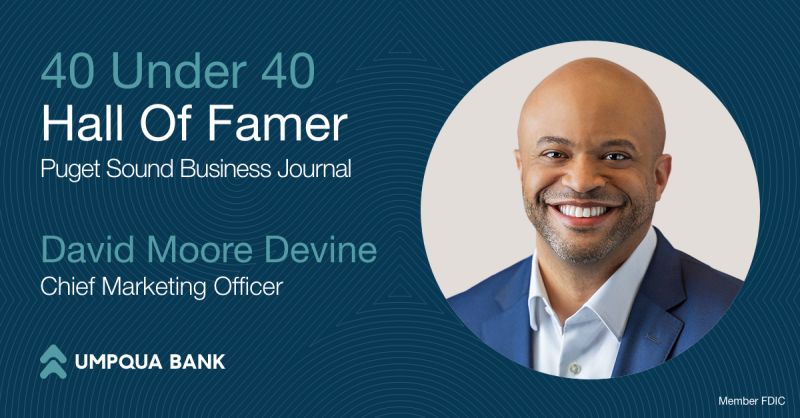
Recognition followed the expanding work. In 2016 he received the American Bankers Association's George Bailey Distinguished Service Award and joined the Puget Sound Business Journal's 40 Under 40. In 2017, the publication named him among its Outstanding Voices, an honor recognizing LGBTQ+ business leaders working toward inclusion. Columbia's marketing earned three Pulse Awards from the Puget Sound chapter of the American Marketing Association under his leadership. In 2025, nine years after the first 40 Under 40 list, he entered its Hall of Fame.
The chronology gives away a useful career tactic. He did not merely climb away from the work. The work expanded until it touched the operating system of the company. That is how marketing stops being the department asked to decorate a decision and becomes one of the disciplines shaping it.
A brand with a coat rack
Community work provides the other half of the story. Columbia's Warm Hearts campaign began before the merger and continued across the combined Umpqua footprint. In the 2023 winter drive, employees and customers across Oregon, Washington, California, Idaho, Nevada and Utah could donate cash and new clothing to more than 100 organizations. Contributions remained in the communities where they were collected.
Moore Devine described the effort as a way to bring people together around neighbors who needed shelter and clothing. The mechanics mattered: thousands of employees, many local destinations and a simple request. A large bank could act at scale without turning the beneficiary into an abstraction. By January 2024, the campaign had raised roughly $2.5 million over its history.
“Our Warm Hearts Winter Drive is all about bringing people together to care for neighbors in need.”David Moore Devine
His civic connections sit in the same frame. Moore Devine joined the executive committee of the Economic Development Board for Tacoma-Pierce County in 2022 and later served in its leadership. He is also identified as Class XXI of the American Leadership Forum's Tacoma/Pierce County chapter. Public foundation filings list him as a director and vice president of the Umpqua Bank Charitable Foundation for the 2023 fiscal year.
These are not proof of a private personality, and they need not be. They show where he has placed professional time: the overlaps among a regional bank, local business growth, civic leadership and charitable activity. The same pattern appears in the branch. The institution gets larger, but the unit of meaning stays local.
What the work teaches
The portable lesson in Moore Devine's career is coherence. Keep valuable equity when a merger encourages amnesia. Make the branch behave like the promise in the advertisement. Use the screen to reveal local people, not to pour generic copy into a glowing rectangle. Give community campaigns a clear action and a local destination. Let marketing concern itself with what employees experience because customers will eventually meet the result.
None of this is especially theatrical. That is its charm. Bank marketing has no shortage of solemn photographs showing handshakes over blueprints. Moore Devine's body of work points toward something more exacting: design the room where the handshake happens, introduce the person extending the hand and make sure the institution behaves the same way after the photographer leaves.
A brand, in that telling, is not the story a company repeats about itself. It is the collection of evidence people encounter. Some evidence is visual: a mark that carries history forward. Some is spatial: a branch willing to host the neighborhood. Some is social: a coat or grant remaining near the place it was given. Moore Devine's career has been built by arranging those pieces until they speak to one another. The bank can be enormous. The proof should still fit inside a room.