The number started at $200 billion. Then the data centers kept getting built, the GPU orders kept stacking up, and the actual revenue from AI applications stayed stubbornly, embarrassingly small. By July 2024, David Cahn ran the math again. The gap had tripled. He renamed the essay. "AI's $600B Question." That question - who is actually going to pay for all of this infrastructure? - ricocheted through venture capital, Wall Street, and every board meeting where someone had recently approved a seven-figure AI spend. Cahn didn't invent the concern. He just did the arithmetic out loud, in public, with a byline.
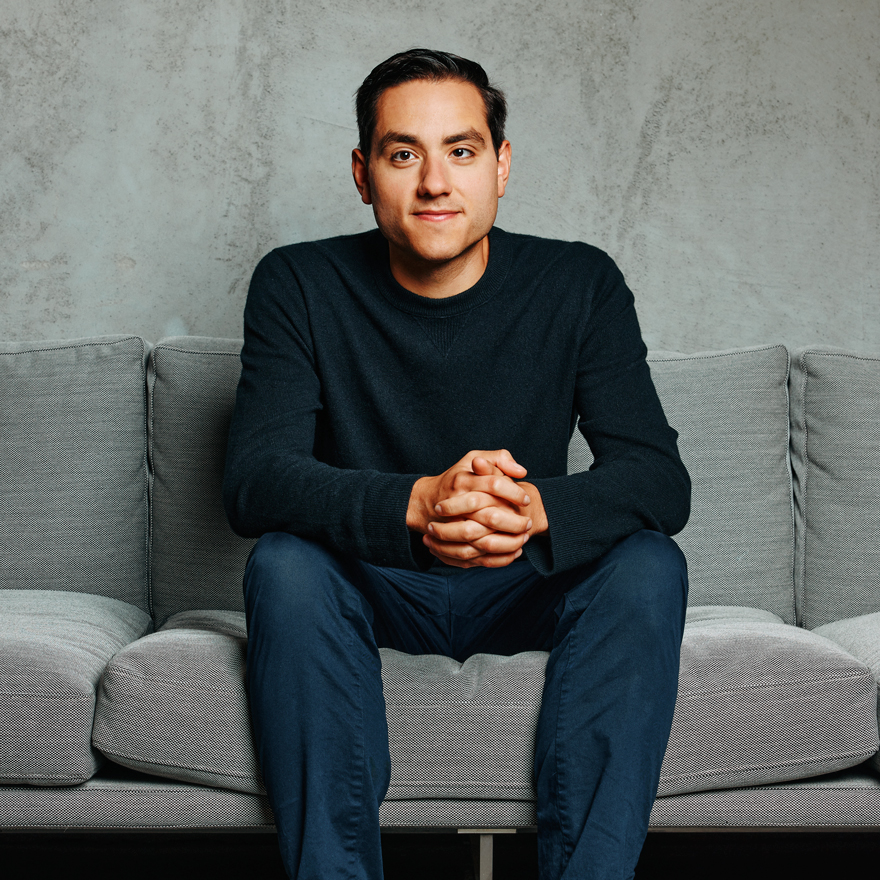
That is, more or less, how David Cahn operates. He thinks carefully. He writes clearly. Then he says the uncomfortable part at full volume and waits to see who argues back productively. At Sequoia Capital, where he joined as a growth partner in early 2023, that disposition has made him one of the firm's most visible voices on AI - not because he is cheerleading the technology, but because he is mapping its economics with the rigor of someone who spent years sorting through the details of Snowflake, Databricks, and Confluent at Coatue Management.
From Stuyvesant to Sand Hill Road
Cahn grew up in New York City - he is a Stuyvesant High School alumnus, which means he spent four years in one of the most academically competitive public school environments in the country. That mix of intensity and intellectual breadth tends to produce either burnout or a certain comfortable baseline assumption that hard problems are worth thinking through carefully. For Cahn, it was the latter. He went on to the University of Pennsylvania, where the computer science curriculum overlaps with the analytical frameworks of Wharton in ways that reward people who like to think about technology and markets simultaneously.
He landed at Coatue Management in 2018, which was a notable choice. Coatue is a crossover fund - it operates across public and private markets - and that gives its investors an unusual vantage point. You see both the early-stage bet and what happens when it scales into a public company. Cahn moved quickly. He was involved in early investments in Snowflake, Databricks, Confluent, UiPath, GitLab, and Marqeta - a run of enterprise software and data infrastructure companies that reads today like a hall of fame of the cloud era's most durable businesses. He joined the board of Weights & Biases, the experiment tracking platform that became essential infrastructure for ML teams everywhere. He joined the board of Repl.it, the browser-based coding environment that eventually became a gateway to programming for millions of people.
"Great founders have an insight that no one else believes is true yet. My job is to understand their perspective and to believe when others don't."
- David Cahn, Sequoia Capital
The HuggingFace Moment
Among Cahn's investments at Coatue, the one that matters most for understanding how he thinks is HuggingFace. He led the investment before HuggingFace was the obvious thing to do. The company had started as a conversational AI chatbot - not an auspicious description - and was pivoting toward becoming an open-source repository for machine learning models. The conventional wisdom was still that proprietary models were where the value would accumulate. Cahn bet on the infrastructure layer: the place where researchers would share, discover, and collaborate. He was right. HuggingFace became the GitHub of AI, hosting hundreds of thousands of models and serving as the connective tissue of the ML research community.
That same instinct - find the layer that everyone depends on but no one is willing to credit yet - runs through his entire investment philosophy. He also backed Runway (generative video), Supabase (open-source Postgres backend-as-a-service), and Notion (the collaborative workspace that became ubiquitous in knowledge-work environments). Each of these was a bet on infrastructure or tooling that would sit beneath a wave of applications, collecting rent from the ecosystem above it.
The Move to Sequoia
By 2022, Cahn had been promoted to General Partner and COO of Venture at Coatue - one of three people running the venture business of a $60B+ fund. Then Sequoia came calling. The connection was not cold outreach. Cahn had encountered Sequoia on two deals: HuggingFace and Notion. Those overlapping interests were effectively a distributed interview. In February 2023, Axios broke the news that he was leaving for Sand Hill Road. He joined the growth team - the part of Sequoia that writes larger checks into companies that have already found their footing.
At Sequoia, his portfolio has expanded to include Clay (the AI-powered CRM and relationship intelligence tool), Juicebox, Sesame AI, Kela, Stark, Astrocade, and Flapping Airplanes. The through-line is companies that combine AI with specific workflow needs - tools that replace something people were doing expensively and manually with something faster and cheaper. He has served as Board Observer at Clay since January 2024, a signal of how closely he tracks the companies he backs.
The Essays That Changed the Conversation
Cahn started writing publicly about AI economics in September 2023. The initial question was simple enough: Nvidia was selling GPUs at an extraordinary rate. Cloud providers were spending tens of billions building out data centers. The implied revenue assumption to justify that capital - the amount AI applications would need to generate to make the math work - was around $200 billion annually. OpenAI was generating $1.6 billion annualized. The gap was obvious to anyone who looked at it. Cahn looked at it, did the calculation, and published it.
"AI's $200B Question" made an argument that felt contrarian at the time: the infrastructure spend was running dramatically ahead of proven demand. Cahn was careful to note he was not calling a bubble exactly - he was pointing out a gap that needed to be closed, either by revenue materializing or by investment moderating. The response from the industry was significant enough that when the numbers evolved, he felt obligated to update the analysis. By July 2024, Nvidia's quarterly data center revenue had expanded, the B100 chip was arriving with dramatically better performance, and OpenAI had grown to $3.4 billion in annualized revenue. But the infrastructure spending had grown faster. The gap had tripled. The $200 billion question became the $600 billion question.
"GPU computing is increasingly turning into a commodity, metered per hour."
- David Cahn, "AI's $600B Question"
His third major essay, "AI is Now Shovel Ready," argued that 2025 would be the Year of the Data Center. The thesis was industrial rather than speculative: we had moved past the hype phase into an actual build phase, complete with supply chain bottlenecks, grid interconnection backlogs, two-year waits for diesel generators, and liquid cooling shortages. The winners and losers in AI infrastructure, Cahn argued, would be determined by operational execution - who could actually build at scale, on time, and on budget.
How He Finds Companies
The investment philosophy Cahn has articulated publicly is notable for what it does not prioritize. He is explicitly not looking for polished pitches. He is not interested in founders who have rehearsed the answers to every objection. What he wants is evidence of fast iteration and genuine learning - a founder who has already made mistakes, understood them, and changed direction. This is a less common filter than it sounds. Many investors say they want this; few actually sit comfortably with the messiness that genuine iteration produces.
The other filter is contrarian insight. Cahn's framing is that great founders believe something true that almost no one else believes yet. The investor's job is not to evaluate whether the insight is plausible by current standards - it is to understand whether the founder has genuinely reasoned their way to a real edge, even if the evidence is thin. This maps directly onto how he thinks about AI infrastructure. The $600 billion question was not a popular thing to ask in mid-2024. Asking it anyway, and being willing to update the number, is the same muscle.
The Person Behind the Essays
Cahn is an identical twin - a fact he has mentioned publicly, and one that sits somewhat amusingly alongside his professional persona as someone who thinks carefully about uniqueness and contrarian differentiation. He moved from New York City to Palo Alto when he joined Sequoia. He has a wife and son. He hikes, reads, and travels - the standard inventory of a Silicon Valley investor who is genuinely busy during working hours. His Substack (dcahn.substack.com) functions as a laboratory for ideas before they become Sequoia-branded essays: a place to process things in public, test arguments, and build the analytical scaffolding that shows up later in more polished form.
The core question he keeps asking - from HuggingFace to the data center buildout to his current bets on Clay and Sesame AI - is where the infrastructure layer actually sits. Not the application that gets the headlines, but the substrate it depends on. Not the model, but the hub. Not the GPU, but the grid. In a technology landscape that rewards whoever controls the layer everyone else needs, Cahn keeps finding the same bet: find what everything else runs on, and back the people building it well.