The company got smaller. The result got better. Roman, Inc., a religious giftware distributor, had been a $66 million business losing more than $3 million a year. After a turnaround led by David Bagley and his team, it was a $40 million business making $2 million annually. For anyone accustomed to judging a company by the size of its sales, that is an inconvenient little story. Revenue had gone down. Something more useful had gone up.
The work involved identifying profitable business units, restructuring the company and improving inventory management. Roman received a Chicago turnaround award and a national honorable mention. Bagley became a principal at MorrisAnderson in 2012. It makes a fitting introduction to an executive whose career has repeatedly required a close look beneath a company’s outward appearance.
Today, Bagley leads Puttshack, the mini golf business that combines digitally tracked play with food and drinks. His route there passes through financial advisory work, interim management, restaurant operations and growth investment. The distance between giftware and glowing golf courses looks considerable. The recurring business question is rather compact: can the operation support the promise?
A smaller company, a better result
A case in which lower sales accompanied a return to profitability.
There is a particular discipline in attending to businesses that need help. The discussion has to move beyond the appealing product, the recognisable name or the persuasive plan. Someone must examine the operation that produces the result. In Roman’s case, the documented changes included the selection of business units and the management of inventory. Those are decisions with physical consequences: what gets bought, what gets held and what remains worth doing.
Bagley joined MorrisAnderson as a managing director in 2001. His assignments included companies with revenues ranging from $25 million to $500 million, across manufacturing, distribution, transportation, retail and hospitality. He took on executive responsibilities as well as advisory ones. The work could mean occupying the CEO, CFO or chief restructuring officer’s chair while a company was in transition.
His education includes a bachelor’s degree from DePauw University and an MBA from Northwestern’s Kellogg School of Management. He became a Certified Turnaround Professional and was named among Turnarounds & Workouts’ People to Watch in 2010. The credentials describe a profession concerned with companies at consequential moments. The assignments show what that profession actually asks someone to do.
The executive who arrives mid-story
An interim executive enters a business whose plot is already in motion. There are obligations, established relationships and decisions made before the new arrival took a seat. At Global Axcess, the terms were unusually explicit. An August 2013 agreement assigned Bagley, through MorrisAnderson, to act as chief operating officer for the company during its bankruptcy proceedings.
The agreement also contemplated officer and board responsibilities when requested. He helped the national ATM services company through a sale process after its move into a DVD business produced losses. This was a management assignment inside an operating company, with shareholders and creditors among the parties whose interests the engagement addressed.
A contract of that kind is a useful corrective to the vague image of an adviser offering thoughts from a safe distance. Here, the title came with a defined role. Someone had to take responsibility while the business sought a way forward. The paperwork may lack the charm of a restaurant menu, but it does possess the considerable virtue of saying who is supposed to do the work.
Restaurants became a recurring part of Bagley’s professional life. His managed or advised companies include Popeyes, Santa Fe Cattle Company, Bar Louie, Granite City Food & Brewery, Sonic Drive-In and Giordano’s. They span different menus and service formats. What they share is the multiunit problem: the brand has to make sense in more than one room, under more than one manager.
“Leadership is what’s critical, especially in times of trouble.”
David Bagley / 2013
By 2019, Bagley was a senior managing director at Carl Marks Advisory Group. In the Restaurants Unlimited restructuring, Carl Marks Advisors, acting through him, accepted the plan administrator role. These assignments belong to the less photogenic side of hospitality: the financial and organisational work that continues after a difficult chapter has reached a formal resolution.
He also wrote about liquidity and capital structure. An essay first published in 2018, and later updated, examines why the arrangement of financing can become critical when a business is under pressure. It considers debt maturities and lease obligations, then returns to the underlying operation. A workable financial structure and a business plan that makes sense have to coexist.
That is a sober subject for someone now responsible for a business devoted to leisure. It also gives the career its continuity. The venue may change. The obligation to connect a plan with the resources needed to carry it out remains.
Capital finds a seat at the table
In 2022, Bagley began serving as chief investment officer of EMERGING Fund. The investment setting brought his restaurant experience into a group that combined capital with industry relationships. Alongside general partners Mathew Focht, John Davie and Matt Menna, he worked within a network of operators, founders and specialists in restaurant technology and entertainment.
The fund’s approach included mentoring portfolio companies and making customer introductions through existing sales channels. For a hospitality technology company, the distance between a promising product and an actual operator willing to use it matters. Capital can fund the journey. A relevant introduction can give it a destination.
A March 2023 conversation with innovation partner Padma Rao placed Bagley directly in that intersection. Rao’s background included technology and marketing roles, while her work at the time involved Bankroll, a Philadelphia sports entertainment venue. The subject brought together hospitality, technology and the design of an evening out. Those strands would recur in Bagley’s next executive assignment.
- 2001MorrisAnderson
Advisory and interim leadership - 2022EMERGING Fund
Chief investment officer - 2025Puttshack
Interim CEO appointment reported
EMERGING’s own investment writing describes restaurants as connected to real estate, supply chains, technology and entertainment. It is a useful way to understand the breadth of this work. A restaurant investment can involve a location, a purchasing system or a consumer experience, with each requiring a different kind of attention. Bagley’s advisory background sits inside that wider operating conversation.
The scorecard gets a second column
In February 2025, Puttshack brought Bagley in as interim chief executive after Logan Powell’s departure. The company then had 16 US sites and four in the UK. Its statement highlighted his corporate finance and operating experience, including his work with entertainment brands. In April, he became a director of Puttshack Ltd. By July 2026, a company announcement identified him simply as CEO.
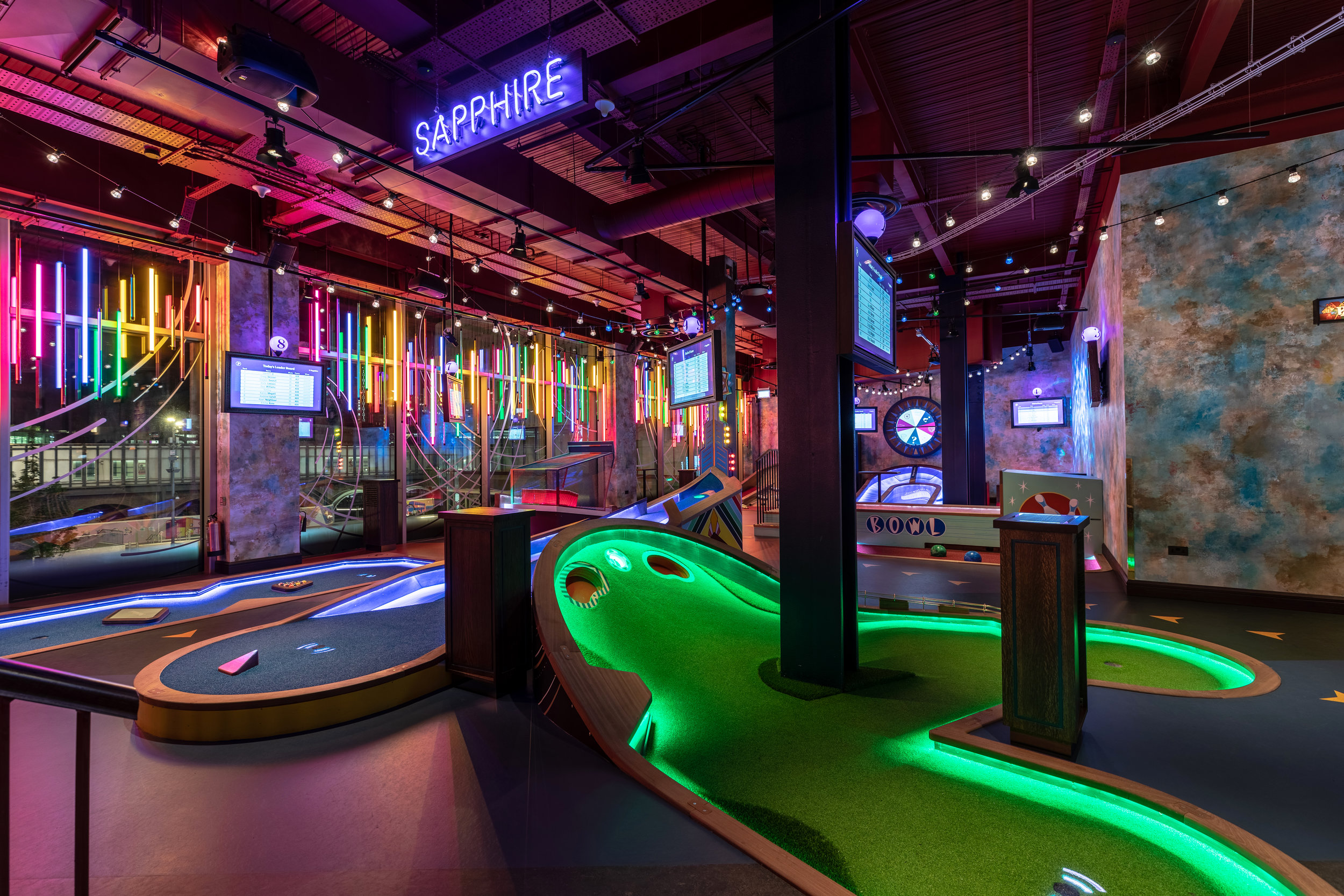
The setting is playful, but much of its complexity is quite literal. Designworks, which worked on Puttshack’s courses, describes two years of design and engineering, full-scale prototypes and data for more than 10,000 components. Digital and physical play had to meet in a manufactured environment. A guest’s casual swing depends on a rather less casual amount of preparation.
Puttshack’s Trackaball technology keeps score automatically. Food and drinks extend the visit beyond the course. The format asks the game, the room and the hospitality operation to cooperate. It is possible to admire the technology and still recognise the many ordinary tasks around it. A scoreboard has limited opinions about dinner.
Expansion continued during Bagley’s tenure. In May 2026, Puttshack opened at Polaris in Columbus, its first Ohio venue. At the opening, the brand had twenty US locations and twenty-four globally. The space included two nine-hole courses and three private Challenge Hole suites, combining shared play with a separate format for groups.
The UK business presented another side of the assignment. Its 2024 accounts reported turnover of approximately £19 million, down from £22.4 million the previous year, and a pre-tax loss of about £2.7 million. Those figures concerned the four UK venues, after the US sites moved into a separate holding structure. They should be read within that geography and accounting period.
Bagley’s accompanying account described pressure from interest rates, wages and constrained discretionary spending. Separate reporting in April 2026 described efforts to refinance the group’s debt and additional lender funding. Expansion and financial adjustment were both part of the picture. An opening establishes that a business has added a place to visit; it does not settle every question about the operation.
The people behind the putt
In July 2026, Puttshack appointed Insight Hospitality to oversee day-to-day UK operations. Des McDonald would lead the arrangement, with Olivier Lavigne du Cadet handling operations and Steve Tonkin responsible for food and beverage. The announcement divided the work into recognisable responsibilities. Bagley’s statement looked toward strategy, growth and “continuing to enhance our guest experience.”
Inside the company, there are equally practical glimpses of his role. At Puttshack’s Chicago sales summit, Bagley delivered a state-of-the-union presentation to the event sales team. The programme also included marketing plans, business development guidance and the launch of a training system giving staff access to procedures. These are the routines through which a company’s intentions reach its locations.
A guest has no reason to study any of that machinery. The reservation should work. The team should know what happens next. The food should arrive, the game should proceed and the group should want another evening together. Delivering that apparent ease requires coordination well before the first ball rolls.
Bagley’s career has put him in the adviser’s seat, the investor’s seat and the executive’s seat. At Puttshack, those experiences meet inside a business selling people time together. Its courses can calculate a score. The larger result depends on the operation around them, repeated one visit at a time.
Keep reading
- Puttshack ↗
- David Bagley on LinkedIn ↗
- EMERGING team ↗
- Roman turnaround and 2012 promotion ↗
- Education and advisory background ↗
- Global Axcess engagement agreement ↗
- Restaurants Unlimited plan administration ↗
- Bagley’s liquidity essay ↗
- EMERGING Fund investment team, 2023 ↗
- Conversation with Padma Rao ↗
- EMERGING’s restaurant investment approach ↗
- Puttshack appointment, February 2025 ↗
- Puttshack Ltd director record ↗
- Columbus opening, May 2026 ↗
- UK financial reporting, May 2026 ↗
- Group refinancing reporting, April 2026 ↗
- UK operating partnership, July 2026 ↗
- Puttshack’s Chicago sales summit ↗
- Puttshack course design and photography ↗
- EMERGING on X (company) ↗
- EMERGING on Instagram (company) ↗