A travel company changes the price of a room in Chicago. Somewhere else on the web, a person is reading about Chicago. A normal banner ad, composed last week, may still show a generic hotel slogan. Dapper’s proposition was more mischievous: why should the ad contain yesterday’s copy when the hotel’s own website has today’s rooms and prices?
- Dapper began in 2006 by turning ordinary web pages into reusable feeds and APIs.
- Its MashupAds product put live advertiser content inside display ads matched to a publisher’s page.
- The 2008 financial crisis derailed a prospective funding round; cofounder Eran Shir later said the company cut about 25% of its staff.
- Yahoo, already a partner, announced an acquisition in 2010 and used Dapper technology in Smart Ads.
The idea sounds obvious now, in an era of catalog-driven advertising. In 2008 it asked an awkward question of the banner: what if the most useful ad creative was not written by a copywriter at all? What if it lived in the advertiser’s inventory, waiting to be extracted?
First, make the web come apart
Dapper began with a broader ambition. Cofounders Eran Shir and Jonathan Aizen wanted to let people take information from websites and use it elsewhere. A person could point and click on fields in a web page, show Dapper a second page so it could recognize the pattern, and turn the result into XML, RSS, JSON, email alerts, maps or widgets. The product called these reusable extracts “Dapps.” In 2006, making an API for a site that had never offered one looked like a small act of liberation.
One early demonstration selected headlines and vote counts from Digg. Another promised a feed from a site without an RSS feed. Dapper’s own launch blog imagined mashups as eccentric as a band’s tour dates combined with camping reservations. Its 2007 Facebook AppMaker went further, turning Dapps into applications; an Answers.com app supplied the examples. The company was building the plumbing for a web people could rearrange.
That freedom came with a question its founders could not ignore. The data belonged to websites, and reuse raised copyright and licensing issues. Aizen talked about a future marketplace where publishers could set terms and prices. The public record shows the ambition clearly; it does not show that marketplace becoming the central business. What did become central was the extractor itself.
The engine, in three moves
Then put the website inside the ad
MashupAds, introduced in private beta in November 2008, applied the feed engine to display advertising. The publisher’s page supplied context; the advertiser’s website supplied the offer. On a travel page about Chicago, an ad could show Chicago hotel inventory. If Marriott changed availability or prices on its site, the ad could reflect the change. Dapper described ads that could behave like little stores rather than static invitations to visit one.
This was a useful difference from a conventional contextual ad. Picking a travel banner for a travel article was only the first step. Dapper wanted the contents of that banner to be specific and current. Retailers with large catalogs, travel sellers with shifting prices and marketers with frequent promotions had a reason to care. Reporting at the time named Expedia, eBay, Marriott and Gap among Dapper’s customers; Weather Underground used its system to build ads that changed with the local weather.
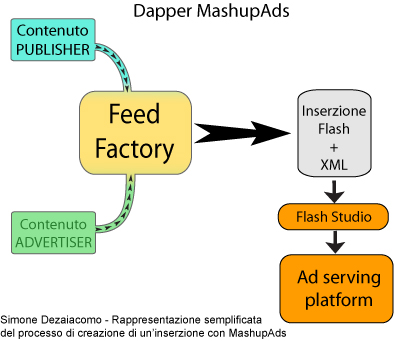
Dapper said its early MashupAds tests produced click-through rates three to five times those of other display ads. That was a company claim from a private beta, not a universal benchmark. The more durable point was operational: a marketer could change the source website and let the ad update, instead of commissioning another round of creative for each price, place and product.
The term sheet disappears
The timing was cruel. Shir later recalled arriving in Silicon Valley in August 2008 to raise a Series B. He expected a term sheet around mid-September. Then the financial crisis closed the financing window. The prospective investor withdrew. Shir said Dapper cut roughly a quarter of its workforce and reorganized. The company did not invent live-content ads because a recession makes for good copy; it had to make a commercial business out of technology already in hand.
The surviving product found buyers. Through 2009, Shir said, business and partnerships grew. Yahoo became a commercial partner. In 2010, Dapper recruited James Beriker, who had led search advertising businesses, as CEO; Shir moved into the CTO role. Beriker framed display as a direct-response channel, one that could use signals of intent and show a relevant offer even when someone was not typing a search query.
A banner becomes a system
By August 2010, Dapper had introduced DisplayDR in both full-service and self-service forms. It could turn a product catalog into an updating feed, match offers to intent, and make media-buying decisions alongside creative decisions. Beriker’s argument was that marketers should not have to stitch together several tools and wait on custom development to run one campaign. Dapper was selling a connected system for making, placing and optimizing the ad.
Its rivals were taking different routes to the same prize. Google had acquired dynamic-creative company Teracent; Tumri was another competitor. Dapper’s distinction was its web extraction heritage: it could begin with content already on an advertiser’s site, rather than requiring the advertiser to build a new feed from scratch. That mattered most for companies whose sites already held plentiful, structured, frequently changing information. A company with three unchanging products had much less to gain.
Yahoo announced the Dapper acquisition that October. It did not disclose a purchase price, although contemporary reports put estimates around $50 million to $55 million. The logic of the deal was less mysterious. Yahoo had used Dapper in its Smart Ads program and wanted its own engine for dynamic creative across a larger network. In 2011, Yahoo said Smart Ads for Homepage was powered by Dapper technology.
What can a reader copy from a business that was absorbed sixteen years ago? Start with a capability, then follow the part of the market that values it most. Dapper’s original users wanted flexible data. Advertisers wanted current offers, speed and measurable response. The code could serve both, but the latter could buy campaigns at scale. The other lesson is more prosaic: personalization needs good source material. A dynamic ad built on stale inventory merely automates the mistake.
Dapper’s story ends inside Yahoo, yet its central observation remains oddly fresh. An ad is a promise about something available elsewhere. If that “elsewhere” changes by the minute, the promise should know.