Danny King had a problem that a transcript could explain in a single letter. He wanted to study computer science at Durham University. His mathematics grade was a D. The admissions system had a straightforward answer, and it was an answer he disliked enough to challenge.
He tracked down the head of admissions for computer science and persuaded him to listen. The conversation lasted about an hour. King’s argument was that the mathematics result was a poor forecast of the computer scientist he might become. He had other evidence. Someone agreed to look at it.
Durham let him in. He graduated at the top of his class.
This would make a satisfying story to tell at a reunion, preferably within earshot of anyone who had predicted otherwise. King and fellow Durham student Alan Heppenstall found a longer use for it. They began working on a question with considerably more people attached: how do you give someone a fair hearing when there is no sympathetic admissions officer available?
An hour that a letter could not contain
King had been programming since he was six. By the time he applied to university, his interest in computing had a history that his examination results could not adequately carry. The mismatch mattered because Durham was somewhere he particularly wanted to go. A place could be intellectually inviting and administratively out of reach at the same time.
In his later telling, luck has a conspicuous role. He found the right person; that person took a chance. He does not present admission as an inevitable reward for persistence. The uncomfortable part is how easily the conversation might never have happened.
His eventual result gave the episode its sting. The applicant whose grades had made him look unsuitable became the student finishing first. For King, that raised a practical problem about the quality of information used to allocate opportunity. A letter was doing work that required a fuller account of a person.
His own academic record became impressive. He could have made peace with the machinery once it began producing flattering results. Instead, the exception became the starting point for a business concerned with making achievement easier to inspect.
How much ability gets missed when the evidence is too small?
Two students, then a move to Silicon Valley
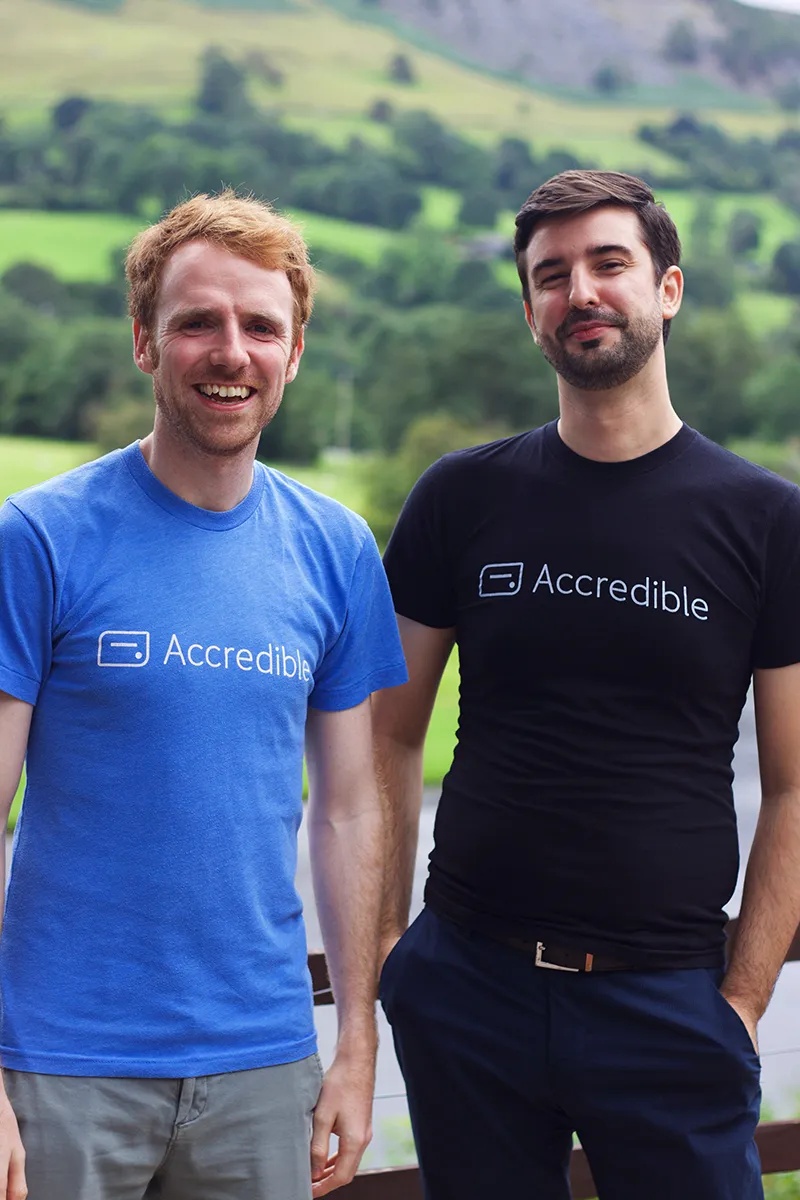
Durham also supplied his co-founder. King and Heppenstall met at university, where King helped establish Entrepreneurs Durham, a society bringing students together around business ideas. Before there was a credentialing company to manage, there were people to gather, conversations to start and ideas to test.
By July 2013, King was explaining that process to business enterprise students at the University of Buckingham. He talked through research, brand building, feedback, iteration, fundraising and hiring. The account is usefully unromantic. Starting a company involved repeatedly checking whether anyone wanted what you were building.
That spring, the founders had relocated to Silicon Valley to join the education accelerator Imagine K12. Early Accredible helped people assemble evidence of learning beyond conventional college and job applications. It supported hundreds of massive open online courses, at a time when taking a course online and having somebody else value it were separate achievements.
The company now dates its founding to 2013. King has described its beginnings in 2012, the year he graduated. The idea belongs to that transition from university to working life: an encounter with the limits of grades becoming a sustained attempt to improve the records people carry forward.
The certificate leaves the wall
Accredible grew into a platform through which universities, associations and companies issue and verify digital certificates and badges. Its customers include Google, McGraw Hill and Skillsoft. King is its CEO; Heppenstall is its CTO. Their shared problem has acquired a substantial amount of infrastructure.
A digital credential can travel into a professional profile, an application or a directory. An employer can inspect the achievement rather than rely entirely on a candidate’s description of it. The distinction is mundane until you are the person trying to get an interview. Then the difference between an assertion and something checkable becomes rather interesting.
In September 2023, Accredible announced a Series B led by Frontier Growth, with participation from The Stephens Group, PivotNorth and Uncork Capital. At that point, the company reported more than 75 million credentials issued and verified on behalf of over 2,000 customers.
Funding brought another set of expectations, but King’s explanation of the opportunity remained close to the working life of a learner. People needed ways to update their skills; organizations needed to run the programs without making administration the difficult part of the qualification.
“Achieving certifications should be tough, managing and growing programs shouldn’t be.”
Danny King, September 2023
After the congratulations email
By the end of 2025, King’s account of the company was increasingly concerned with what happened after issuance. The annual review he published that December reported more than 42 million credentials issued during the year and over nine million learners earning them. Its platform figures covered January 1 through November 14, a useful detail when reading the totals.
He also reported more than 800,000 learners opting into Spotlight directories across 60 organizations. These give credential holders a place to be discovered. More than 1.5 million learners enrolled in structured learning pathways, which help show what to study next.
Those measures describe different jobs for the same record: demonstrating something already achieved, making someone findable and suggesting a next step. A certificate can be the end of a course while remaining the beginning of a much longer decision.
*Accredible’s 2025 review; platform data through November 14.
For King, the ambition extends beyond a better-looking replacement for paper. On his personal website, he describes helping people understand the educational and career routes ahead of them, including their likely returns in time, money and happiness. That last item is an unusually human entry in a discussion otherwise liable to fill with dashboards.
The next test is whether it helps
By 2026, the harder question was becoming explicit. In his introduction to Accredible’s State of Credentialing report, King described increasing pressure on credentialing leaders to demonstrate outcomes. Issuing a record and counting completions would not satisfy every executive or board. They wanted evidence that programs created value.
The research surveyed 1,000 learners and 194 education and training leaders. Among the issuers, 44 percent named demonstrating program value as a top strategic priority, compared with 22 percent in 2025. Those are findings from Accredible’s surveys, rather than a census of education. Even within that frame, the shift sharpens the challenge facing his business.
Trust remains part of the same task. A February 2026 partnership with Integrity Advocate linked verified online assessments to credential issuance. King put the principle plainly: “A credential is only as trustworthy as the process that created it.” The record has to preserve the meaning of the work, not merely survive the journey to someone’s inbox.
Elsewhere, he makes things with paper
There is a pleasing complication in this campaign to move qualifications beyond paper. King is a bookbinder. His personal site shows journals, notebooks, productivity planners and printed books made using traditional methods. The person helping institutions issue digital records also spends time making physical objects designed to hold words.
He describes himself as British American, a husband and dad living in California’s San Francisco Bay Area. The bookbinding gallery is a more intimate sort of portfolio than the corporate customer list: small books, leather bindings, bright covers and the satisfaction of an object that closes properly.
His coding has an artistic life, too. In 2017, he made a set of ten posters from one-dimensional cellular automata, using Processing. Each image develops row by row from a rule and an initial arrangement of dots. He designed them to print and hang at home. A computer-science project had found its way onto the wall.
Later came Color Orbs, an exploration of animated color and texture. During 2021 and 2022, he generated tens of thousands of them, then selected roughly a hundred favorites for themed collections. Some are smooth, others chaotic. His titles include Brimstone, Gravity and Vanilla & Chocolate. Even an algorithmic universe apparently needs pudding.
The website lets visitors try a designer and inspect the settings behind individual pieces. King explains both the machinery and the pleasure of finding an unexpected result. There is room here for an interpretation of his working interests: build a system, examine what it produces, keep looking for what deserves attention. The art offers that reading without requiring it to become a business parable.
A better chance of being seen
King’s story keeps returning to the gap between a person and the record used to judge them. At Durham, he crossed it through a conversation. At Accredible, he and his colleagues work on records that can cross it without requiring everyone to track down a department head.
The problem has grown alongside the company. More credentials create more evidence, but evidence still needs to be understandable, trustworthy and useful when somebody makes a decision. His current emphasis on outcomes makes the original promise harder to measure and more consequential to keep.
The memorable achievement remains the top-of-class finish. The more revealing detail is his insistence on remembering the chance that preceded it. Before there was a company, a funding round or a platform, somebody agreed to spend an hour looking beyond a grade. King has spent the years since trying to give that hour a longer reach.